 School





Spanish 2 Curriculum: How to Build Real Progression After Spanish 1
Plan Spanish 2 as real progression from Spanish 1, with stronger communication, better recycling and more independent listening, speaking, reading and writing.
Grade 9 School brings curriculum, lesson planning, practice, homework, feedback, live activities, printables and progress tracking into one connected teaching workflow.
 Spanish
 French
 German
 Portuguese
 Italian
Practice, feedback and progress in one place.
Spanish 2 should not feel like Spanish 1 with longer vocabulary lists.
It should also not assume every student arrives with the same Spanish 1 experience.
The strongest second-year courses do two things at once:
- recover and strengthen the language students already have;
- ask students to do more with it.
A useful progression spine is:
diagnose → recycle → increase connected language → reduce support → broaden functions
The exact path will vary by district. The principle is simpler:
Spanish 2 should increase what students can communicate, not just how many grammar topics they have seen.
Explore the topic ↓
One platform for teaching, practice, feedback and progress.
Plan lessons, set homework, run live activities, generate printables, give AI-supported grading and track progress across Spanish, French, German, Portuguese and Italian.
Writing & speaking grading
Set writing and speaking tasks, collect submissions, generate detailed feedback and keep teacher review in the loop.
Explore this guide →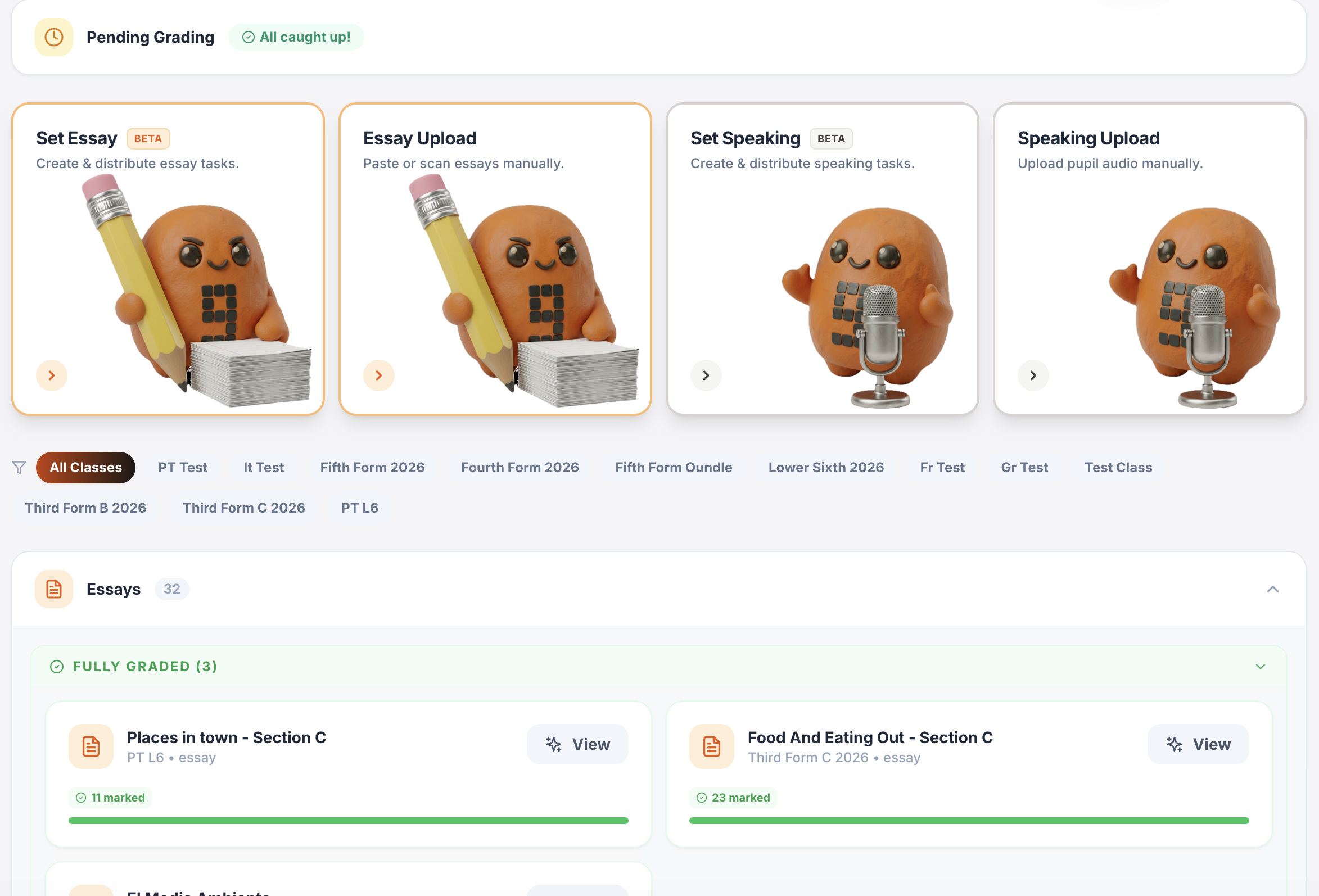
Gradebook & reports
Track scores, completion, engagement and learning evidence across classes.
Explore this guide →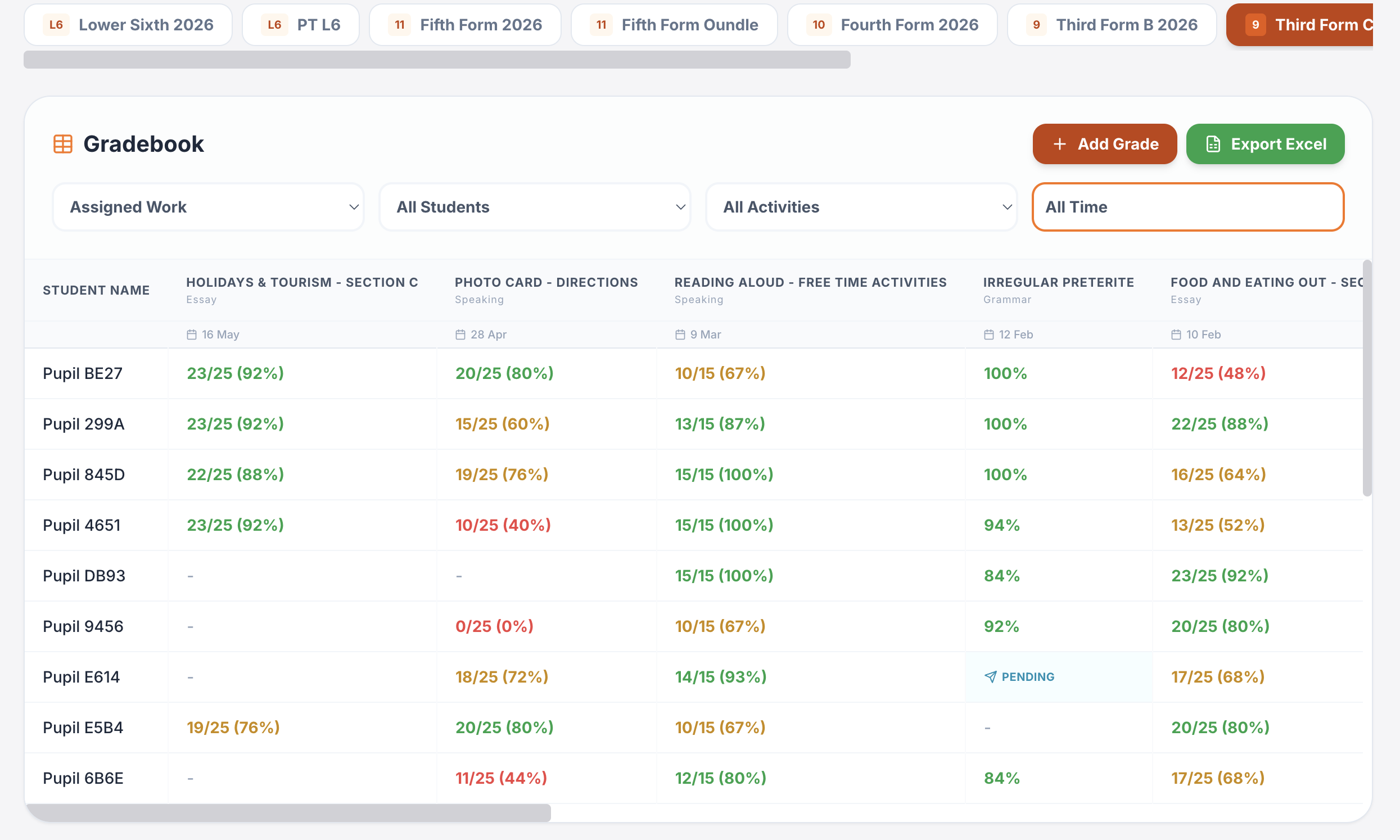
Interactive lessons
Generate, edit, save and reuse complete lesson presentations.
Explore this guide →Printables in seconds
Vocabulary, grammar, translation, reading, listening, worksheets and booklets.
Explore this guide →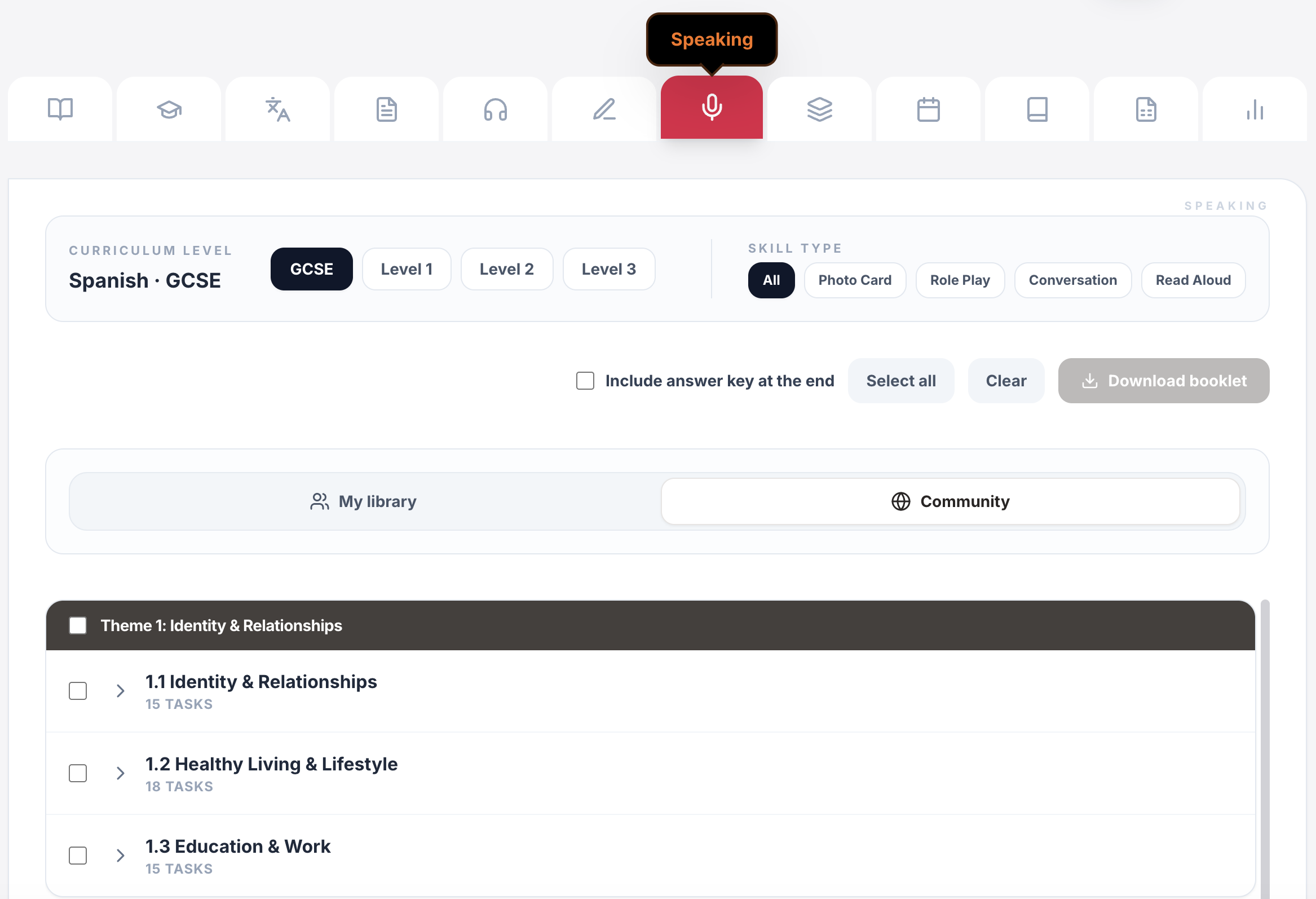
Live games & whiteboards
Turn curriculum content into whole-class competition, retrieval and live response.
Explore this guide →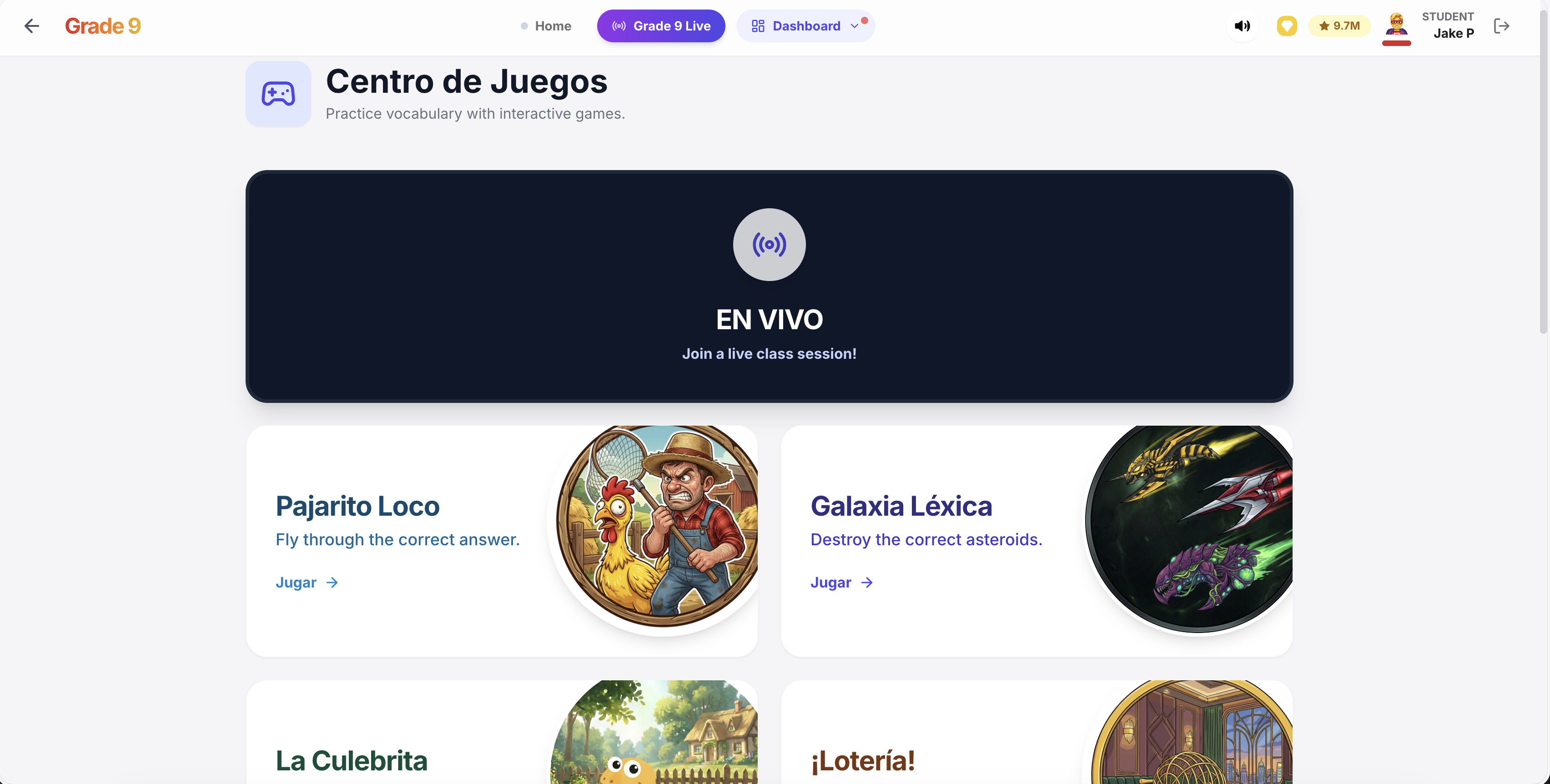
Assignments & tracking
Set work for a whole class or selected students, schedule it and see who has started or finished.
Explore this guide →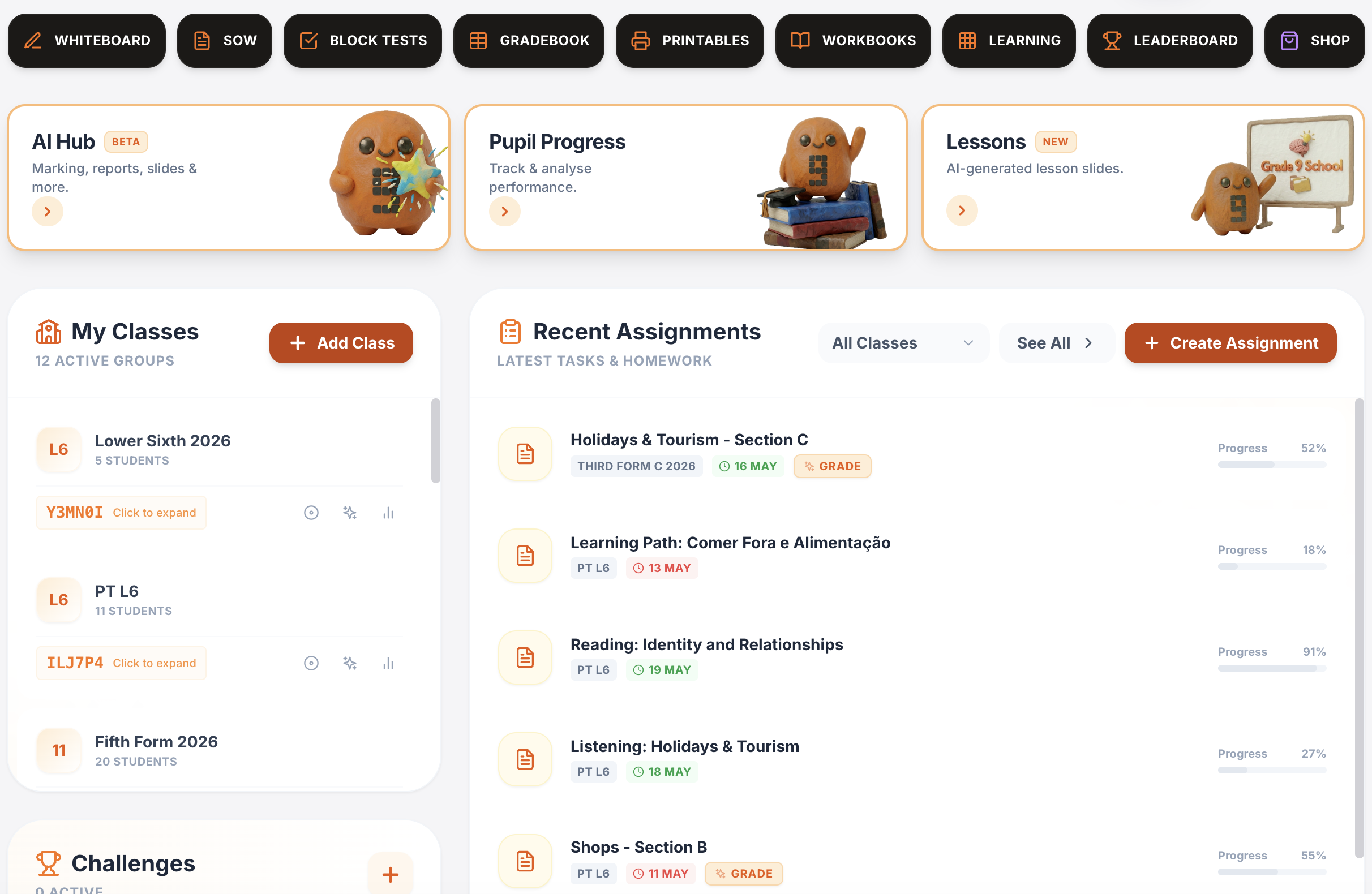
Vocabulary, grammar, translation & independent practice
Structured learning paths, flashcards, vocabulary builders, grammar, verb work, translation and tracked independent learning across supported languages.
Explore this guide →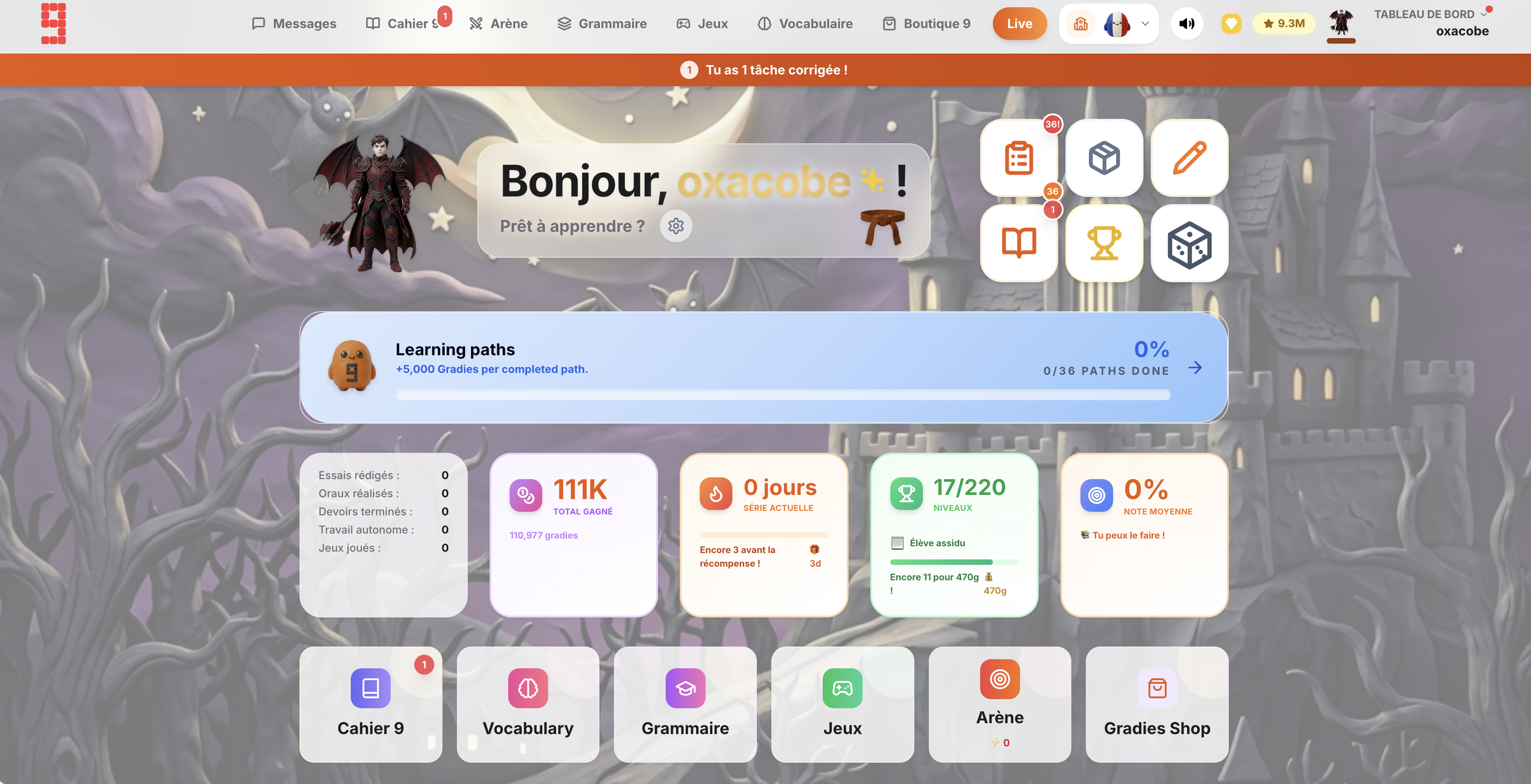
Spanish · French · German · Portuguese · Italian
Use the same platform architecture across the languages your department teaches, while keeping each class in its own language and curriculum context.
Explore language workflows →
From planning to progress, it all connects.
Curriculum management, assignments, AI feedback, printables, gradebook and lesson planning all sit inside the same Grade 9 environment.
Find the detail you need.
Open any section for the key facts, practical detail, examples and sources.
01Start the year by diagnosing, not guessing⌄
A Spanish 2 roster can contain very different students:
- students who retained most of Spanish 1;
- students who forgot large chunks over the summer;
- students who transferred from a different sequence;
- students with strong listening but weak writing;
- heritage learners or students with home exposure;
- students who know grammar terminology but hesitate in real communication.
Before launching a long review unit, collect small pieces of evidence:
- a short supported reading;
- a brief listening with gist and detail questions;
- a partner exchange on familiar topics;
- a short unprepared writing sample;
- a few high-frequency retrieval prompts.
The goal is not one Spanish level number. It is to find out what the class can already do and where support needs rebuilding.
02Spanish 2 does not map to one national proficiency target⌄
ACTFL’s proficiency and performance frameworks are useful for describing growth, but ACTFL does not define Spanish 2 as one universal sublevel.
The 2026 Can-Do Statements are adaptable to local curricula and are not a prescribed sequence by course or grade. [S2]
Use proficiency language to sharpen expectations, not to pretend the course title guarantees a result.
03What progression can look like⌄
Progression is often visible when a familiar Spanish 1 task becomes less supported, more connected or more interactive.
| Spanish 1 version | Spanish 2 progression |
|---|---|
| Say which class you like. | Explain preferences and compare parts of a school day. |
| Describe a family member. | Describe relationships, compare people and respond to follow-up questions. |
| List weekend activities. | Recount or sequence recent activities where the local curriculum supports past-time language. |
| Order food from a model. | Handle a less scripted exchange, ask a follow-up and justify a choice. |
| Identify details in a short text. | Find the main idea plus supporting details in a longer familiar-context text. |
| Write separate simple sentences. | Link ideas more deliberately and sustain a short message for an audience. |
Not every class will make each shift at the same time.
The point is increasing independence.
04Review Spanish 1 through use⌄
The first weeks of Spanish 2 often need review. Review is most useful when it makes old language functional again.
Instead of re-teaching every old conjugation or vocabulary list in isolation, use a familiar communicative task to reveal gaps.
Students might interpret a short profile, interview a classmate and write a short introduction. The teacher can then see which high-frequency forms and vocabulary need explicit repair.
The grammar and vocabulary are still reviewed, but inside communication.
05Build Spanish 2 around richer questions⌄
A course becomes more demanding when students have to answer better questions.
Spanish 1:
- What do you like?
- What do you do after school?
- What is your family like?
Spanish 2:
- Why do you prefer one activity?
- What did you do and what happened next?
- How is your routine different on weekdays and weekends?
- Which option would you recommend and why?
- How are two cultural practices similar and different?
The vocabulary may still be familiar. The thinking and language control are deeper.
06A sample Spanish 2 unit: weekend and free time⌄
This is one possible second-year unit. Adapt it to the local curriculum and the time frames students have been taught.
Communicative outcomes
Students should be able to:
- understand the main idea and selected details in a short account of someone’s weekend;
- ask and answer follow-up questions about free-time activities;
- sequence a short account of what happened;
- express and support a preference;
- create a short spoken or written account for an audience.
Language resources
Depending on the local sequence, students might need:
- familiar free-time vocabulary;
- sequencing words;
- high-frequency past-time forms;
- expressions of frequency;
- question words;
- opinion and reason phrases;
- connectors.
Do not introduce every possible past-tense form simply because the unit touches past time. Give students the language needed for the communicative outcome, then widen control over time.
Interpretive task
Students listen to or read a short weekend account.
First pass:
- Where did the person go?
- What was the main activity?
- Was the weekend positive or negative?
Second pass:
- What happened first?
- Who was involved?
- What reason or opinion was given?
The progression is not just a longer text. It is a more demanding purpose for listening or reading.
Interpersonal task
Partners compare their own or fictional weekends.
Require a follow-up move, not only a response:
- ask a question;
- answer;
- react;
- ask one related follow-up.
Students can use a support card at first, then repeat with less scaffolding.
Presentational task
Students create a short audio, message or post titled A weekend worth recommending or My ideal weekend.
A useful rubric can focus on:
- whether the message is understandable;
- whether ideas connect;
- whether the required functions are present;
- how successfully the student uses familiar language;
- one or two accuracy priorities that matter for the unit.
Do not try to grade every possible error equally.
07Extend each skill without rebuilding another course guide⌄
Spanish 2 needs regular interpretive, interpersonal and presentational work, but each strand can stay focused on second-year progression.
Listening and reading
Use familiar-context material with more connected meaning, less support or a more demanding purpose: main idea plus evidence, sequencing, comparing sources, identifying opinion and reason, or inferring a familiar word from context.
For a full listening routine, see World language listening practice.
Speaking
Increase independence gradually. Ask for a follow-up, a reaction, a less scripted exchange or a similar task in a new context. Remove scaffolds in stages rather than all at once.
For a fuller progression, see World language speaking practice.
Writing
Move from separate sentences toward a short message with clearer sequencing, linking, reasons or reactions. Keep the communicative purpose visible rather than turning writing into a tense drill.
For the full feedback-to-revision workflow, see World language writing feedback.
Vocabulary
Spanish 2 should recycle Spanish 1 language while extending what students can do with it. Retrieval should include older high-frequency language as well as the current unit.
For a fuller practice ladder, see World language vocabulary practice.
08Grammar should expand what students can say⌄
Second-year grammar often includes more complex or varied structures. The exact sequence depends on the local course.
A useful decision rule is:
Teach the structure when it opens a communicative door.
Past-time language can let students narrate. Comparisons let them evaluate options. Commands can support advice. Expanded question forms can improve interpersonal speaking.
Important structures should reappear across units rather than being treated as one-time coverage.
09Use culture to deepen the task⌄
Culture in Spanish 2 can move beyond identifying facts.
Students can compare perspectives in short sources, notice how a familiar practice differs across Spanish-speaking communities, interpret a real menu, review, map, ad or schedule, and use cultural information to make a recommendation.
The World-Readiness Standards connect communication with cultures, connections, comparisons and communities rather than treating culture as a separate trivia category. [S1]
10Differentiate without building three separate courses⌄
Mixed Spanish 2 classes are normal.
Differentiation can vary:
- amount of support;
- number of required details;
- degree of spontaneity;
- text length;
- number of follow-up questions;
- choice of extension;
- audience or purpose;
- whether students receive a word bank.
All students can complete the same interpersonal task while one group uses question stems, another uses only key words, and a more confident group sustains the exchange for an extra turn and adds an unprepared follow-up.
The communicative goal stays shared.
11Common Spanish 2 planning mistakes⌄
1. Spending a quarter reviewing Spanish 1
Review is necessary. Endless pre-teaching delays the second-year work students need.
2. Treating progression as a grammar inventory
More verb tenses do not automatically mean more communicative ability.
3. Assuming every student had the same Spanish 1
Diagnose early and expect uneven profiles.
4. Making texts harder only by making them longer
Difficulty can also come from less visual support, more connected ideas or a more demanding interpretive question.
5. Removing scaffolds too fast
Independence grows through repeated successful use.
6. Never removing scaffolds
A sentence frame can become a crutch if students are never asked to perform without it.
7. Replacing communication with projects
Judge the language students have to understand and produce, not the decoration.
12How Grade 9 School can support Spanish 2⌄
In the US experience, a Spanish 2 class can use a Level 2 curriculum context or a custom curriculum selected by the teacher.
Assignments can target the whole class or selected students, which can help when Spanish 1 retention is uneven. Teachers can use saved activity evidence to decide who needs more practice without treating one practice score as a proficiency label.
For a fuller explanation of completion, performance and proficiency evidence, see Student progress tracking in world languages.
The Presentation Generator can work from a selected topic, language level, activities, optional grammar focus and final task. Generated material must still be reviewed for language, cultural appropriateness and fit for the actual class.