 School


Spanish 1 Curriculum: What First-Year Spanish Should Build
Build a practical Spanish 1 course around novice communication, useful vocabulary, culture and repeated practice. Includes a sample unit and lesson sequence.
Grade 9 School brings curriculum, lesson planning, practice, homework, feedback, live activities, printables and progress tracking into one connected teaching workflow.
 Spanish
 French
 German
 Portuguese
 Italian
Practice, feedback and progress in one place.
Spanish 1 has a difficult job.
Students are starting with very little language, but the course still needs to feel like Spanish is something they can use, not something they are waiting to use after they have learned enough grammar.
A good first-year course builds a small but increasingly flexible language system. Students learn to understand familiar messages, ask and answer simple questions, describe their world, express preferences and create short messages of their own.
The exact topics and sequence will vary by district. The bigger question is more stable:
What can students do with the Spanish they have learned?
Explore the topic ↓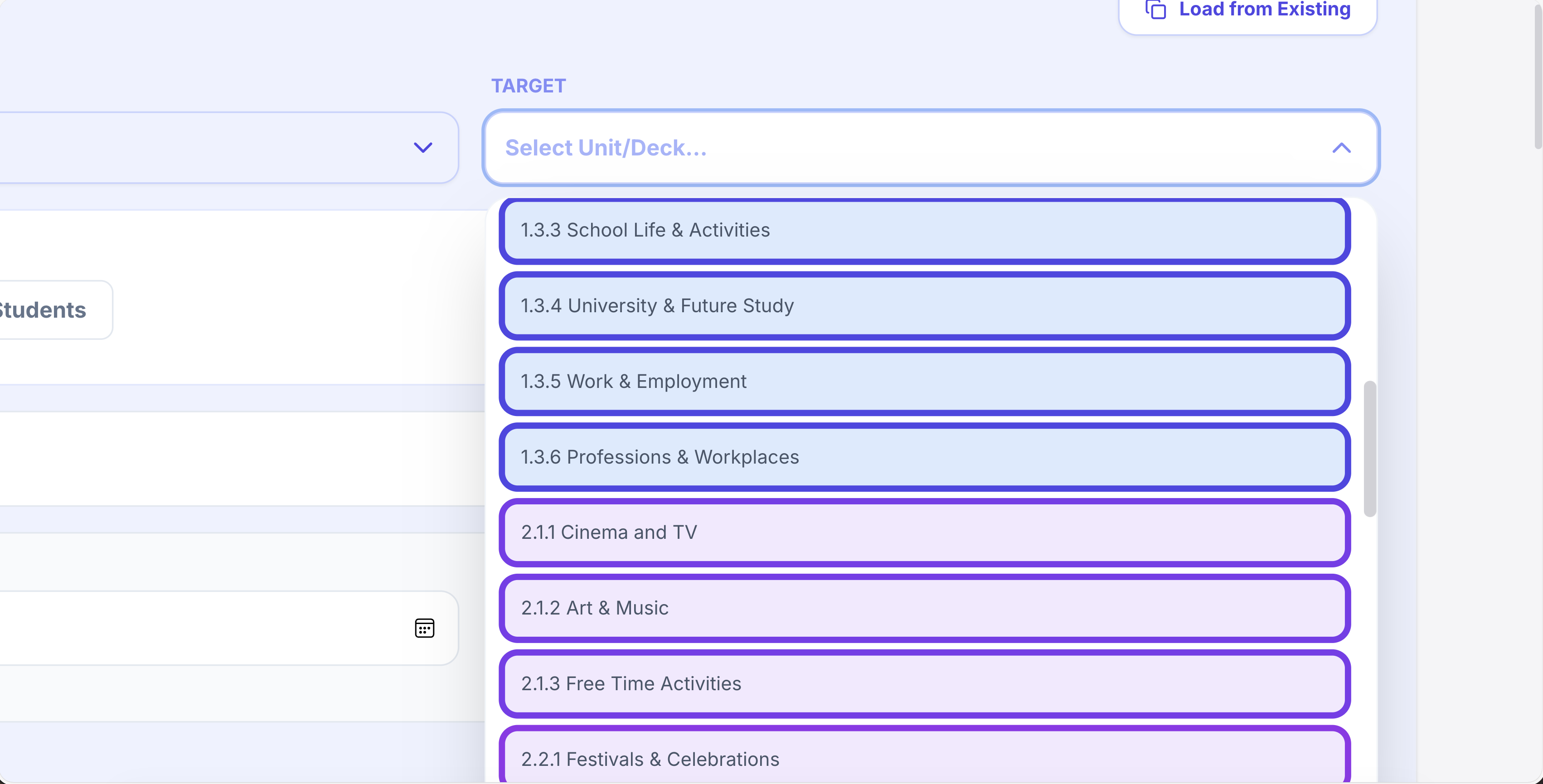
One platform for teaching, practice, feedback and progress.
Plan lessons, set homework, run live activities, generate printables, give AI-supported grading and track progress across Spanish, French, German, Portuguese and Italian.
Writing & speaking grading
Set writing and speaking tasks, collect submissions, generate detailed feedback and keep teacher review in the loop.
Explore this guide →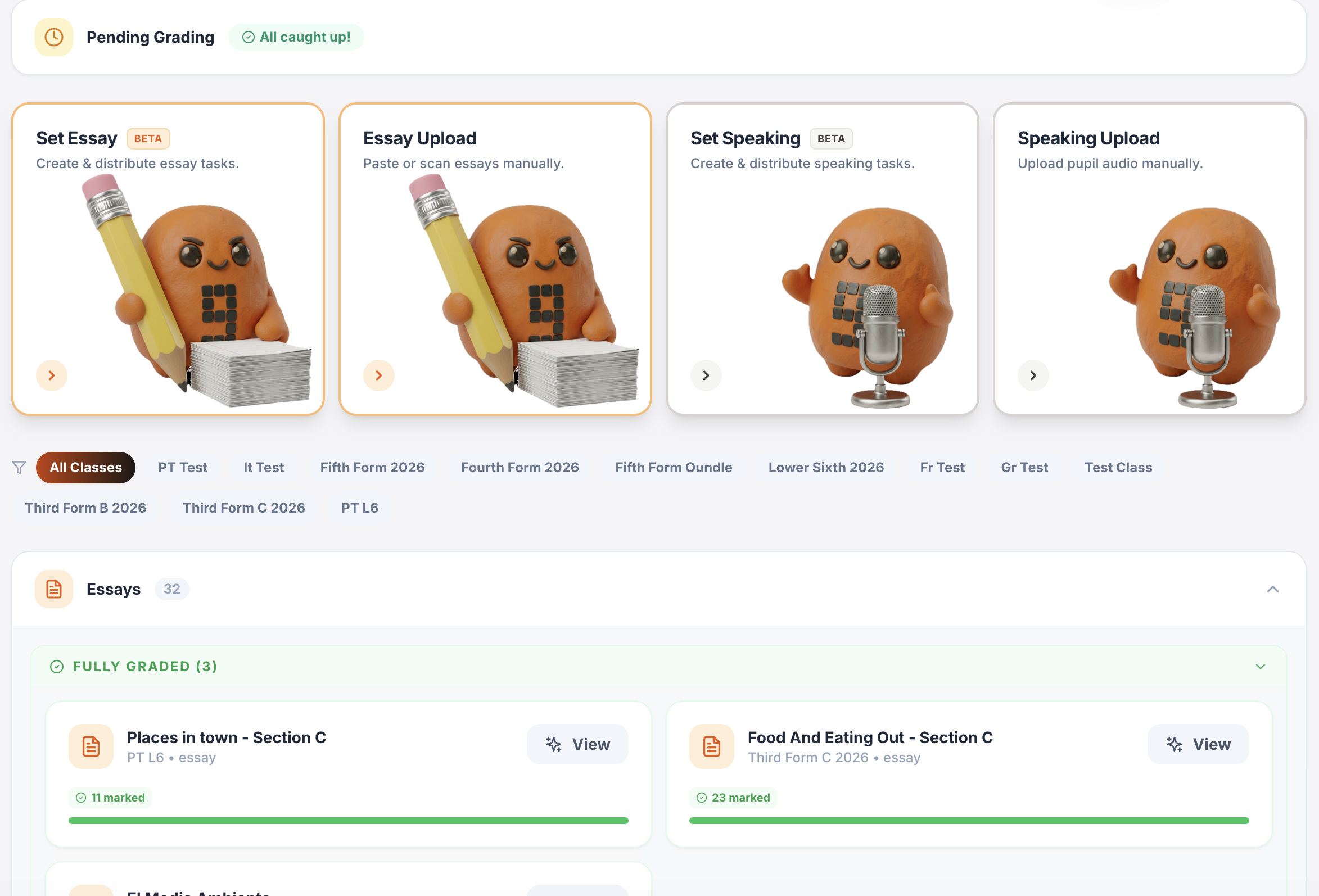
Gradebook & reports
Track scores, completion, engagement and learning evidence across classes.
Explore this guide →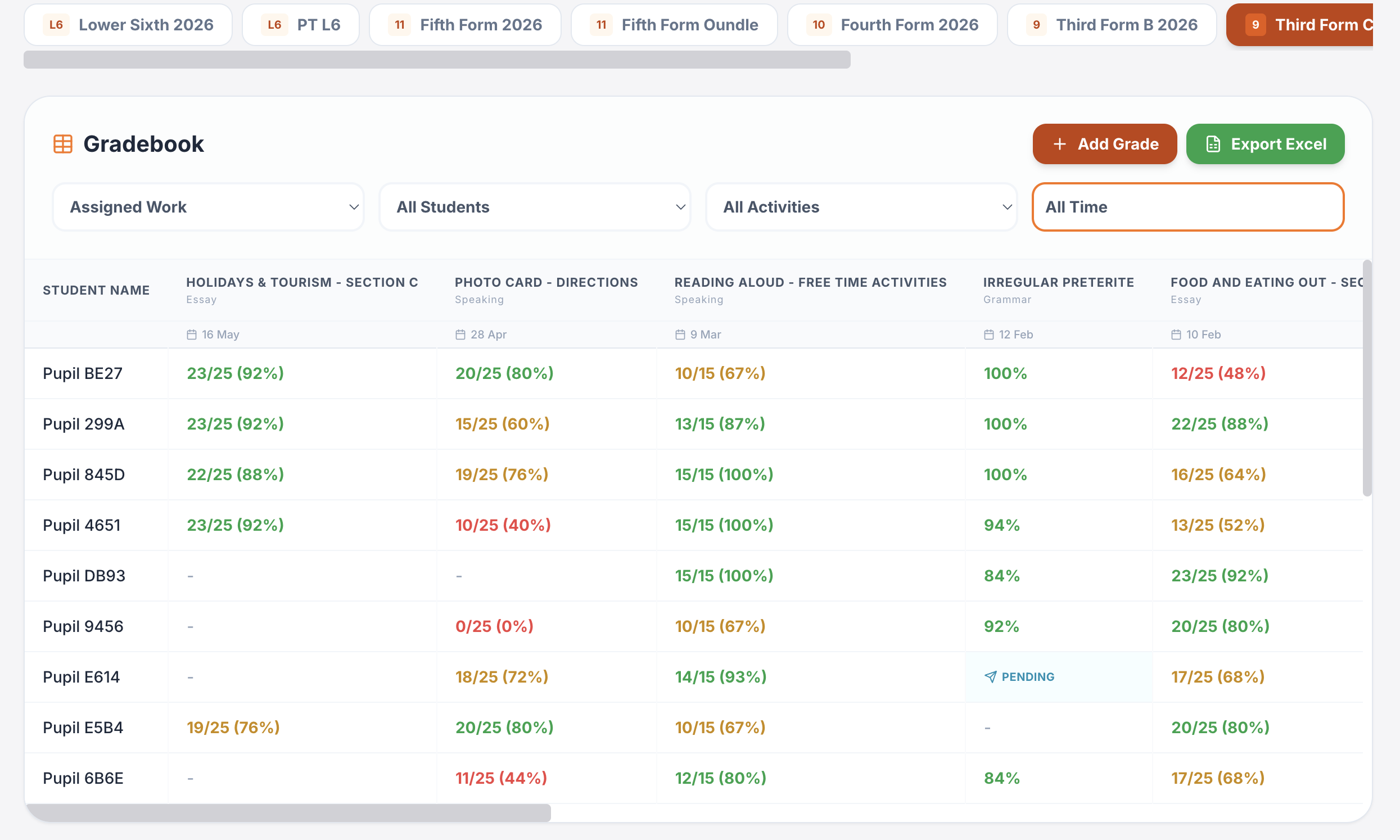
Interactive lessons
Generate, edit, save and reuse complete lesson presentations.
Explore this guide →Printables in seconds
Vocabulary, grammar, translation, reading, listening, worksheets and booklets.
Explore this guide →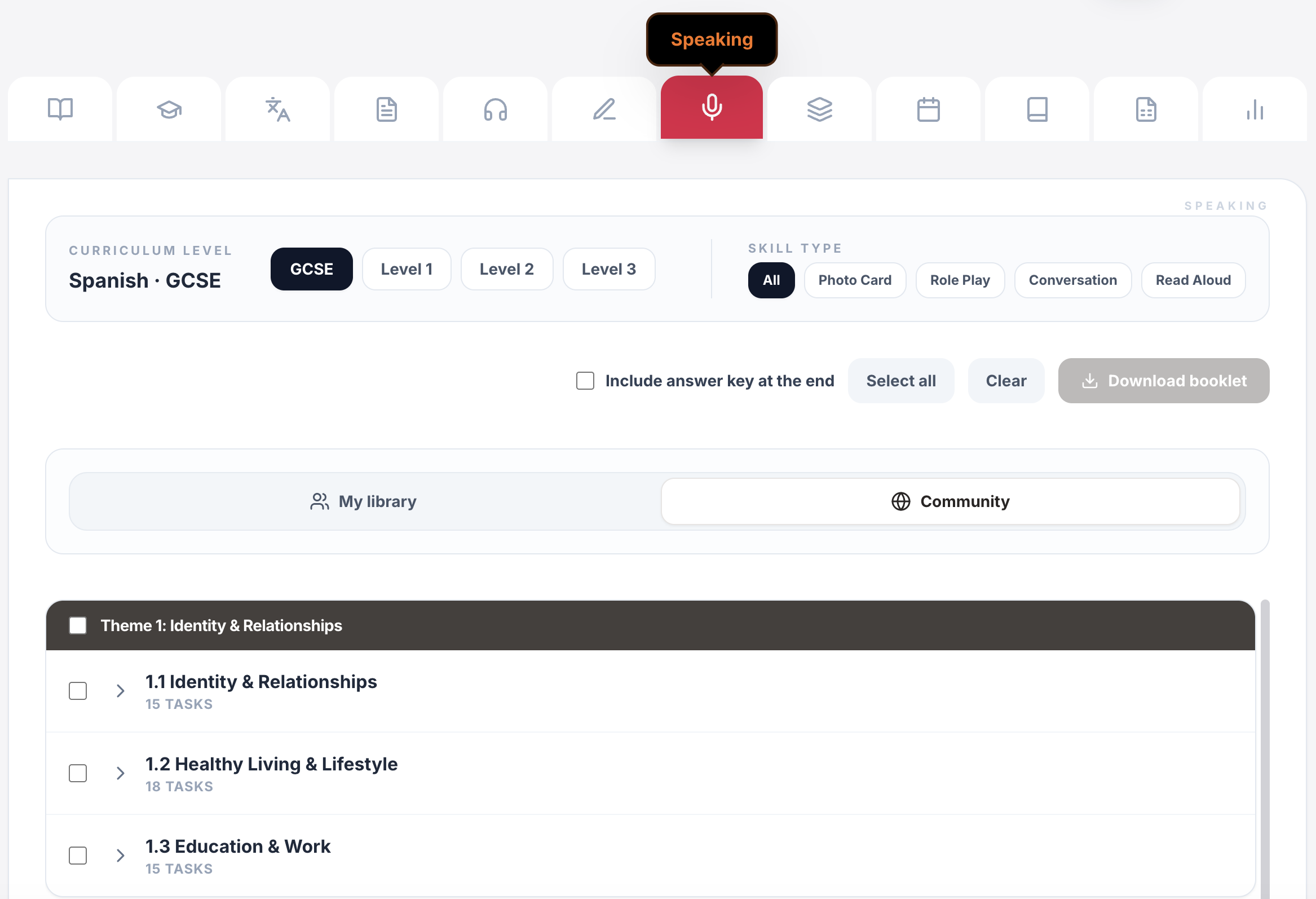
Live games & whiteboards
Turn curriculum content into whole-class competition, retrieval and live response.
Explore this guide →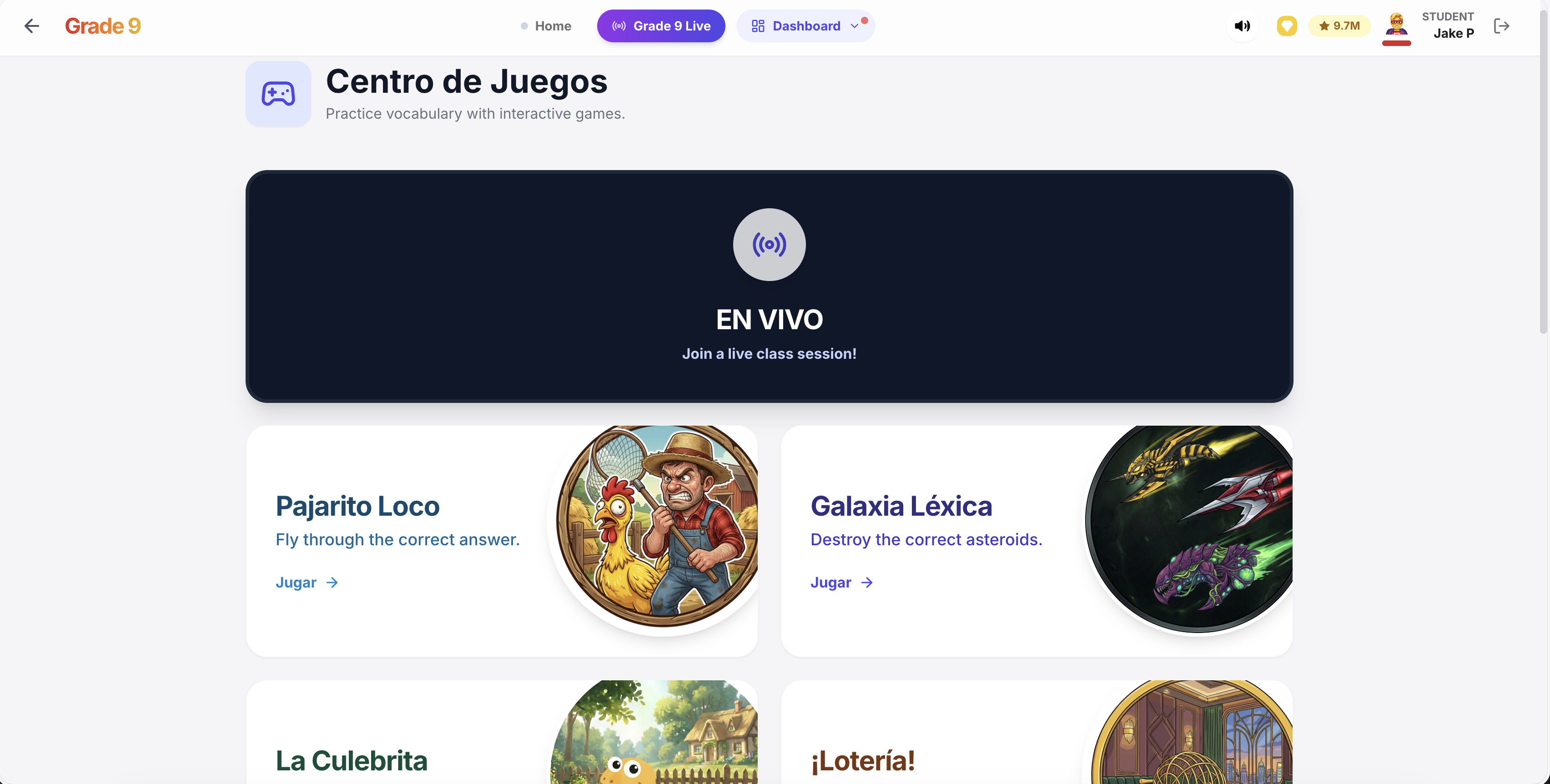
Assignments & tracking
Set work for a whole class or selected students, schedule it and see who has started or finished.
Explore this guide →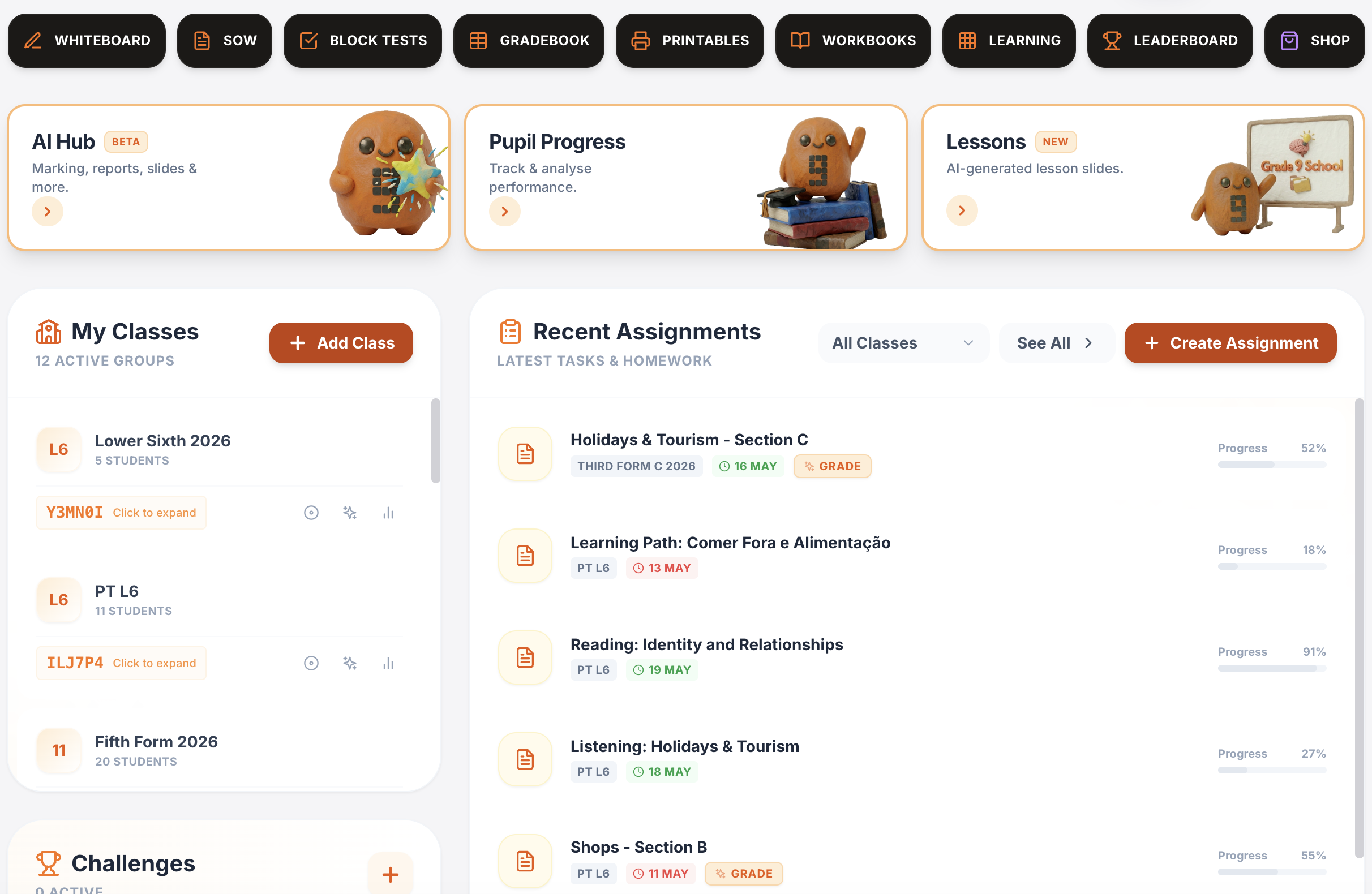
Vocabulary, grammar, translation & independent practice
Structured learning paths, flashcards, vocabulary builders, grammar, verb work, translation and tracked independent learning across supported languages.
Explore this guide →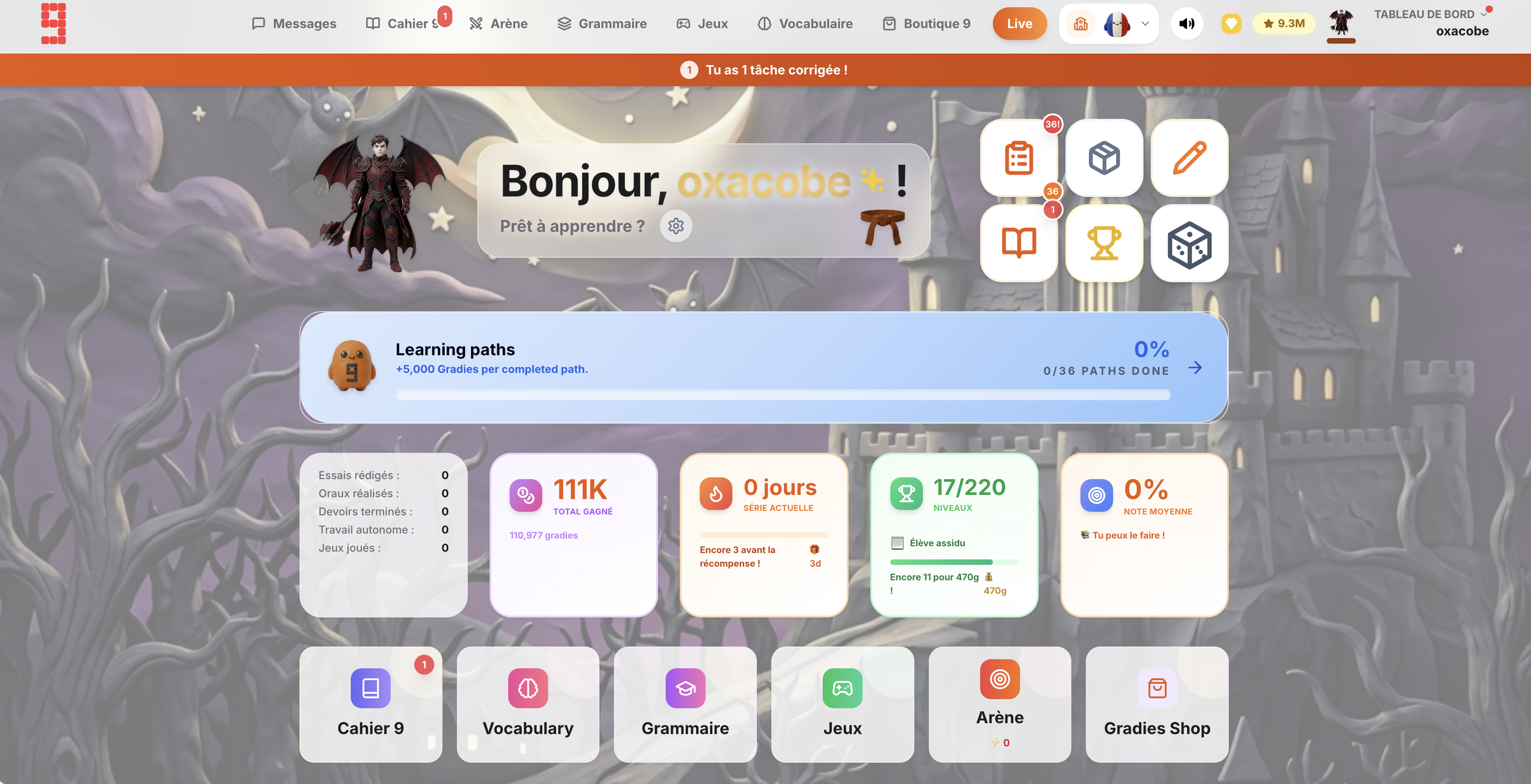
Spanish · French · German · Portuguese · Italian
Use the same platform architecture across the languages your department teaches, while keeping each class in its own language and curriculum context.
Explore language workflows →
From planning to progress, it all connects.
Curriculum management, assignments, AI feedback, printables, gradebook and lesson planning all sit inside the same Grade 9 environment.
Find the detail you need.
Open any section for the key facts, practical detail, examples and sources.
01Spanish 1 is not a national grammar checklist⌄
There is no single US Spanish 1 sequence that every school follows.
The 2026 NCSSFL-ACTFL Can-Do Statements are organized around what learners can do across proficiency levels and communication modes, but the examples are not a prescribed curriculum. They are meant to be adapted to local curriculum and context. [S2]
Your district may begin with greetings, school, family and food. Another may organize around identity, community, leisure and cultural themes. One program may introduce past-time language in the first year; another may not.
You can still judge the quality of the course by asking whether students are becoming more able to understand and communicate.
02What novice communication can look like⌄
At the Novice range, ACTFL describes learners working with high-frequency language, familiar contexts and relatively short text types, with support often playing an important role. [S3]
In Spanish 1, that might mean students can:
- identify the main topic and a few details in a short supported text or audio;
- introduce themselves and give basic personal information;
- ask and answer familiar questions;
- express likes, dislikes and simple opinions;
- describe people, places or routines using simple language;
- create short spoken or written messages from familiar language;
- use context, visuals and cognates to make meaning before understanding every word.
These are examples of sensible communicative work for beginning learners, not a fixed checklist or a guarantee of a particular ACTFL sublevel.
03Plan from functions, then choose language⌄
A first-year course becomes easier to design when each unit has a communicative purpose.
Instead of starting with adjective agreement, start with something students should be able to do:
Describe a person and ask someone else for a description.
Then identify the language that makes that possible:
- high-frequency physical and personality descriptions;
- forms of ser and tener where needed;
- adjective agreement;
- question forms;
- simple connectors such as y, pero and porque.
The grammar now has a job.
04Useful Spanish 1 topic contexts⌄
These are flexible contexts for novice communication, not a mandatory sequence:
- greetings and introductions;
- identity and personal information;
- classroom and school life;
- family, friends and descriptions;
- likes, dislikes and leisure;
- food and simple choices;
- home, town and places;
- weather and plans;
- daily routine;
- clothing and preferences;
- celebrations and cultural practices.
The same topic can support very different quality of teaching. Food can become a list of 50 nouns, or it can become a sequence where students interpret a menu, ask what someone likes, make a choice, compare eating practices and recommend something to a classmate.
The second version gives the vocabulary a reason to exist.
05A sample Spanish 1 unit: school day and preferences⌄
Here is one possible novice unit. It is intentionally small enough to be teachable.
Communicative outcomes
By the end, students should be able to:
- identify basic information in a simple schedule;
- say which classes they have and when;
- ask a classmate what they study;
- express a simple preference and give a short reason;
- write or record a short description of their school day.
Core language
Possible high-frequency language:
- tengo…
- estudio…
- mi clase de…
- a las…
- me gusta / no me gusta…
- es…
- porque…
- ¿qué clase tienes?
- ¿a qué hora…?
- ¿te gusta…?
Do not turn the list into 40 isolated words if students only need a smaller set to complete the final tasks.
Interpretive work
Give students a short school schedule, message or supported audio.
Early questions can focus on meaning:
- Which class is first?
- What time is math?
- Which class does the speaker like?
- What reason do they give?
A novice student does not need to translate every word to show comprehension.
Interpersonal work
Move from rehearsal to a real information gap.
For example, partners have slightly different schedules. They ask each other questions to complete missing information, then compare which day they would prefer.
Scaffolds can include question stems at first. Remove some support after students have used the language successfully several times.
Presentational work
Students record or write a short My school day message.
A realistic first version might contain four to six connected simple sentences. The exact length should depend on what the class can genuinely control, not on a desire to make the assignment look impressive.
Cultural connection
Use a real or teacher-curated school timetable from a Spanish-speaking context and ask students to notice similarities and differences.
Keep the question focused. What is the same and what is different about the schedule? is usually more useful than a long list of cultural facts.
This unit is the page’s one concrete lesson sequence. For a reusable daily planning framework, see World language lesson planning.
06Spanish 1 skill principles⌄
The course still needs deliberate work across vocabulary, grammar, listening, reading, speaking and writing. The important point is to keep each strand specific to beginning learners rather than turning every strand into its own mini-guide.
Vocabulary: fewer words, more encounters
Prioritize language students will meet and use repeatedly. Recycle it across retrieval, listening, reading, speaking and writing rather than treating Friday’s quiz as the end point.
For a fuller recognition-to-retrieval-to-use progression, see World language vocabulary practice.
Grammar: make accuracy serve a message
Teach the structures students need for high-frequency functions: forming questions, describing, expressing preferences, using common present-tense verbs and making agreement where needed.
The order should follow the local curriculum and the communicative task rather than a universal grammar checklist.
Listening and reading: start early and keep the purpose small
Beginning learners can interpret short, supported language from the start. Ask for gist, a few details, a sequence, a choice or a match rather than full translation.
For listening routines and re-listening design, see World language listening practice.
Speaking: scaffold the exchange, then reduce support
Use repeated low-stakes pair work, information gaps, choice questions and short recordings. Model first, give students something worth finding out from another person, and fade support rather than removing it all at once.
For a fuller speaking progression, see World language speaking practice.
Writing: short, frequent and reusable
Spanish 1 writing can be a short profile, recommendation, message, description or comparison. Small tasks often provide better evidence of what students genuinely control than a long piece assembled from heavy support.
For a feedback-to-revision workflow, see World language writing feedback.
07Common Spanish 1 planning mistakes⌄
1. Teaching about Spanish instead of using Spanish
Explanations in English can be necessary. If most student time is spent discussing rules rather than understanding or producing Spanish, the balance needs checking.
2. Starting every unit with a giant vocabulary list
Give students the words they need, then make them use those words repeatedly in context.
3. Making free speaking the first speaking step
Novice students usually need modeling, retrieval and guided practice before a genuinely independent exchange.
4. Confusing challenge with length
A longer reading is not necessarily a better reading. Challenge can come from inference, comparison or less support.
5. Finishing a unit and abandoning its language
Build planned recycling into later units.
6. Letting the textbook chapter define the outcome
A chapter can provide useful content. The learning outcome should still be something students can understand or communicate.
08How Grade 9 School can support Spanish 1⌄
For a Spanish 1 class in the US experience, Grade 9 can use a Level 1 curriculum context or a custom curriculum chosen by the teacher.
Teachers can assign vocabulary practice to a whole class or selected students, choose activities, schedule release and due dates, and review saved work. The Presentation Generator can start from selected curriculum content and a final task, then scaffold earlier activities toward that outcome.
Generated material still requires teacher review. Structural validation can catch missing sections or malformed activity structures; it cannot guarantee that every Spanish sentence is the best choice for a particular class.
If the district sequence does not match a built-in structure, teachers can use a custom curriculum rather than force the course into a generic platform order.