 School


World Language Student Progress Tracking: Completion Is Not Progress
Track World Languages progress without confusing completion, scores and proficiency. Build a useful evidence routine for students and teachers.
Grade 9 School brings curriculum, lesson planning, practice, homework, feedback, live activities, printables and progress tracking into one connected teaching workflow.
 Spanish
 French
 German
 Portuguese
 Italian
Practice, feedback and progress in one place.

A dashboard can tell you that a student completed 18 activities.
That is useful.
It does not automatically tell you what the student can do with the language.
World Languages progress is easier to interpret when teachers keep different kinds of evidence separate instead of forcing everything into one number.
Explore the topic ↓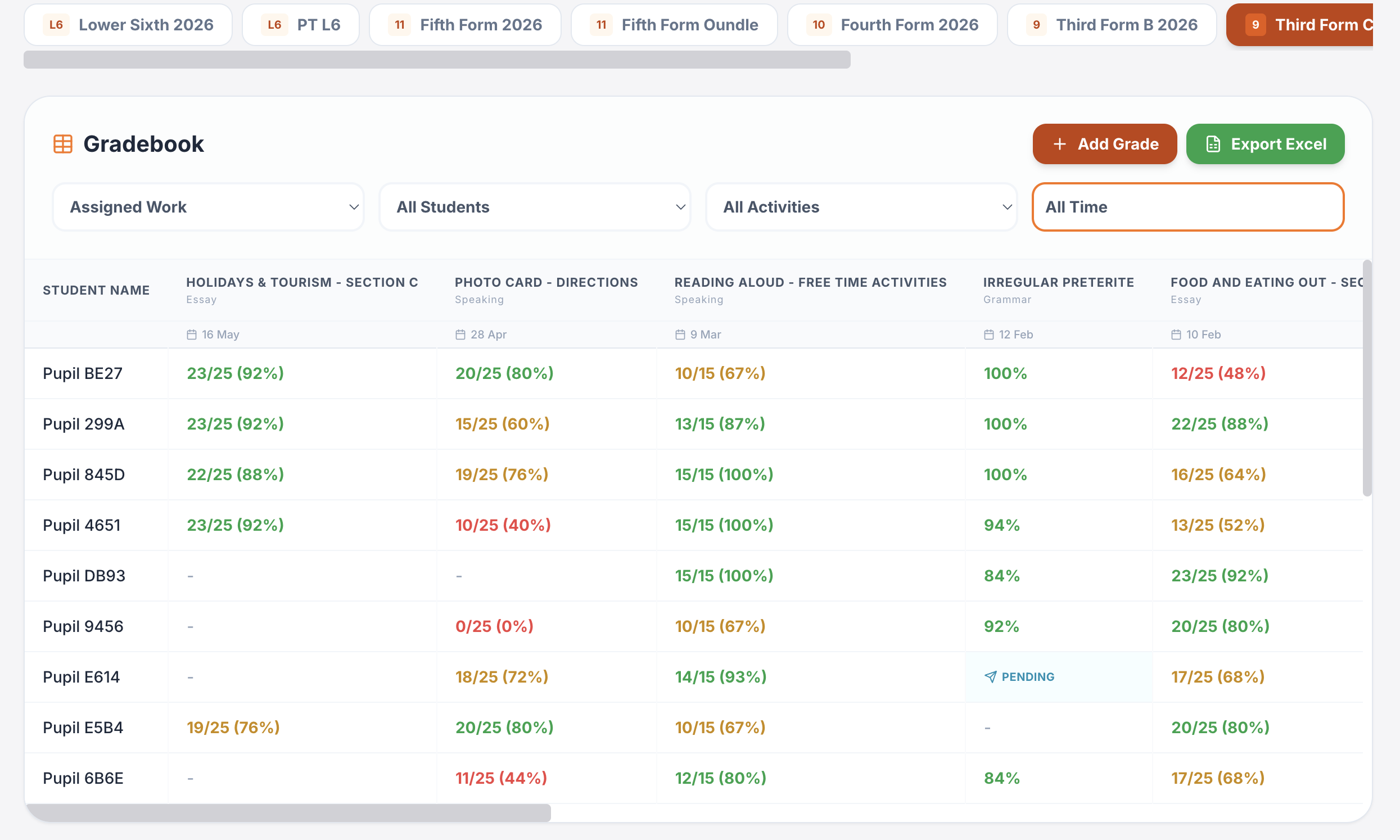
One platform for teaching, practice, feedback and progress.
Plan lessons, set homework, run live activities, generate printables, give AI-supported grading and track progress across Spanish, French, German, Portuguese and Italian.
Writing & speaking grading
Set writing and speaking tasks, collect submissions, generate detailed feedback and keep teacher review in the loop.
Explore this guide →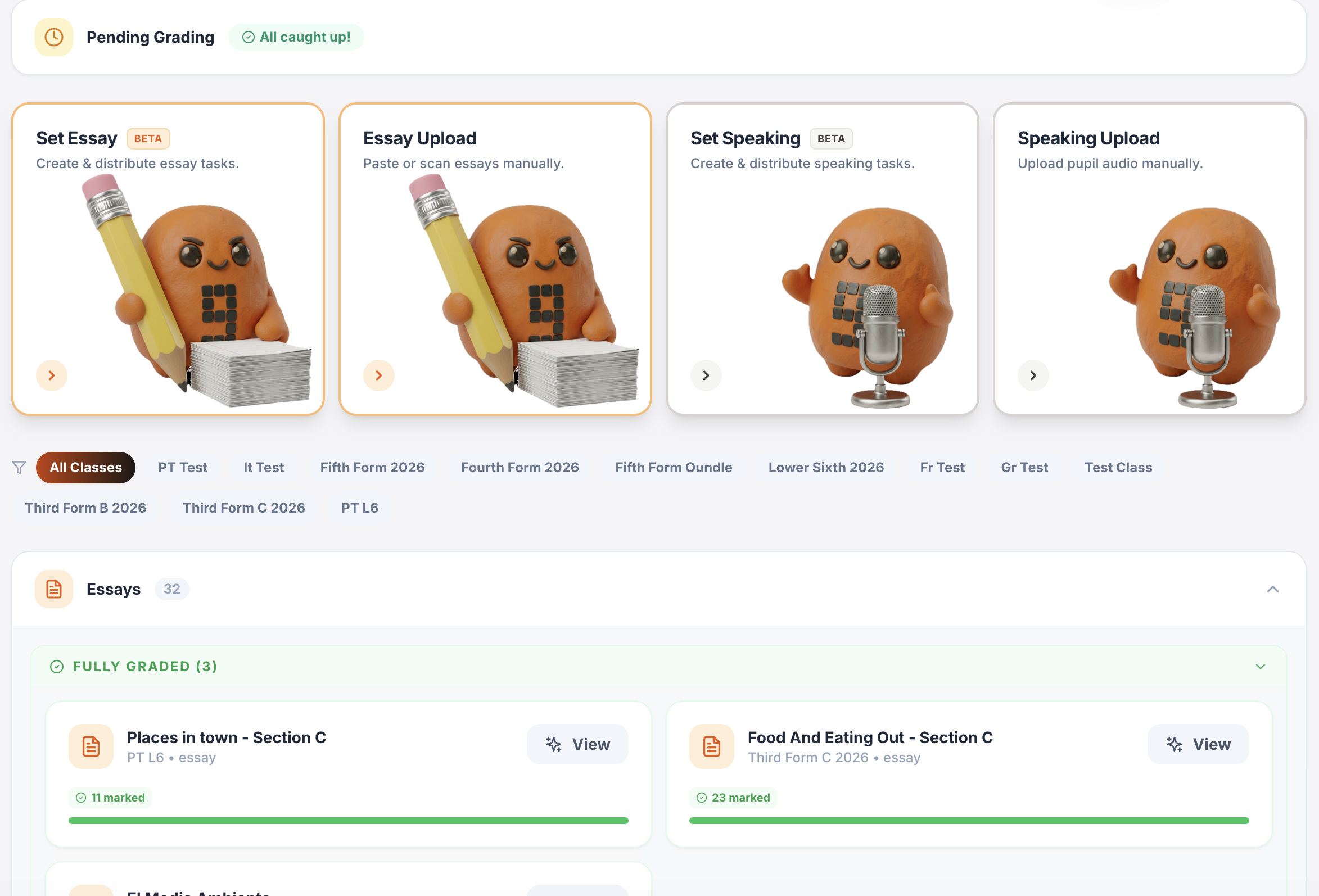
Gradebook & reports
Track scores, completion, engagement and learning evidence across classes.
Explore this guide →Interactive lessons
Generate, edit, save and reuse complete lesson presentations.
Explore this guide →
Printables in seconds
Vocabulary, grammar, translation, reading, listening, worksheets and booklets.
Explore this guide →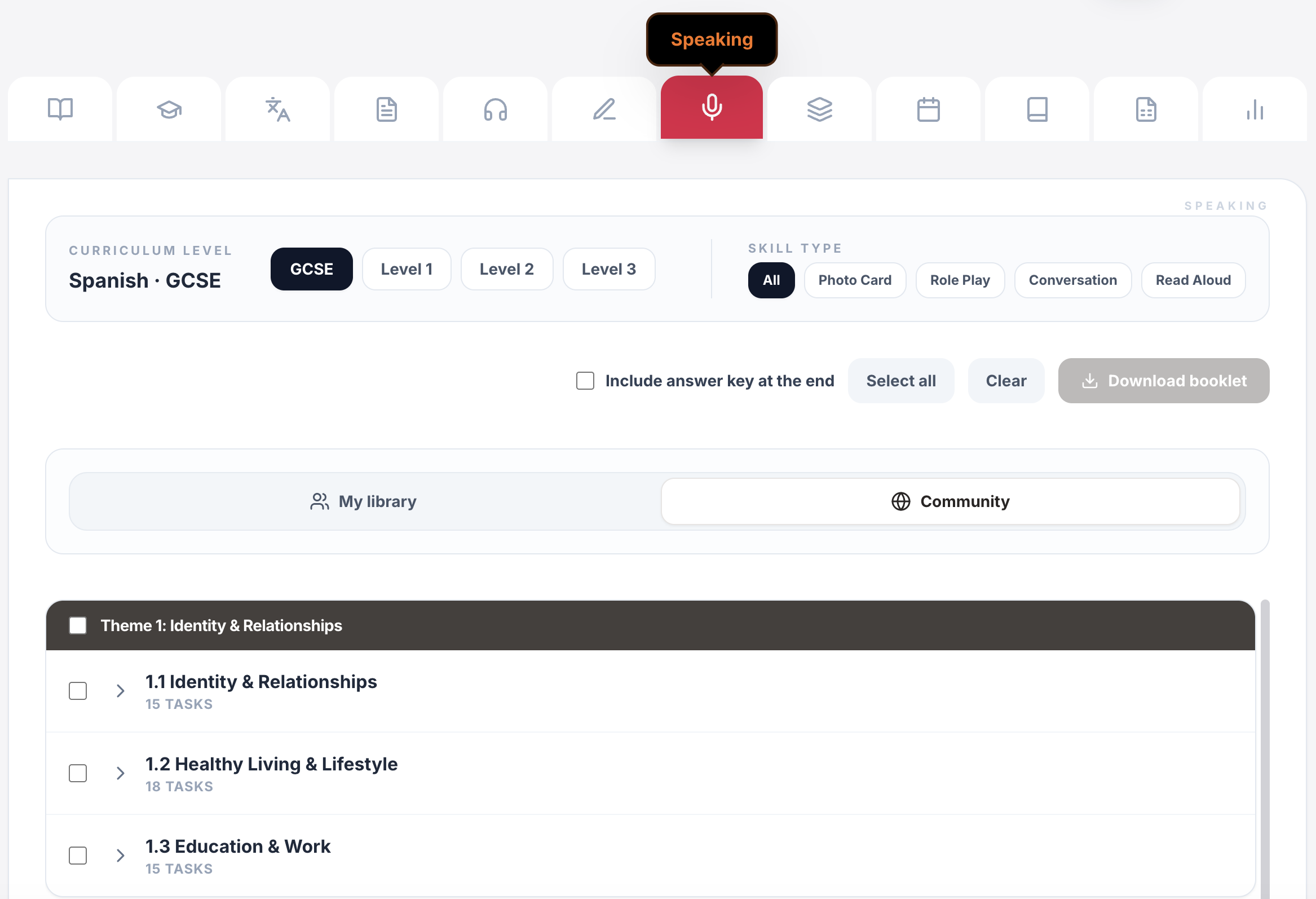
Live games & whiteboards
Turn curriculum content into whole-class competition, retrieval and live response.
Explore this guide →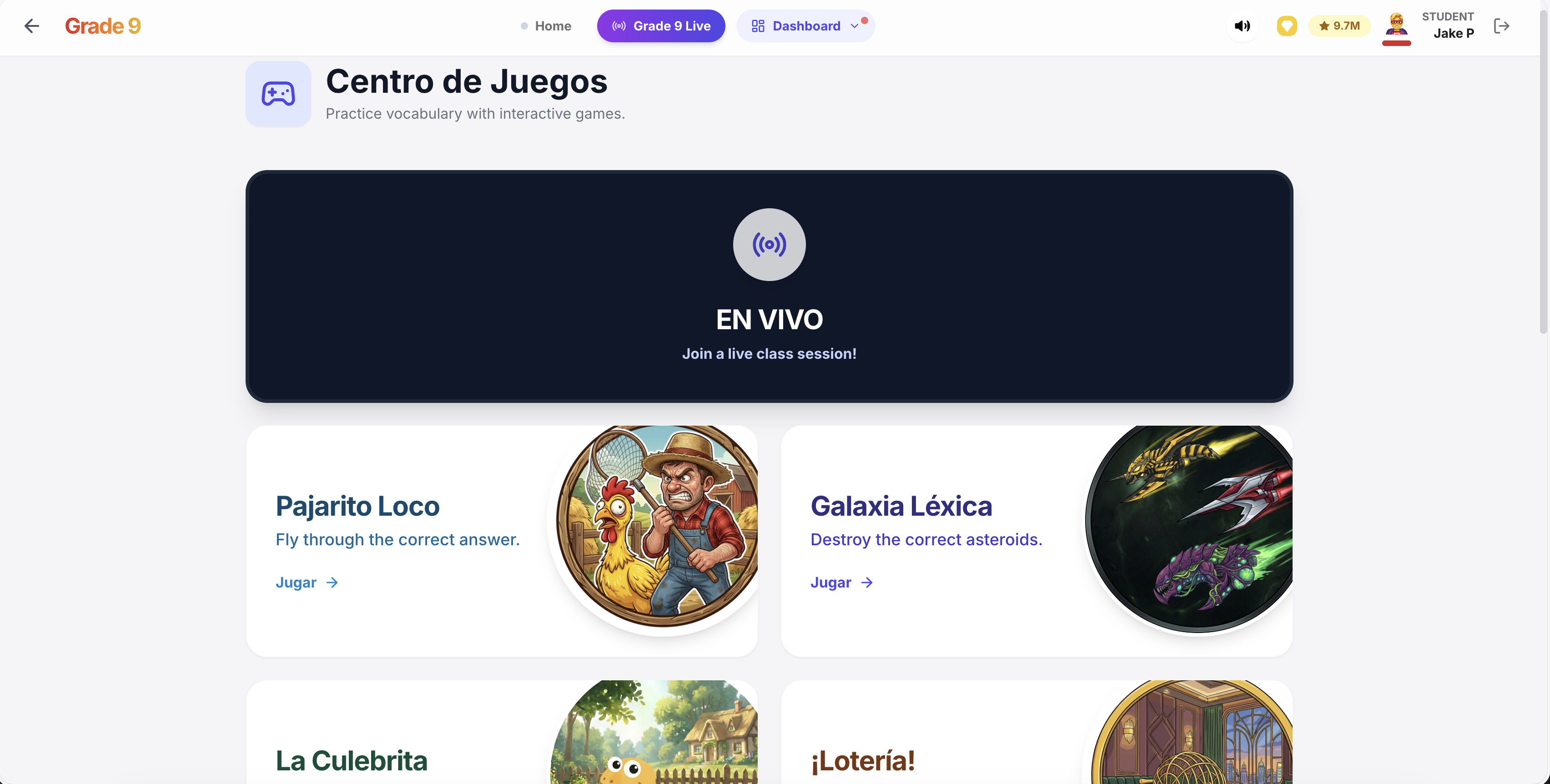
Assignments & tracking
Set work for a whole class or selected students, schedule it and see who has started or finished.
Explore this guide →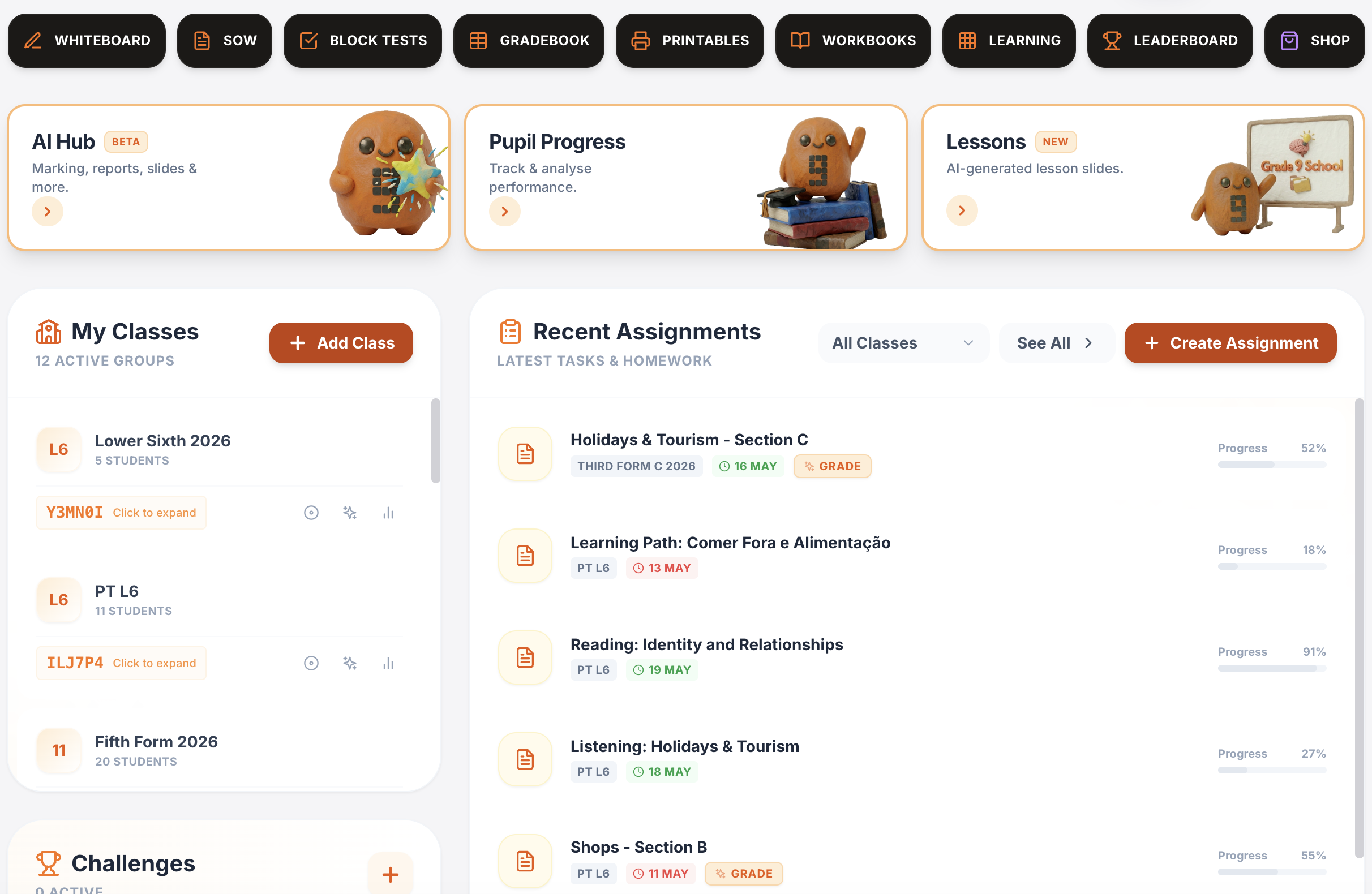
Vocabulary, grammar, translation & independent practice
Structured learning paths, flashcards, vocabulary builders, grammar, verb work, translation and tracked independent learning across supported languages.
Explore this guide →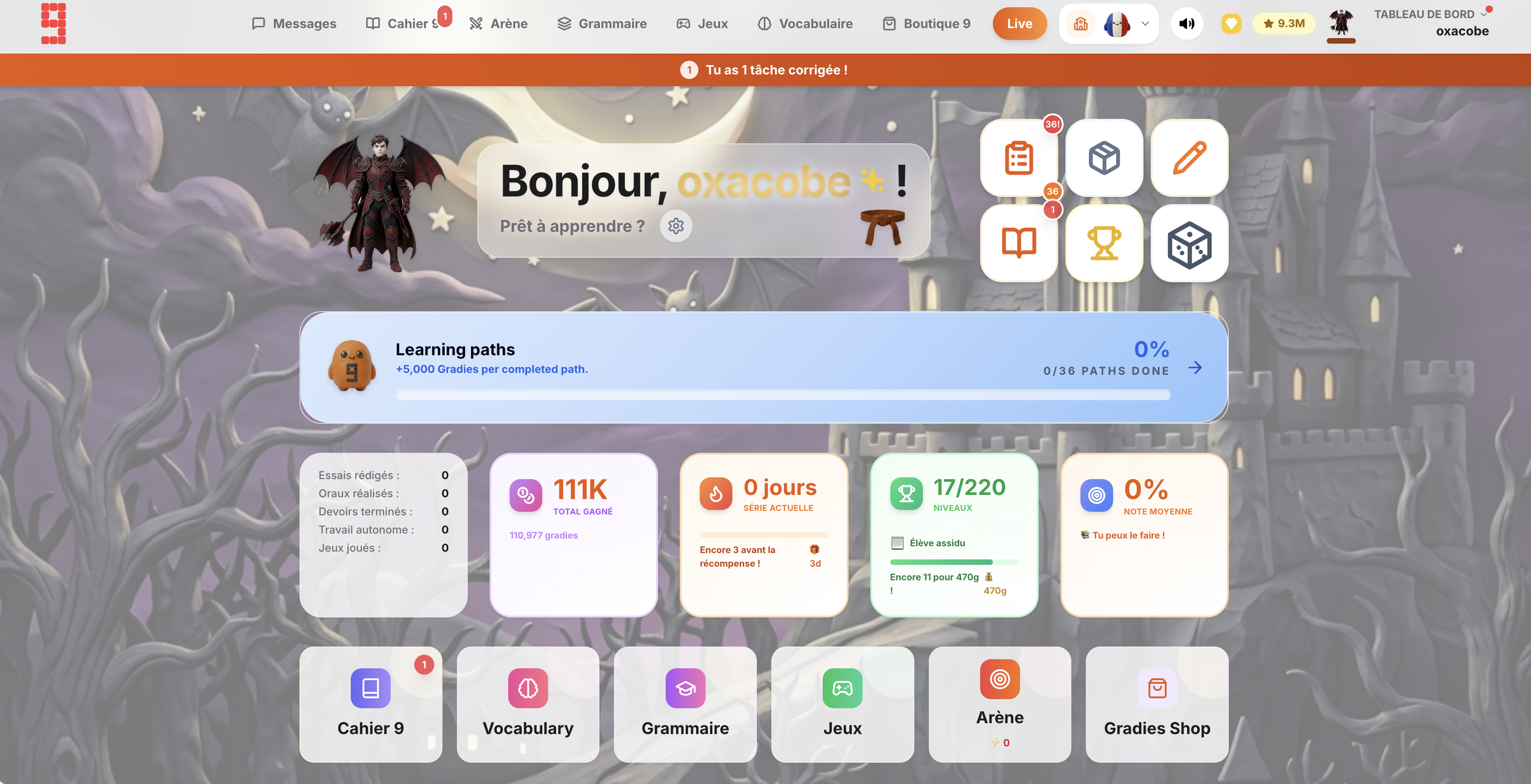
Spanish · French · German · Portuguese · Italian
Use the same platform architecture across the languages your department teaches, while keeping each class in its own language and curriculum context.
Explore language workflows →
From planning to progress, it all connects.
Curriculum management, assignments, AI feedback, printables, gradebook and lesson planning all sit inside the same Grade 9 environment.
Find the detail you need.
Open any section for the key facts, practical detail, examples and sources.
01Track at least three questions⌄
1. Did the student do the work?
This is completion evidence.
It helps with:
- missing work;
- participation in assigned practice;
- follow-up;
- pacing;
- homework routines.
Completion matters, but it is not performance.
2. How did the student perform?
This is task evidence.
Examples:
- vocabulary score;
- listening comprehension result;
- writing sample;
- recorded speaking response;
- grammar accuracy;
- successful revision.
Performance tells you more than completion, but it is still tied to a particular task.
3. What can the student do consistently with language?
This is the larger proficiency/performance question.
ACTFL’s Proficiency Guidelines describe ability across speaking, writing, listening and reading in terms of functions/tasks, accuracy, context/content and text type. A classroom activity score is not automatically an ACTFL proficiency rating.
That distinction protects teachers from over-interpreting small pieces of data.
02Use Can-Do statements as evidence prompts⌄
The NCSSFL-ACTFL Can-Do Statements can help students and teachers name what a performance demonstrates.
For example:
“I can ask and answer simple questions about after-school activities.”
Evidence might include:
- a partner observation;
- a short recording;
- a teacher conference;
- a student reflection;
- a later repeated task.
The Can-Do statement is not proven because the student checked a box once. It becomes more useful when connected to real performance evidence.
03Look for patterns, not isolated percentages⌄
One 62% does not tell you enough.
Ask:
- Is the same issue appearing in several tasks?
- Is the student improving across repeated attempts?
- Is one skill consistently stronger than another?
- Did performance drop because the task became harder?
- Is accuracy improving while output remains very short?
- Is homework completion high but independent performance weak?
A trend needs context.
04Keep skill evidence visible⌄
World Languages progress can disappear when every activity is averaged into one overall grade.
Keep some skill categories visible:
- listening;
- reading;
- speaking;
- writing;
- vocabulary/grammar practice where useful.
The exact categories can vary by course, but the principle is that a student should be able to see where the evidence comes from.
05Build a small progress routine⌄
You do not need a data meeting every week.
A 10-minute teacher routine can be enough.
Weekly or biweekly
- Check missing/incomplete assigned work.
- Scan recent performance by skill.
- Identify one class-wide pattern.
- Identify a small group needing a targeted follow-up.
- Save one piece of richer evidence if it shows important progress.
At the end of a unit
- Return to the unit Can-Do statements.
- Compare early and late evidence.
- Ask students to choose one example of improvement.
- Note one next target.
- Avoid treating the unit average as the whole story.
06Student reflection should use evidence⌄
Weak reflection:
“I got better at Spanish.”
Stronger:
“At the start of the unit I answered speaking questions with one short sentence. In my final recording I used follow-up questions and gave reasons without the phrase bank.”
The second reflection teaches the student to notice growth.
ACTFL’s effective-feedback guidance includes reflective feedback and self-assessment as part of the feedback picture. Portfolios, recorded performances and learner reflection can all contribute.
07A classroom example: Spanish 2, one week of evidence⌄
Student A:
- completed all four assigned tasks;
- vocabulary scores are high;
- listening result is weaker;
- speaking recording shows strong range but several breakdowns when asking questions.
Student B:
- missed one homework;
- listening result is strong;
- writing shows accurate but very short sentences;
- vocabulary practice is incomplete.
The students do not need the same intervention.
Student A may need more interpretive listening and question formation.
Student B may need a completion follow-up plus a writing task that pushes connected output.
A single “current average” would hide that difference.
08Do not turn practice data into a false proficiency label⌄
A digital platform may have lots of data.
That does not mean every number should become a level.
Be careful with statements such as:
- “This student is Intermediate Mid because their average is 82%.”
- “Ten completed activities prove mastery.”
- “The app score is the student’s proficiency.”
Proficiency decisions require appropriate evidence and context.
Use practice data to ask better questions, not to manufacture certainty.
09How Grade 9 School records progress⌄
The documented Grade 9 model separates assignment state from performance.
For a teacher-set assignment, the platform can show states such as pending, in progress and completed. Those states answer whether the student finished the assigned work.
Saved learning records can also include score information, answers, activity breakdown, duration and course context where the activity supports them.
Grade 9 then surfaces evidence in different places:
- My Activity gives the student a compact history.
- Cuaderno 9 / Student Book can show richer learning evidence and feedback where the task supports it.
- Class Progress gives teachers a trend view over saved activity.
- Assignment views show whether a particular teacher-set task has been completed.
The handbook explicitly warns that Class Progress is learning evidence, not an official examination grade or proficiency rating.
That distinction should remain visible in the U.S. page.
10Completion and score can disagree⌄
A student can be:
Completed + low score.
That means the task is finished, but the learning evidence may still require intervention.
A student can be:
In progress + strong partial work.
That means they have not finished the assignment even though the work so far looks good.
Those are not contradictory states.
11Progress data should lead to an action⌄
For every tracker or chart, ask:
What decision can this help me make?
Possible actions:
- reteach one form;
- assign targeted retrieval;
- give a student another listening attempt;
- group students for speaking;
- return writing for revision;
- celebrate a specific improvement;
- stop assigning practice the student has already outgrown.
If the data never changes a teaching decision, collect less of it.