 School



Teacher-Controlled AI in World Language Teaching
A practical model for using AI in World Languages while keeping teachers in control of content, feedback, student work and consequential decisions.
Grade 9 School brings curriculum, lesson planning, practice, homework, feedback, live activities, printables and progress tracking into one connected teaching workflow.
 Spanish
 French
 German
 Portuguese
 Italian
Practice, feedback and progress in one place.

AI for teachers can mean very different things.
It can mean a teacher asking for five draft listening questions. It can mean software proposing feedback on a student recording. It can also mean a student chatting directly with an AI system and receiving answers the teacher never sees.
Those are not the same risk, the same pedagogy or the same level of teacher control.
The useful question is not simply:
Does this tool use AI?
Ask instead:
Who initiates the AI action, what data is sent, who can review or reject the output, what reaches the student, and what happens when the AI is wrong?
Explore the topic ↓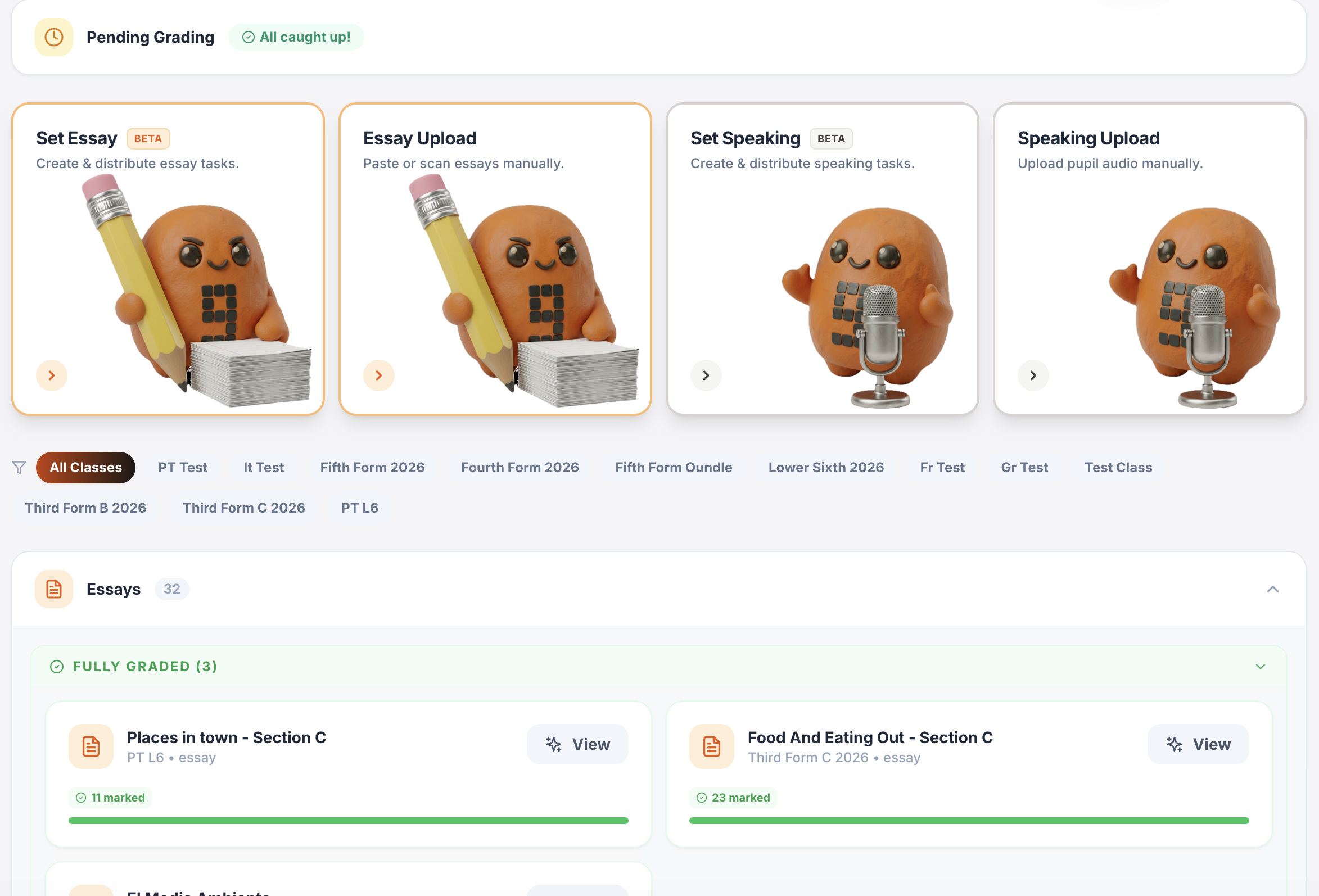
One platform for teaching, practice, feedback and progress.
Plan lessons, set homework, run live activities, generate printables, give AI-supported grading and track progress across Spanish, French, German, Portuguese and Italian.
Writing & speaking grading
Set writing and speaking tasks, collect submissions, generate detailed feedback and keep teacher review in the loop.
Explore this guide →Gradebook & reports
Track scores, completion, engagement and learning evidence across classes.
Explore this guide →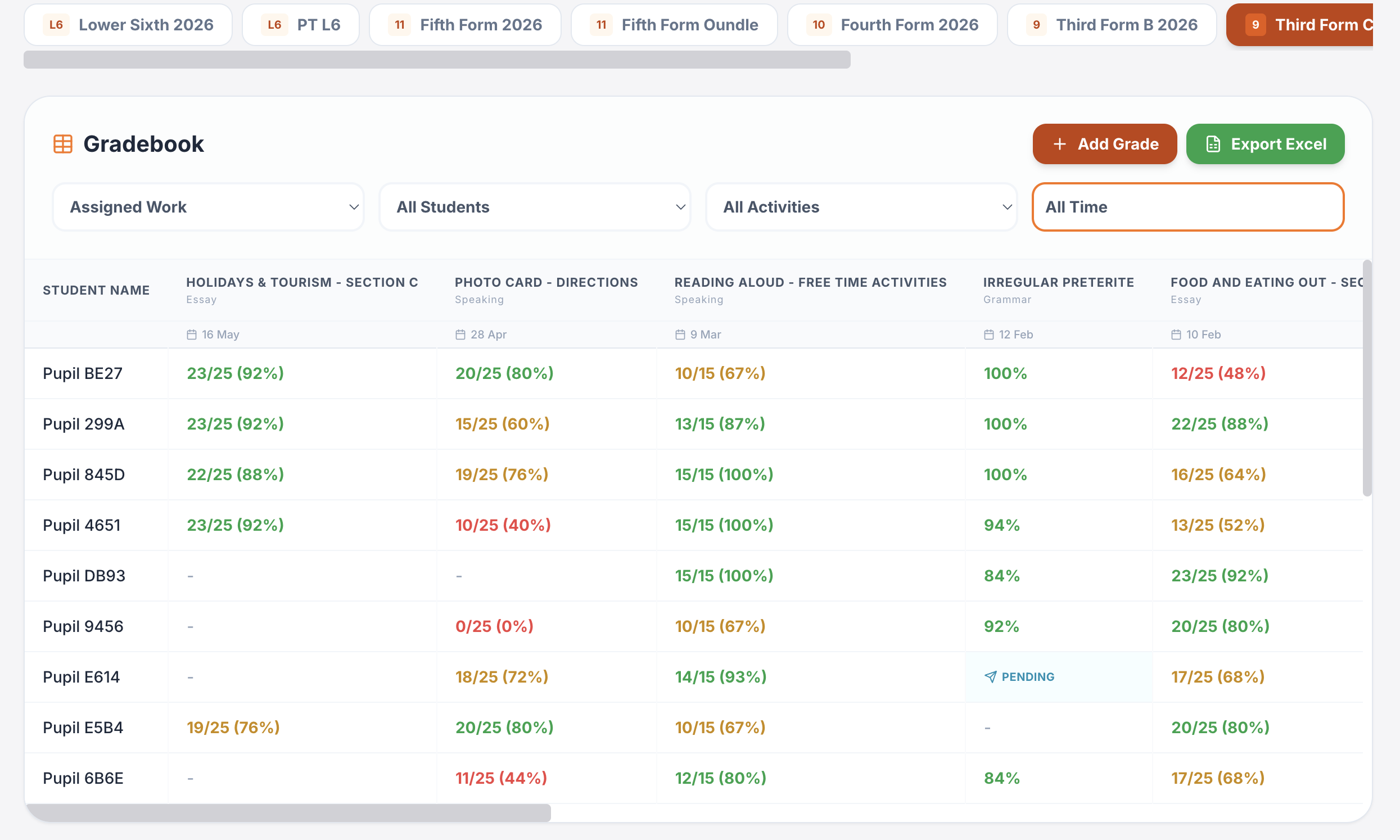
Interactive lessons
Generate, edit, save and reuse complete lesson presentations.
Explore this guide →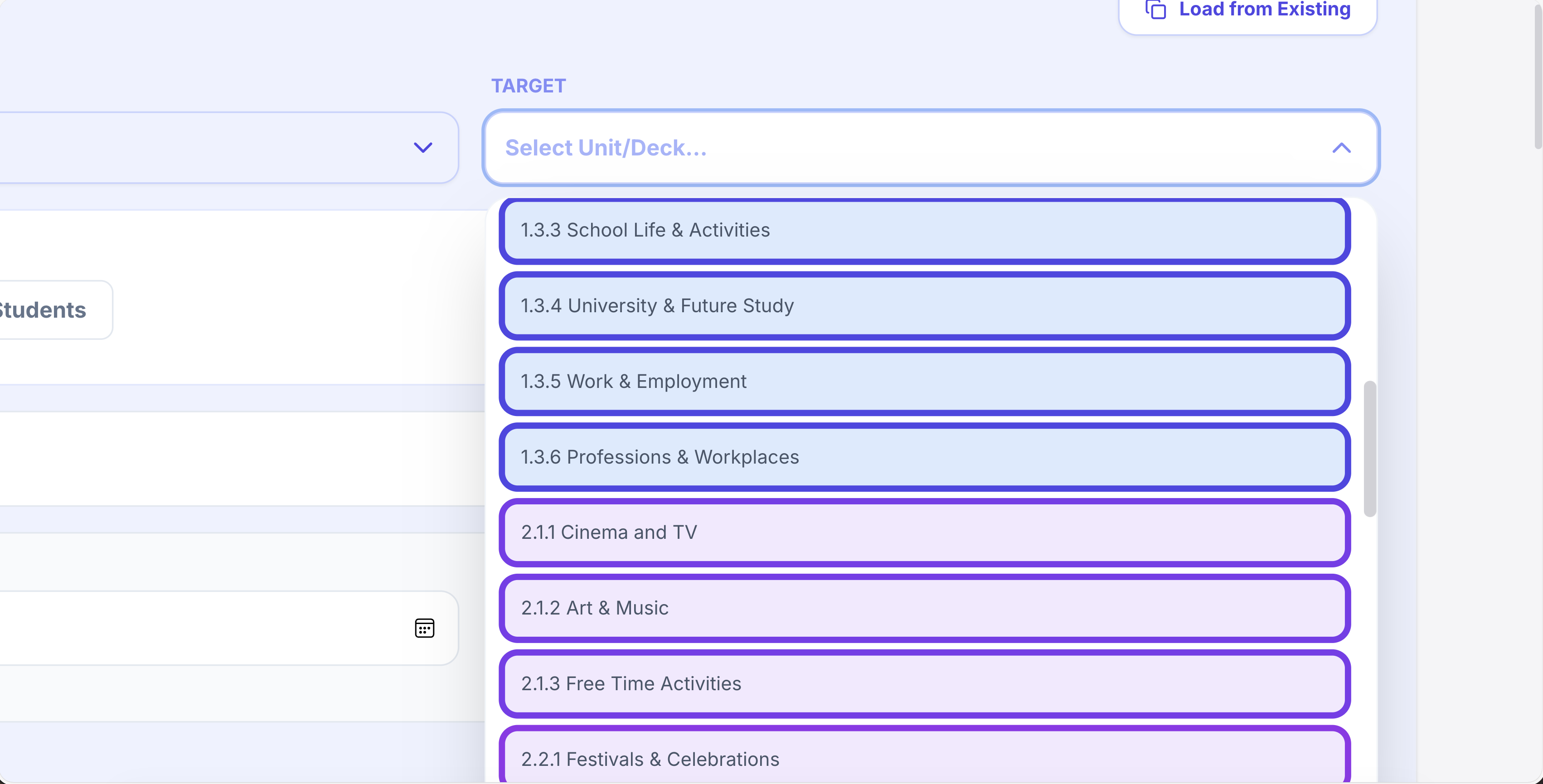
Printables in seconds
Vocabulary, grammar, translation, reading, listening, worksheets and booklets.
Explore this guide →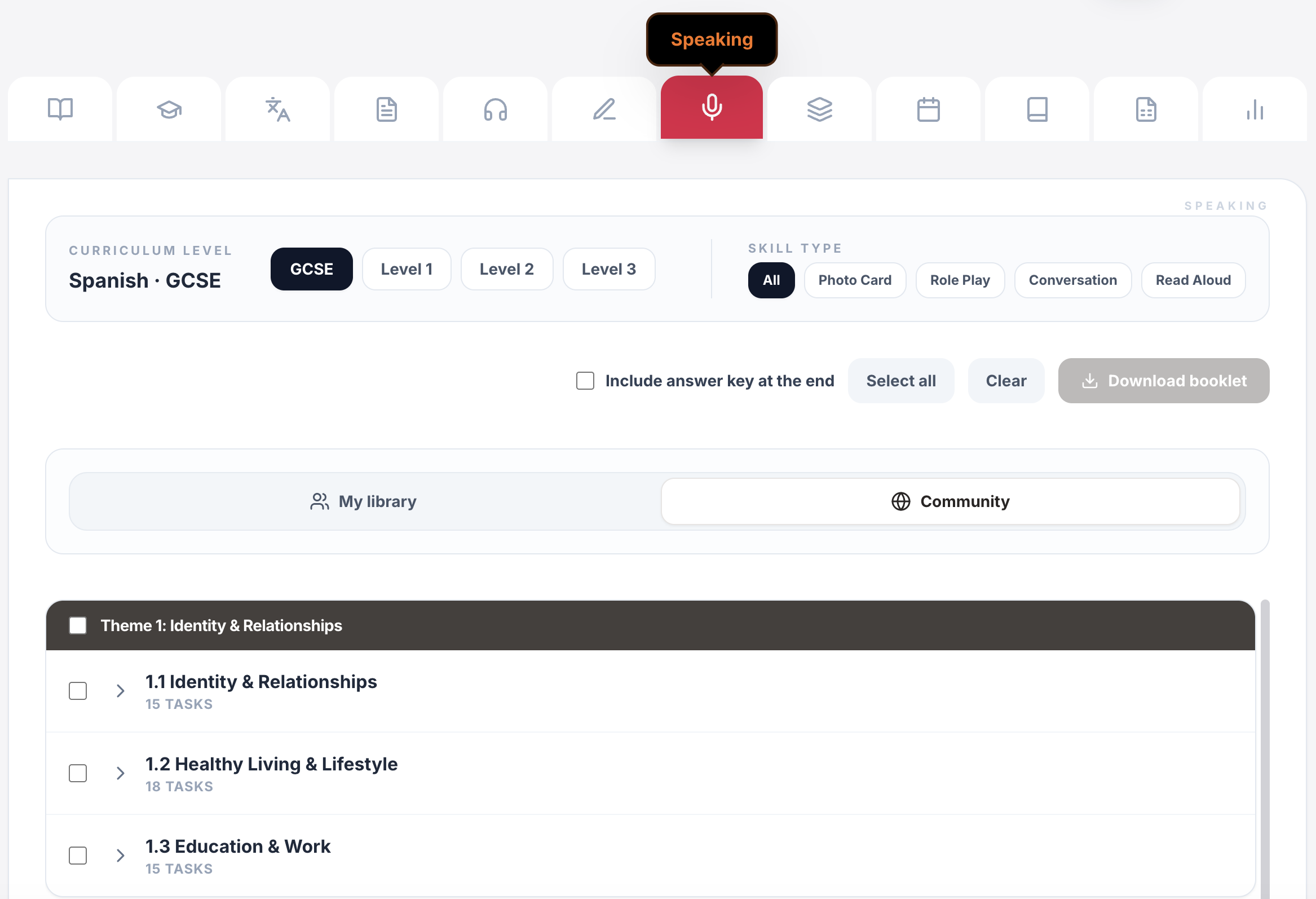
Live games & whiteboards
Turn curriculum content into whole-class competition, retrieval and live response.
Explore this guide →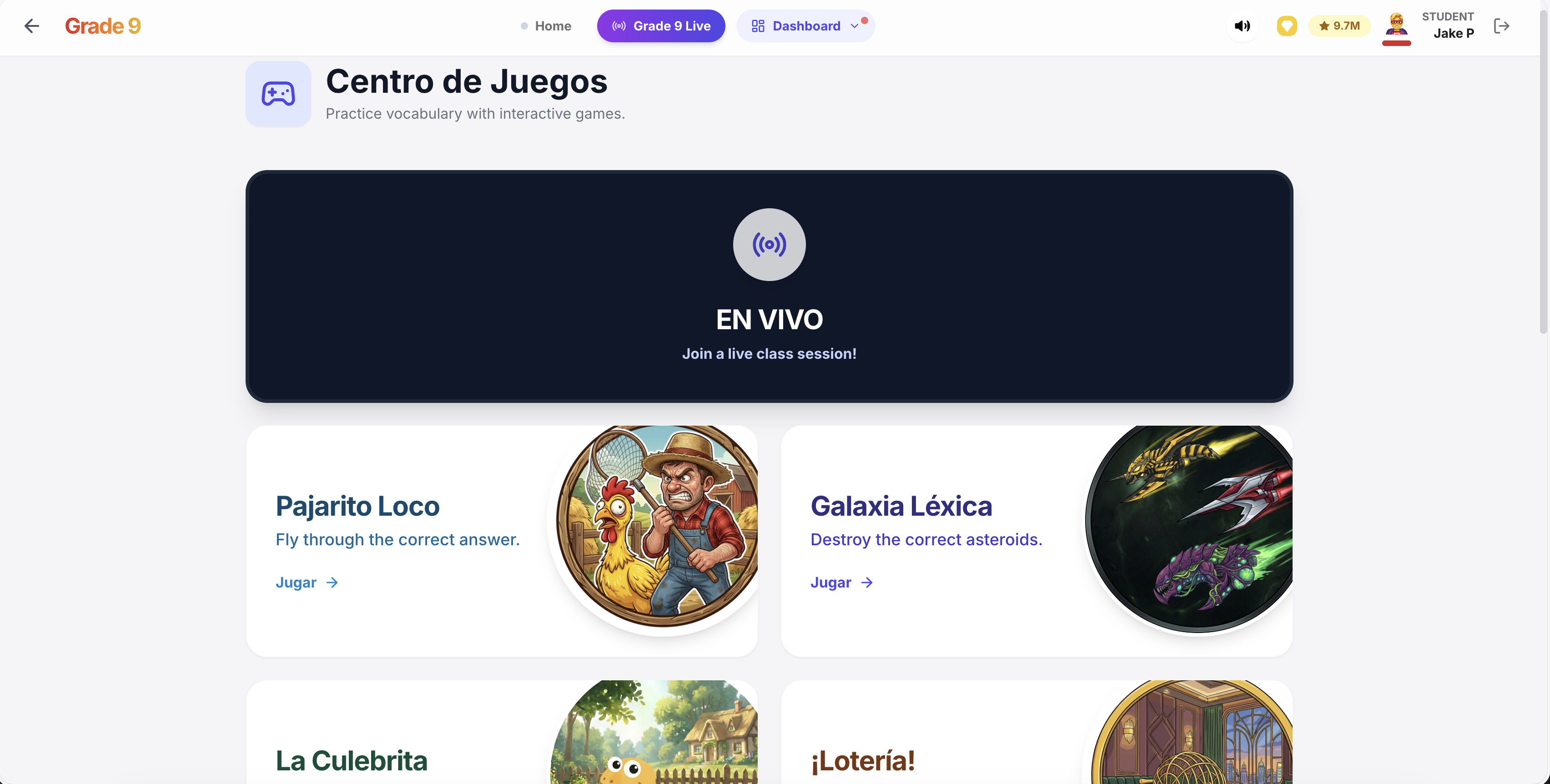
Assignments & tracking
Set work for a whole class or selected students, schedule it and see who has started or finished.
Explore this guide →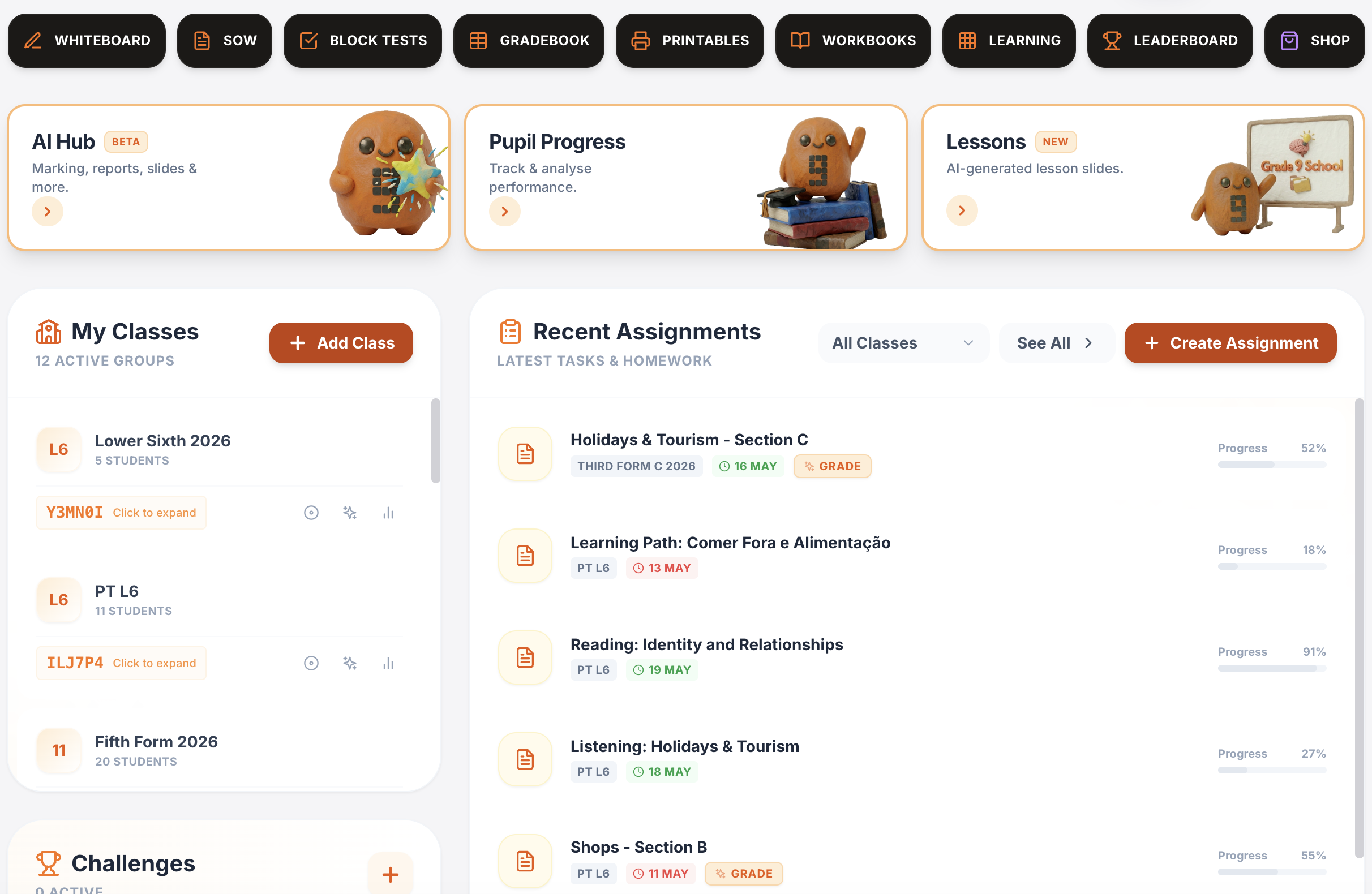
Vocabulary, grammar, translation & independent practice
Structured learning paths, flashcards, vocabulary builders, grammar, verb work, translation and tracked independent learning across supported languages.
Explore this guide →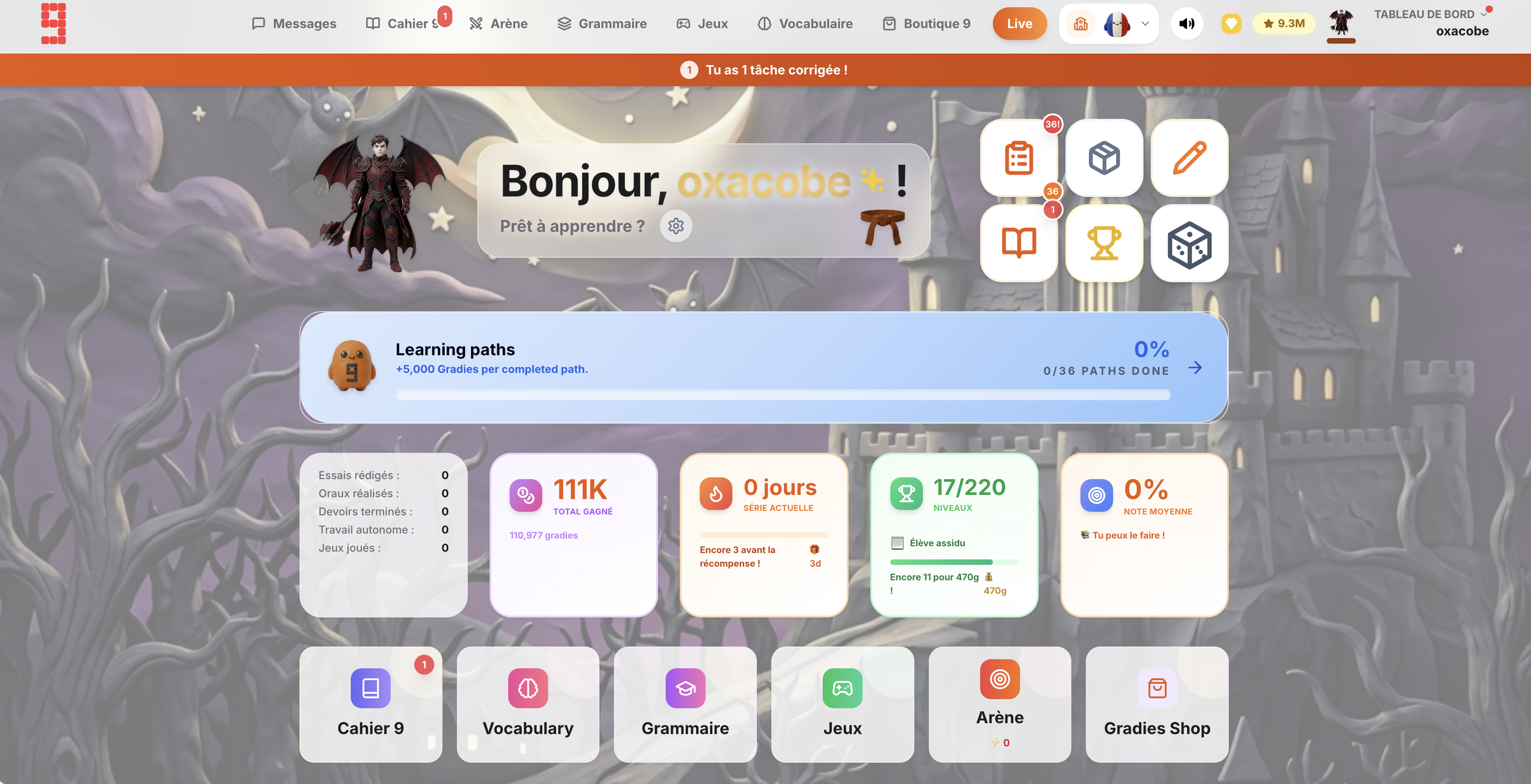
Spanish · French · German · Portuguese · Italian
Use the same platform architecture across the languages your department teaches, while keeping each class in its own language and curriculum context.
Explore language workflows →
From planning to progress, it all connects.
Curriculum management, assignments, AI feedback, printables, gradebook and lesson planning all sit inside the same Grade 9 environment.
Find the detail you need.
Open any section for the key facts, practical detail, examples and sources.
01What teacher-controlled AI should mean in practice⌄
Teacher control is operational when the teacher retains consequential decisions.
For resource generation:
- the teacher chooses the learning goal and context;
- AI produces a draft;
- the teacher reviews and edits it;
- the teacher decides whether students ever see it.
For feedback:
- the student submits real work;
- AI may analyze that work;
- the teacher sees the proposed result;
- the teacher can change or reject it;
- the teacher decides when feedback is published.
For lesson planning:
- the teacher sets the intended outcome;
- AI can help draft activities;
- the teacher checks language, level, sequence and appropriateness.
If the system bypasses those decision points, teacher controlled is only a marketing phrase.
02Keep the learning problem visible⌄
The U.S. Department of Education’s August 2026 guidance on responsible education technology encourages states and local communities to focus on instructional value, educator judgment, transparency and student outcomes. [S1]
That is a useful starting point for AI too.
Before using AI, define the problem.
Useful problem:
I need three differentiated versions of this short reading task so students can practice the same interpretive goal.
Weak problem:
I want AI somewhere in this lesson.
Useful problem:
I have 28 recorded speaking submissions and need a first-pass way to organize possible feedback before I review them.
Weak problem:
I want the machine to grade speaking for me.
AI is easier to justify when it is attached to a clear teacher workflow.
03Good uses of AI for a World Languages teacher⌄
AI can help draft:
- short readings;
- listening scripts;
- question sets;
- sentence examples;
- role-play prompts;
- writing prompts;
- practice variations.
It can also help organize patterns in submitted work or create a first draft of feedback.
The teacher should still check linguistic accuracy, register, cultural appropriateness, level and whether the generated material actually supports the intended outcome.
04Uses that need much more caution⌄
Unreviewed student-facing feedback
Fluent wording can hide a wrong correction.
High-stakes grading
A model-generated number is not automatically valid because it is precise.
Open-ended student chatbot use
Direct student AI changes the supervision, privacy, prompt and academic-integrity questions. It should not be treated as equivalent to a teacher using AI privately to draft a resource.
Sensitive student information
Before sending student work to an AI service, schools need to understand the data flow, provider terms, retention, account model and local policy.
Replacing productive struggle
Students need to retrieve, compose, interpret and negotiate meaning themselves. If AI performs the core language work, the activity may become easier while the learning disappears.
05A teacher-control checklist⌄
Before adopting an AI workflow, ask:
- Who starts the AI action?
- What information is sent?
- Can the teacher see the original student evidence?
- Can the teacher edit or reject the output?
- Does anything publish to students automatically?
- Can students access an open-ended chatbot?
- What happens if the AI is wrong?
- What data is stored, by whom and for how long?
- Can the task still work if AI is unavailable?
- Is the AI reducing clerical drafting or replacing the learning itself?
A school does not need a marketing slogan. It needs clear answers to those questions.
06What teacher control looks like in feedback⌄
A defensible flow is:
Student work
→ AI draft
→ teacher review
→ teacher edit or override
→ teacher publication
→ student revision
That keeps the professional decision point with the teacher.
The dedicated World language writing feedback guide owns the detailed writing workflow, including the feedback-to-revision loop.
07What teacher control looks like in lesson planning⌄
Planning is lower stakes than grading, but generated material can still be unnatural, too advanced, culturally odd, repetitive, factually wrong or badly sequenced.
Use AI to get a draft faster. Do not let generated become a synonym for ready.
The detailed backward-design and daily-sequencing method belongs on World language lesson planning.
08Keep local policy and provider questions separate from pedagogy⌄
A classroom workflow can be educationally sensible and still require a separate school decision about data, accounts or provider terms.
Before adoption, schools should know:
- what student or teacher data is sent;
- which provider processes it;
- what the provider retains;
- whether accounts are required;
- whether students interact directly with AI;
- what local district or school policy permits;
- how the teacher can avoid sending unnecessary information.
Teacher control is one safeguard. It is not by itself a FERPA, COPPA or privacy-compliance guarantee.
09What should not be delegated⌄
AI should not be allowed to decide, without meaningful teacher review:
- a consequential student grade;
- whether a student has met a high-stakes standard;
- whether generated cultural content is appropriate;
- whether a correction changes the student’s intended meaning;
- whether a student’s work justifies a particular proficiency label;
- what student-facing feedback is finally published.
The teacher remains responsible for those judgments.
10How Grade 9 School applies teacher control⌄
The current Grade 9 handbook documents two main patterns.
Resource creation
Teachers can generate materials such as lesson presentations, reading or listening content and task prompts. Generated outputs are reviewable and editable. Structural validation cannot prove every language example is pedagogically ideal.
Student feedback
For writing and speaking, AI feedback is stored as a teacher-side draft before publication. The teacher can review the original student work, edit proposed marks or comments, regenerate only when useful, and publish with Approve & Send when they accept the result.
Students do not receive open-ended direct access to generative AI through this documented feedback workflow.
That does not make every AI use automatically safe, accurate or compliant. Schools still need to evaluate data handling, provider terms and local policy.
11What Grade 9 does not claim⌄
This page does not imply that:
- AI feedback is an official ACTFL proficiency rating;
- AI replaces teacher grading judgment;
- generated language is error-free;
- teacher control alone creates FERPA or COPPA compliance;
- federal agencies certify or approve Grade 9 School;
- AI processing never involves third-party infrastructure;
- every account has every AI feature.
12When not to use AI⌄
Skip AI when:
- a strong saved resource already exists;
- the teacher can make the needed edit faster than regenerating;
- students need to do the thinking themselves;
- the school has not approved the relevant data flow;
- the teacher cannot review the output responsibly;
- the task is too consequential to rely on an unvalidated automated judgment.
The best AI workflow is sometimes no AI workflow.