 School




World Language Listening Practice Beyond “Play It Twice”
Plan world language listening practice that develops interpretation, not guessing. Use purposeful re-listening, dictation and follow-up tasks in class.
Grade 9 School brings curriculum, lesson planning, practice, homework, feedback, live activities, printables and progress tracking into one connected teaching workflow.
 Spanish
 French
 German
 Portuguese
 Italian
Practice, feedback and progress in one place.

Listening becomes frustrating when the only strategy students learn is: listen harder.
A recording plays. Students miss the first sentence, panic, and spend the rest of the audio trying to recover. The teacher plays it again. Students who understood it the first time are bored; students who did not understand it are often just repeating the same failure.
Good listening practice gives each listen a job.
ACTFL places listening within Interpretive Communication: students understand, interpret and analyze what they hear, read or view. That is a useful reminder that listening is not word-by-word transcription. The aim is to build meaning from evidence.
Explore the topic ↓
One platform for teaching, practice, feedback and progress.
Plan lessons, set homework, run live activities, generate printables, give AI-supported grading and track progress across Spanish, French, German, Portuguese and Italian.
Writing & speaking grading
Set writing and speaking tasks, collect submissions, generate detailed feedback and keep teacher review in the loop.
Explore this guide →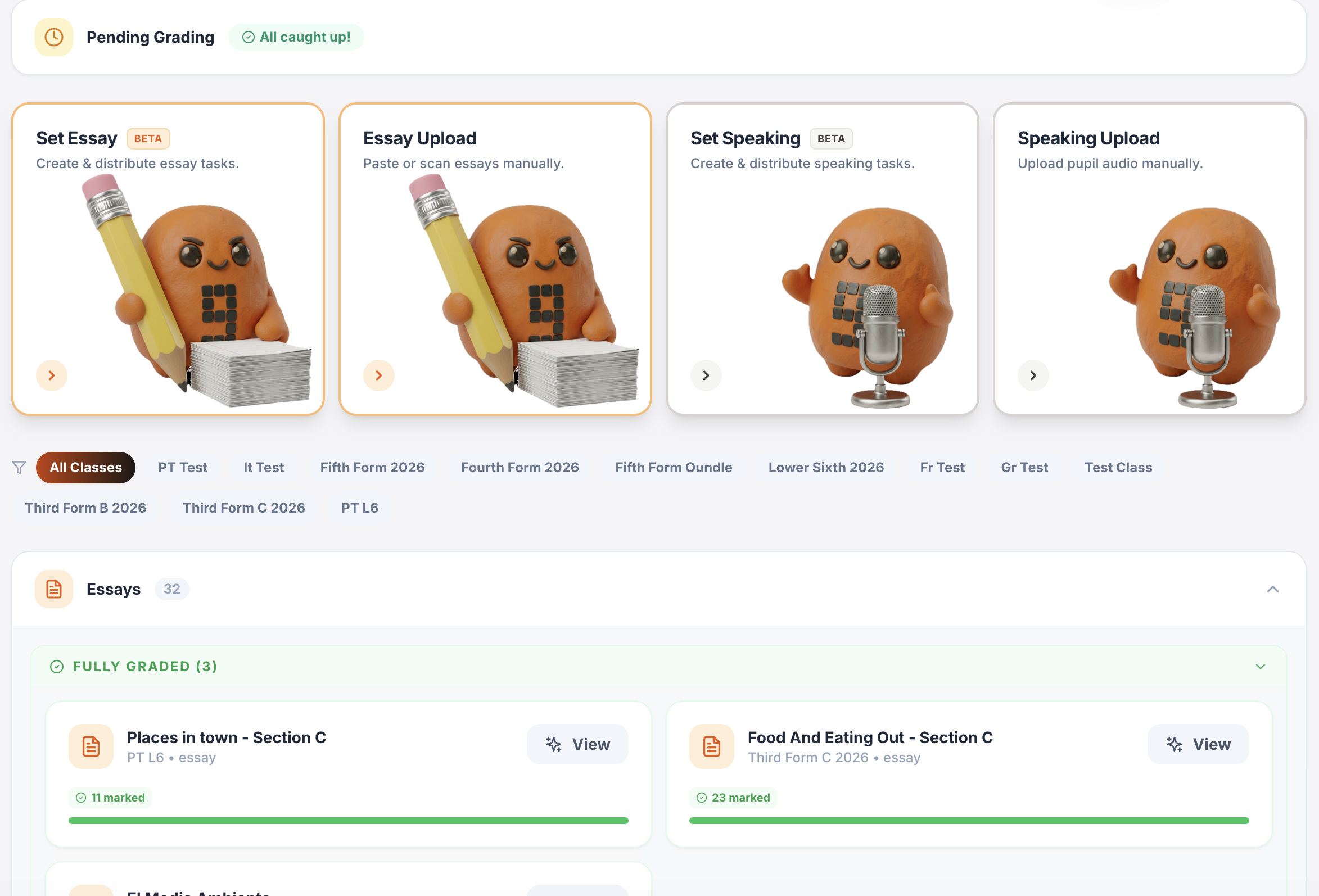
Gradebook & reports
Track scores, completion, engagement and learning evidence across classes.
Explore this guide →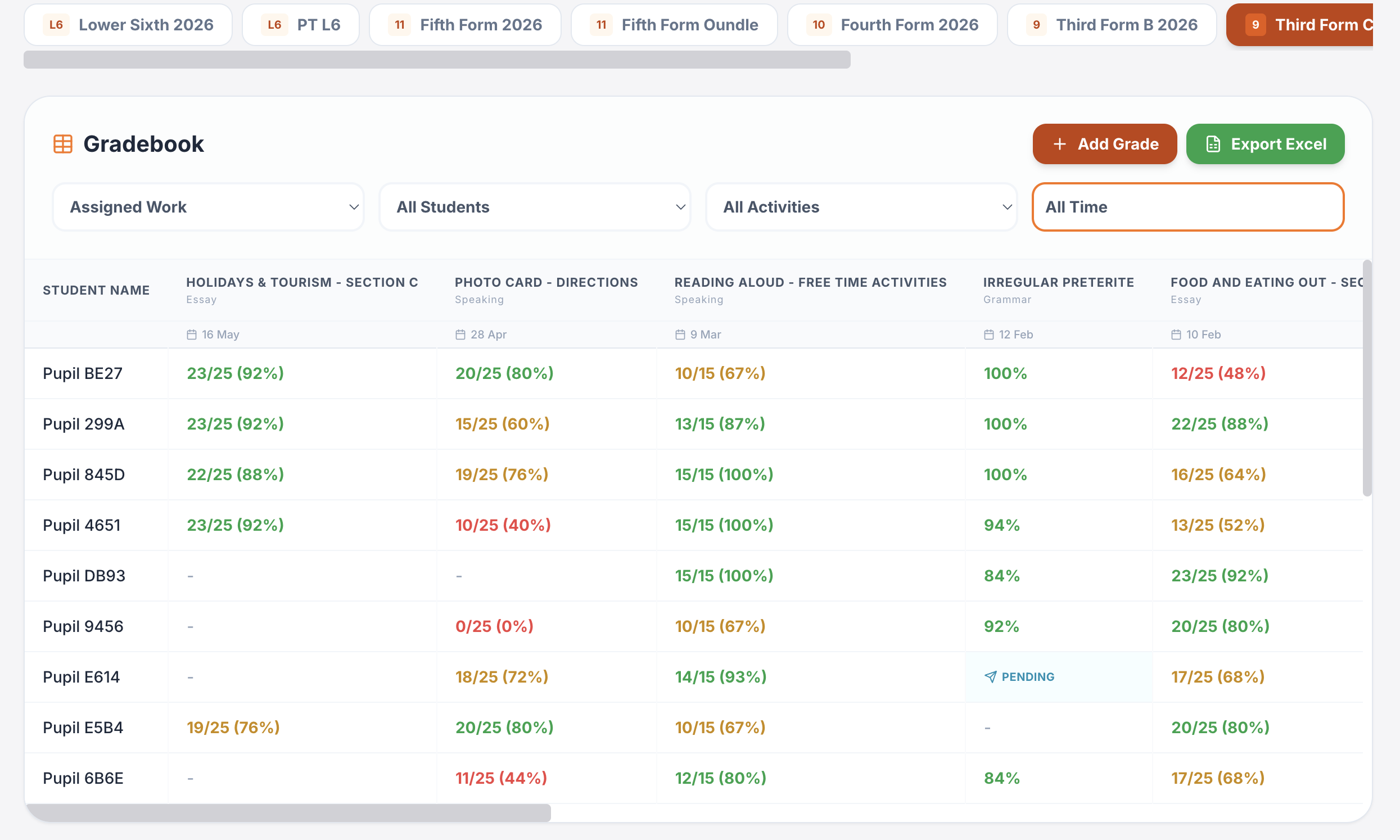
Interactive lessons
Generate, edit, save and reuse complete lesson presentations.
Explore this guide →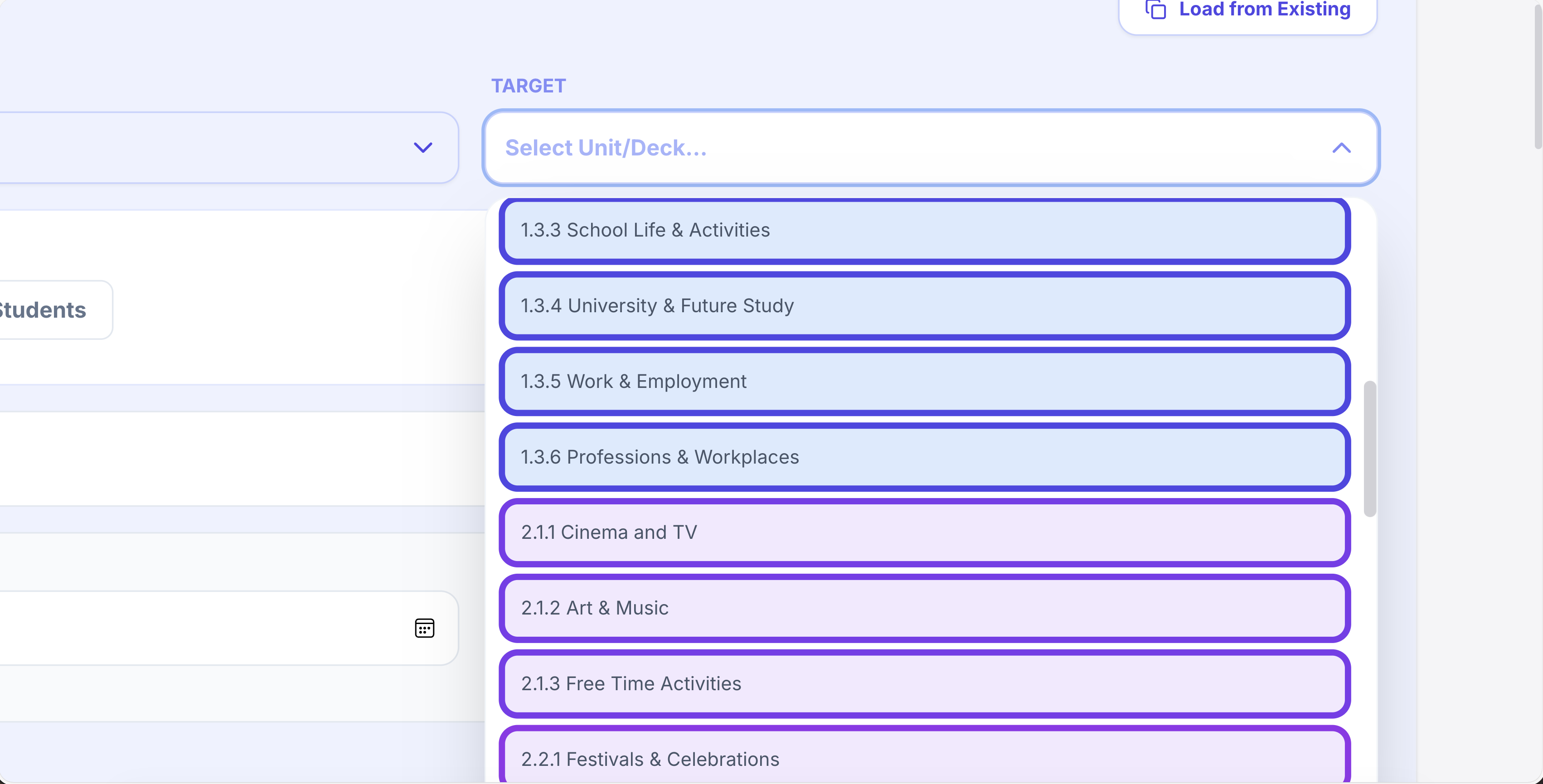
Printables in seconds
Vocabulary, grammar, translation, reading, listening, worksheets and booklets.
Explore this guide →Live games & whiteboards
Turn curriculum content into whole-class competition, retrieval and live response.
Explore this guide →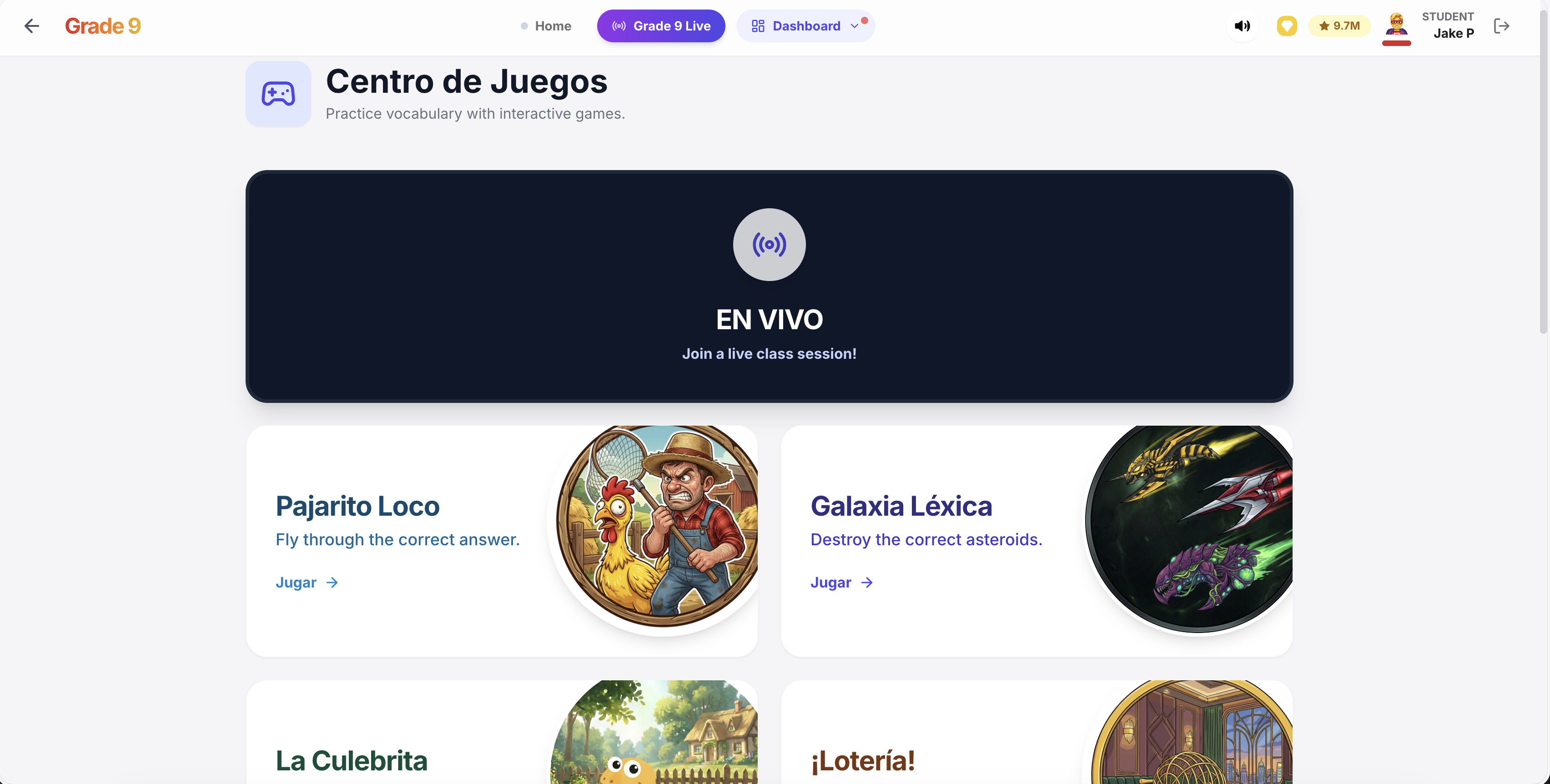
Assignments & tracking
Set work for a whole class or selected students, schedule it and see who has started or finished.
Explore this guide →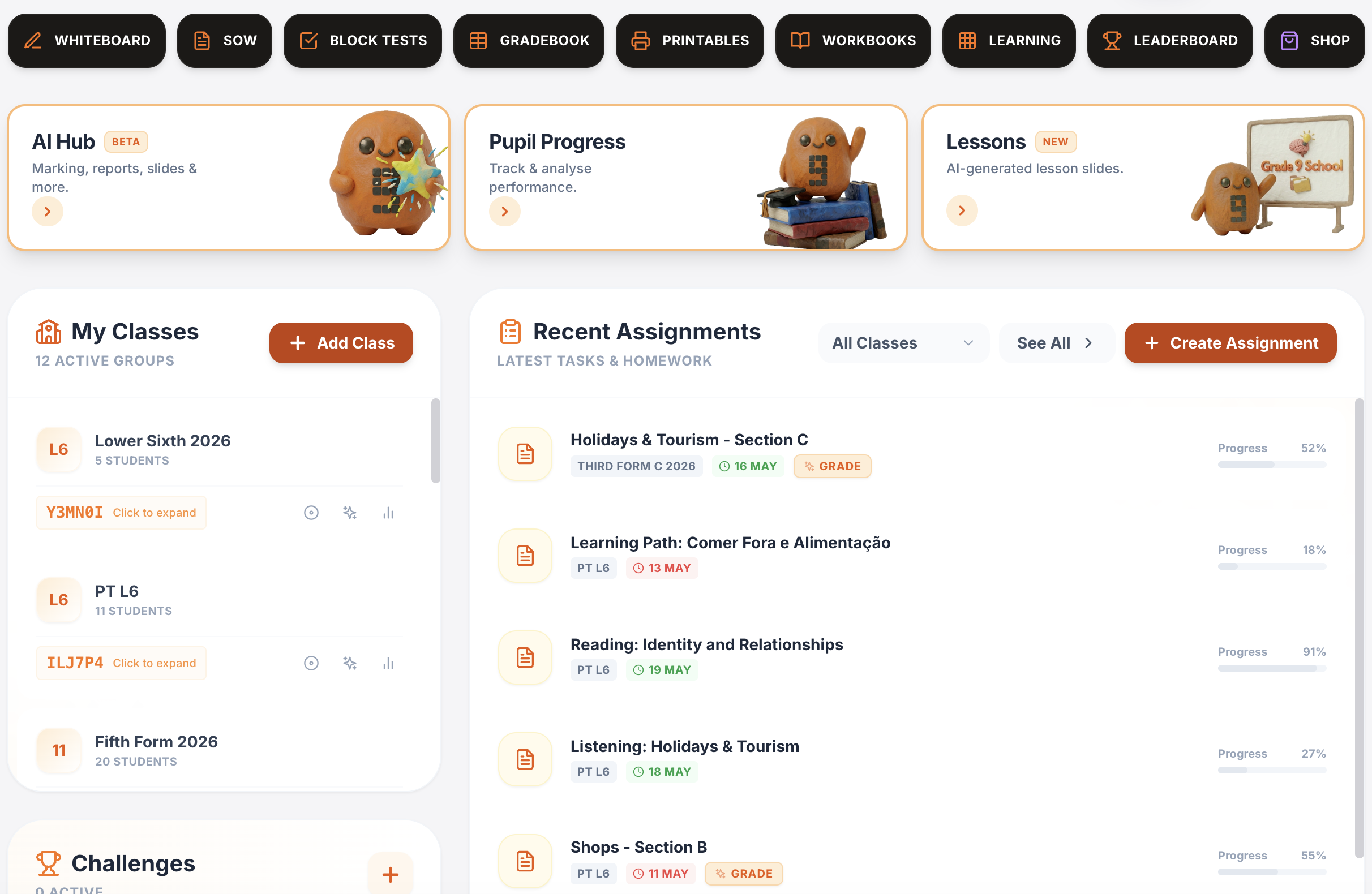
Vocabulary, grammar, translation & independent practice
Structured learning paths, flashcards, vocabulary builders, grammar, verb work, translation and tracked independent learning across supported languages.
Explore this guide →
Spanish · French · German · Portuguese · Italian
Use the same platform architecture across the languages your department teaches, while keeping each class in its own language and curriculum context.
Explore language workflows →
From planning to progress, it all connects.
Curriculum management, assignments, AI feedback, printables, gradebook and lesson planning all sit inside the same Grade 9 environment.
Find the detail you need.
Open any section for the key facts, practical detail, examples and sources.
01Decide what students are listening for⌄
Before pressing play, decide what success should look like.
Possible listening goals include:
- identify the situation and speakers;
- understand the main idea;
- pick out two key details;
- follow the order of events;
- identify an opinion and its reason;
- distinguish two similar options;
- notice a target structure in context;
- reconstruct a short phrase accurately.
One audio clip can support several of these goals, but students should not be asked to do all of them at once.
02A three-pass listening routine⌄
A simple three-pass structure works across many course levels.
Pass 1: build the situation
Question:
What is happening?
Students might identify:
- who is speaking;
- where they are;
- the broad topic;
- the speaker’s purpose or attitude.
Do not ask for ten details on the first listen. Give students a way into the text.
Pass 2: collect evidence
Now ask for specific information.
For example:
- Which two activities are mentioned?
- What time does the train leave?
- Why does the speaker reject the first option?
- Which statement is true?
Students are now listening with a map.
Pass 3: notice language
The final listen can zoom in.
Ask students to:
- complete a short phrase;
- identify a verb form;
- correct a near-miss transcript;
- order four chunks;
- write one exact sentence as dictation.
This is where careful listening to sound-form relationships becomes useful.
03Do not turn pre-listening into pre-answering⌄
Pre-listening should reduce unnecessary difficulty, not reveal the whole text.
Useful preparation might be:
- showing one image that establishes context;
- activating two or three essential words;
- asking students to predict likely content;
- reminding them of a listening strategy.
Less useful preparation is translating every difficult word in advance. That can turn the listening into matching a script students already know.
04Use transcripts carefully⌄
A transcript is powerful after students have listened.
It is much less useful when it becomes the first place their eyes go.
A productive sequence is:
- Listen without the transcript.
- Compare what students understood.
- Listen again for evidence.
- Reveal only the relevant section of transcript.
- Ask students to locate why they missed a phrase.
- Listen once more with the sound-text connection now visible.
Students begin to diagnose their listening rather than simply check answers.
05Dictation is narrow — and that is why it can help⌄
Dictation should not replace interpretive listening, but it can sharpen attention to short stretches of language.
Keep the unit of dictation short enough that the task is about decoding, not working-memory endurance.
Useful dictation variations include:
- one sentence from a longer audio;
- gap dictation around a target structure;
- compare two near-identical phrases;
- student checks against the transcript and marks where sound misled them;
- repair dictation: students hear a sentence, compare it with an inaccurate written version and fix it.
The teacher can then ask the more important question: what made that phrase difficult to hear?
06Listening difficulty has more than one cause⌄
When students fail a listening question, do not assume they “do not know the vocabulary.”
The problem may be:
- they did not know the word;
- they knew it on paper but did not recognize it in speech;
- they lost the thread after one unknown word;
- the sentence was too long to hold in memory;
- the speaker’s speed or audio quality was difficult;
- they misunderstood the task;
- they selected an answer based on one familiar keyword.
Those need different teaching responses.
07Build listening from controlled to less controlled input⌄
Teachers need both.
Controlled input can be useful for:
- a newly taught structure;
- a narrow vocabulary set;
- dictation;
- confidence-building;
- a precise comprehension goal.
Authentic or naturally occurring input can be useful for:
- dealing with real voices;
- varied accents and pacing;
- cultural content;
- inference;
- handling unknown language.
ACTFL’s guiding principles encourage the use of authentic cultural texts with appropriate scaffolding. That does not mean every beginner task must start with a difficult unedited broadcast. It means students should encounter language as communication, with the support needed to interpret it.
08A classroom example: Spanish 1, after-school plans⌄
Audio:
A short exchange between two students deciding what to do after school.
Pass 1:
Students choose the correct setting and identify whether the speakers agree immediately.
Pass 2:
Students identify the two activities discussed and the reason one option is rejected.
Pass 3:
Students complete one short line containing ir + a + infinitive.
Follow-up:
Pairs use the same decision pattern to make their own after-school plan.
The listening now feeds speaking. It is not an isolated worksheet.
09Make the post-listening task earn its place⌄
After comprehension, ask students to do something with the meaning.
For example:
- respond to the message;
- compare it with their own routine;
- choose between the options mentioned;
- retell the sequence;
- write the missing final line;
- act out a similar exchange;
- create one question another student should be able to answer from the audio.
That keeps listening connected to communication.
10Common listening-practice mistakes⌄
Asking every question on the first listen
Students need different listening purposes at different stages.
Replaying without changing the task
A second listen should have a new focus.
Showing the transcript too early
Students read instead of listening.
Treating synthetic audio as authentic speech
Teacher-created or generated audio can be useful for controlled practice. It should complement, not erase, exposure to varied real-world voices.
Making the audio harder than the objective
If the learning goal is one new structure, a needlessly dense recording can bury the target.
11How Grade 9 School can support this workflow⌄
In the documented Grade 9 listening workflow, script, activities and audio are separate stages. That separation is useful pedagogically: a teacher can review and edit the script before generating the final audio rather than discovering a wording problem after synthesis.
Grade 9 supports worksheet-style listening and dictation workflows. Saved listening resources can be reused with another class without regenerating the core material. The teacher can also use their own text or edit generated content before delivery.
Generated listening material still needs teacher review. Voice choice, audio quality, language variety and course context matter.