 School





World Language Vocabulary Practice Beyond Memorizing a List
Move world language vocabulary from recognition to retrieval and sentence-level use with practical classroom routines, flashcards and follow-up tasks.
Grade 9 School brings curriculum, lesson planning, practice, homework, feedback, live activities, printables and progress tracking into one connected teaching workflow.
 Spanish
 French
 German
 Portuguese
 Italian
Practice, feedback and progress in one place.

Students can score 20/20 on a matching quiz and still freeze when they need the word in a sentence.
That is not surprising. Recognition, recall and communicative use are different demands.
Vocabulary practice works better when students move through those demands deliberately rather than repeating one favorite activity until the list feels familiar.
Explore the topic ↓
One platform for teaching, practice, feedback and progress.
Plan lessons, set homework, run live activities, generate printables, give AI-supported grading and track progress across Spanish, French, German, Portuguese and Italian.
Writing & speaking grading
Set writing and speaking tasks, collect submissions, generate detailed feedback and keep teacher review in the loop.
Explore this guide →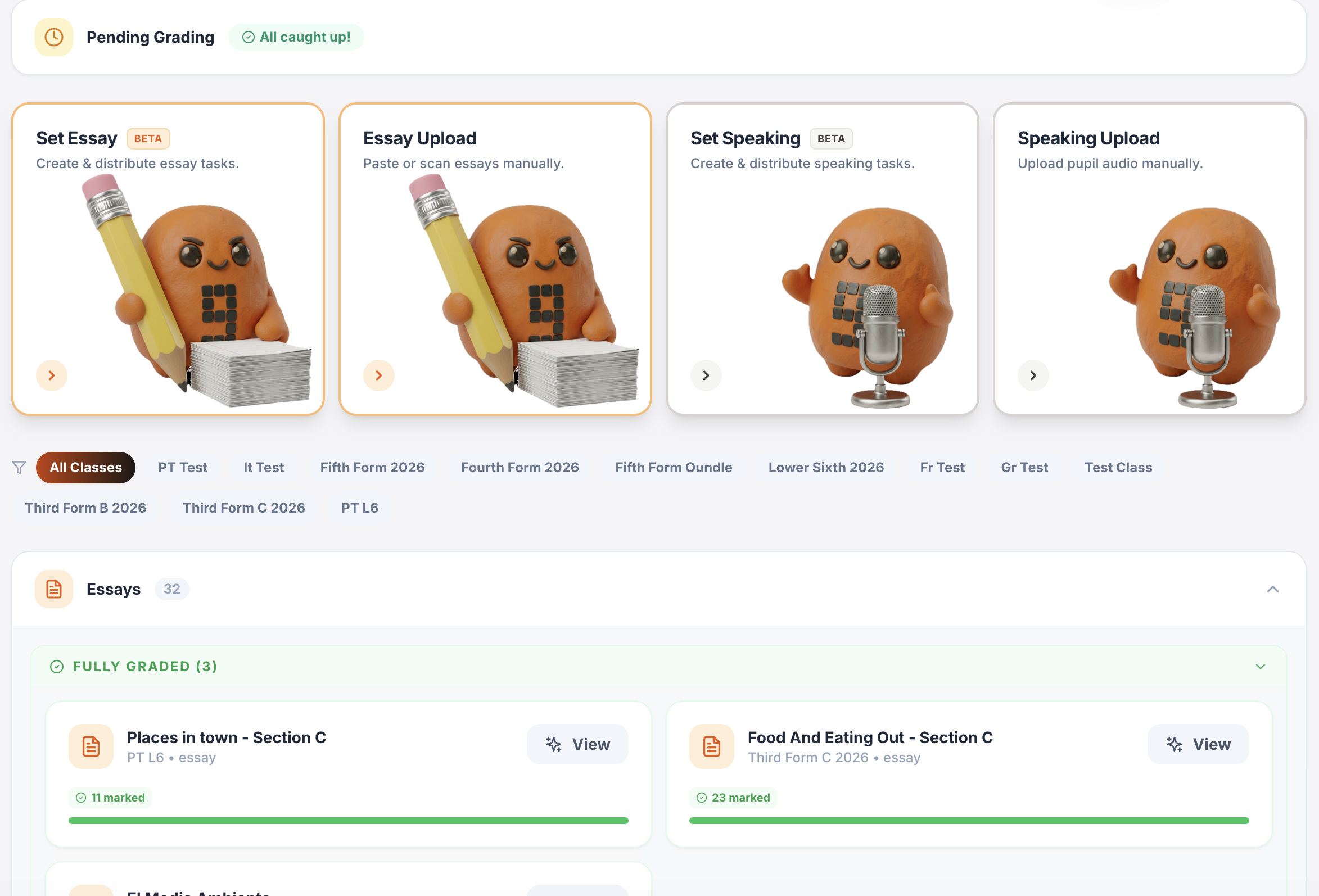
Gradebook & reports
Track scores, completion, engagement and learning evidence across classes.
Explore this guide →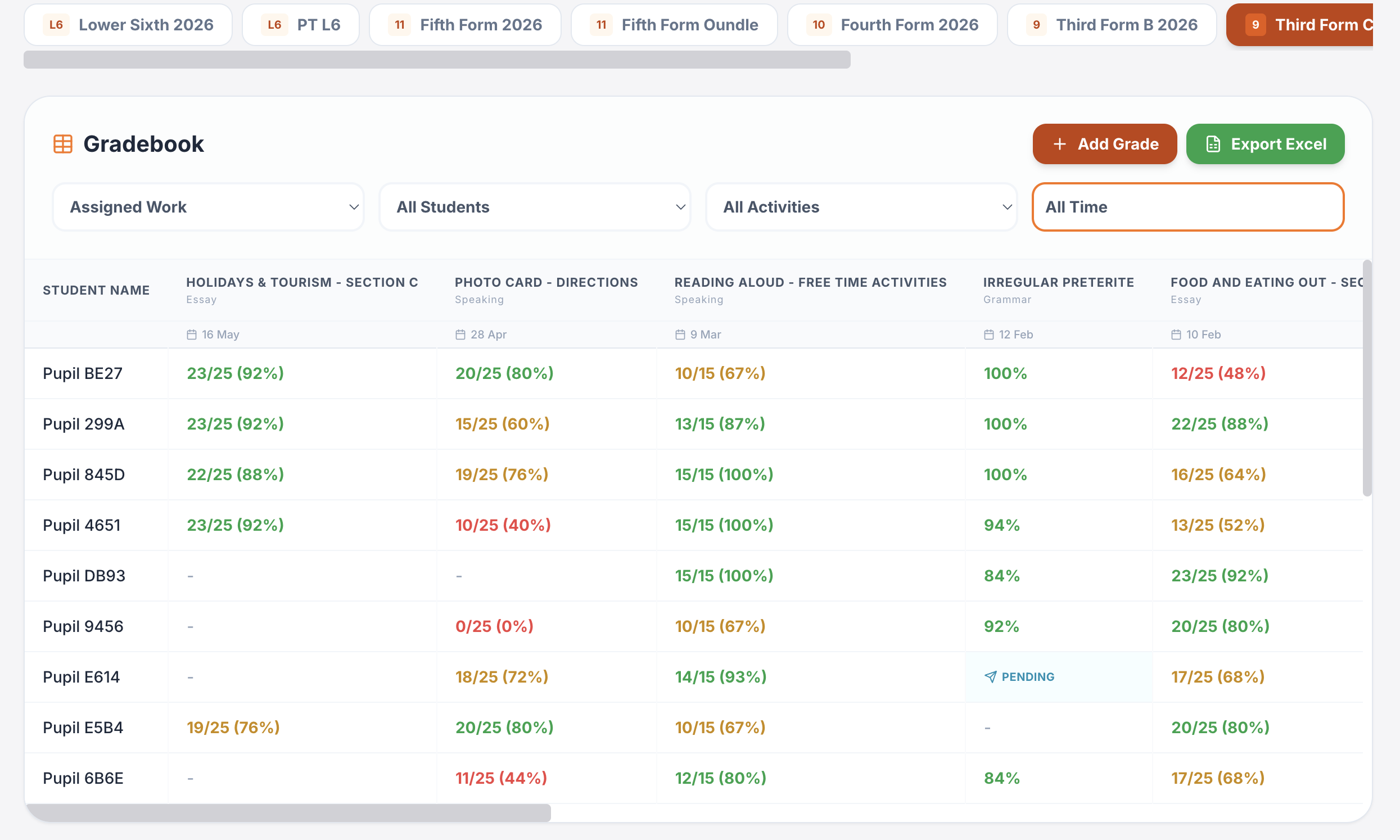
Interactive lessons
Generate, edit, save and reuse complete lesson presentations.
Explore this guide →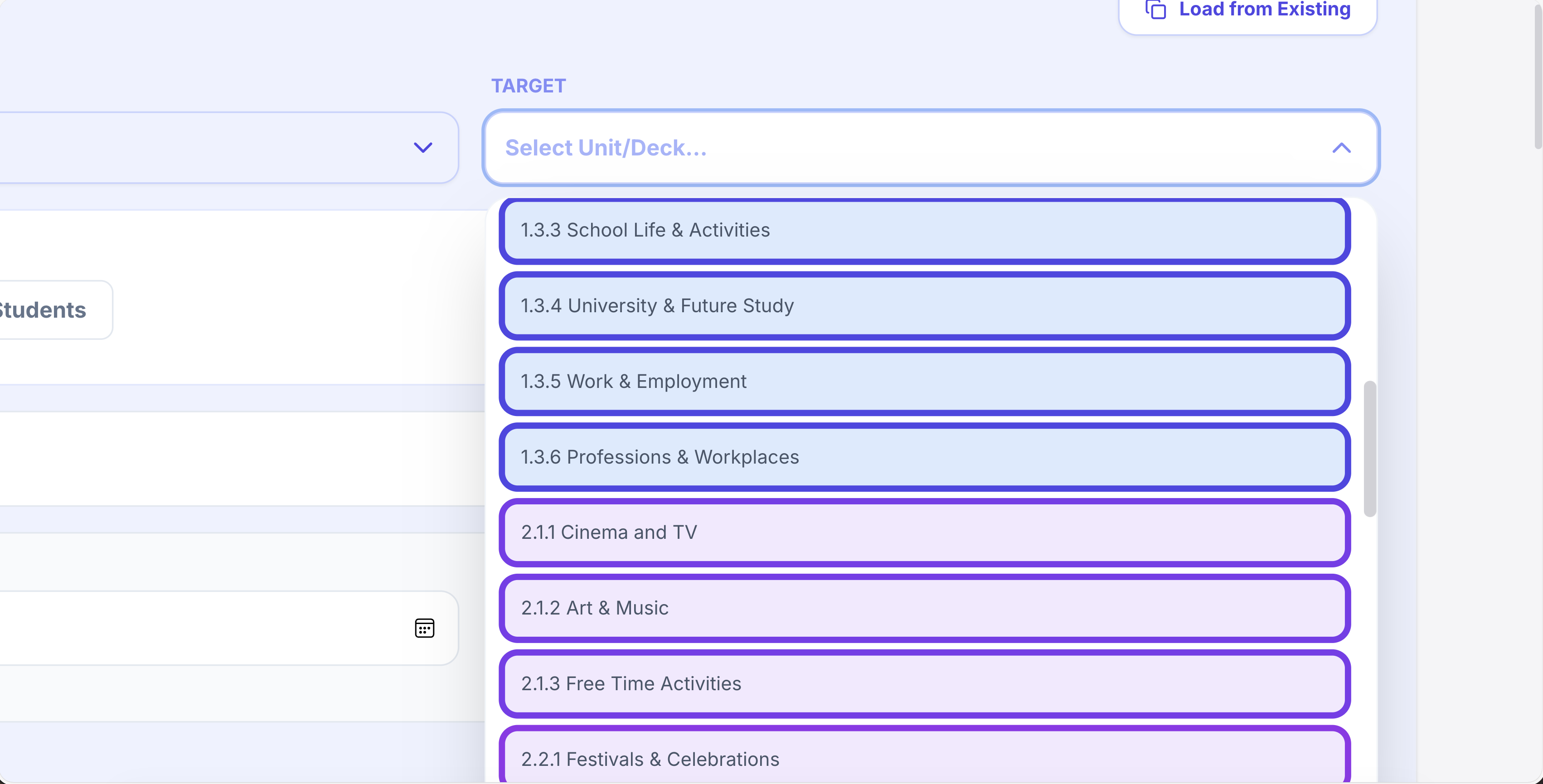
Printables in seconds
Vocabulary, grammar, translation, reading, listening, worksheets and booklets.
Explore this guide →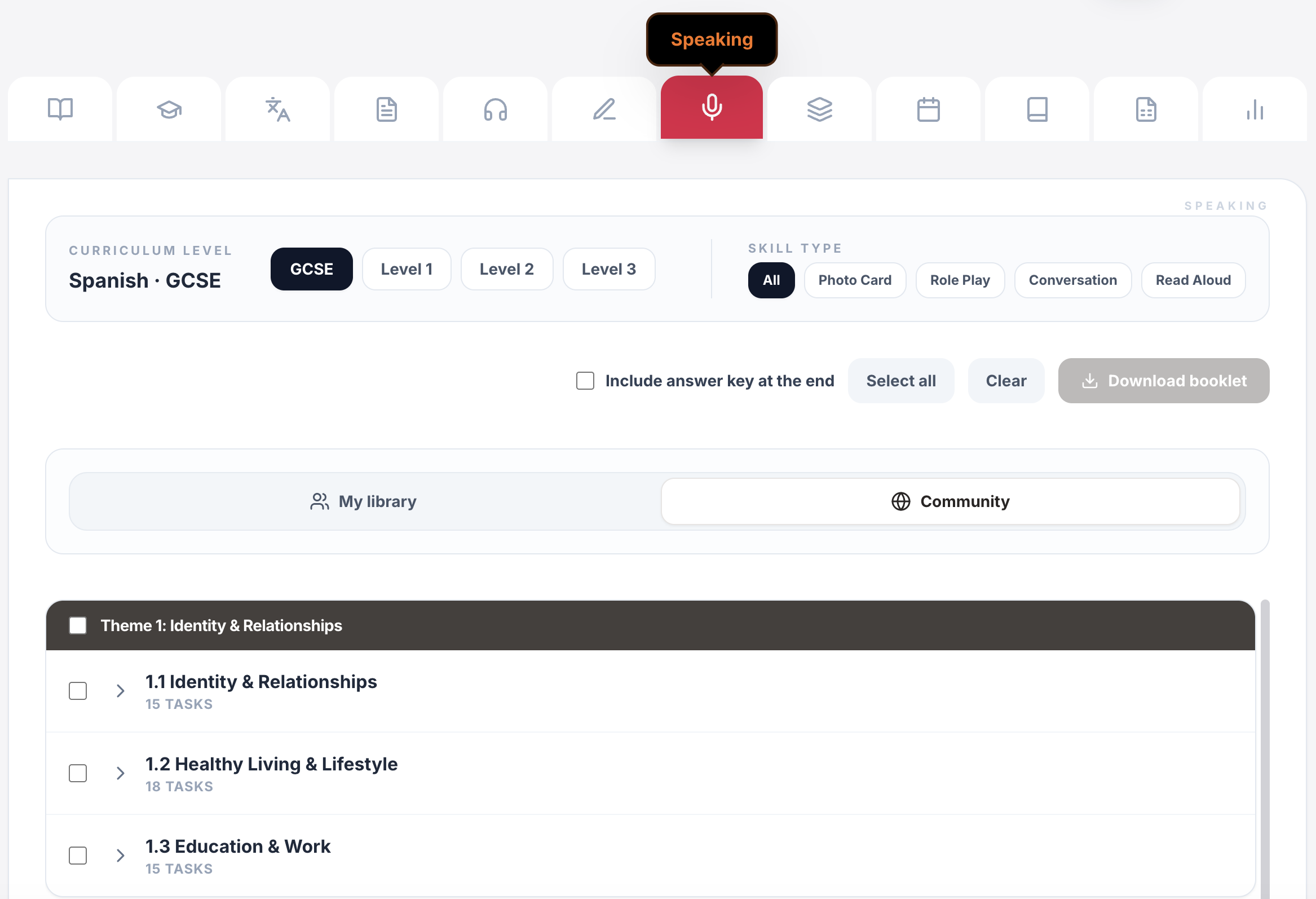
Live games & whiteboards
Turn curriculum content into whole-class competition, retrieval and live response.
Explore this guide →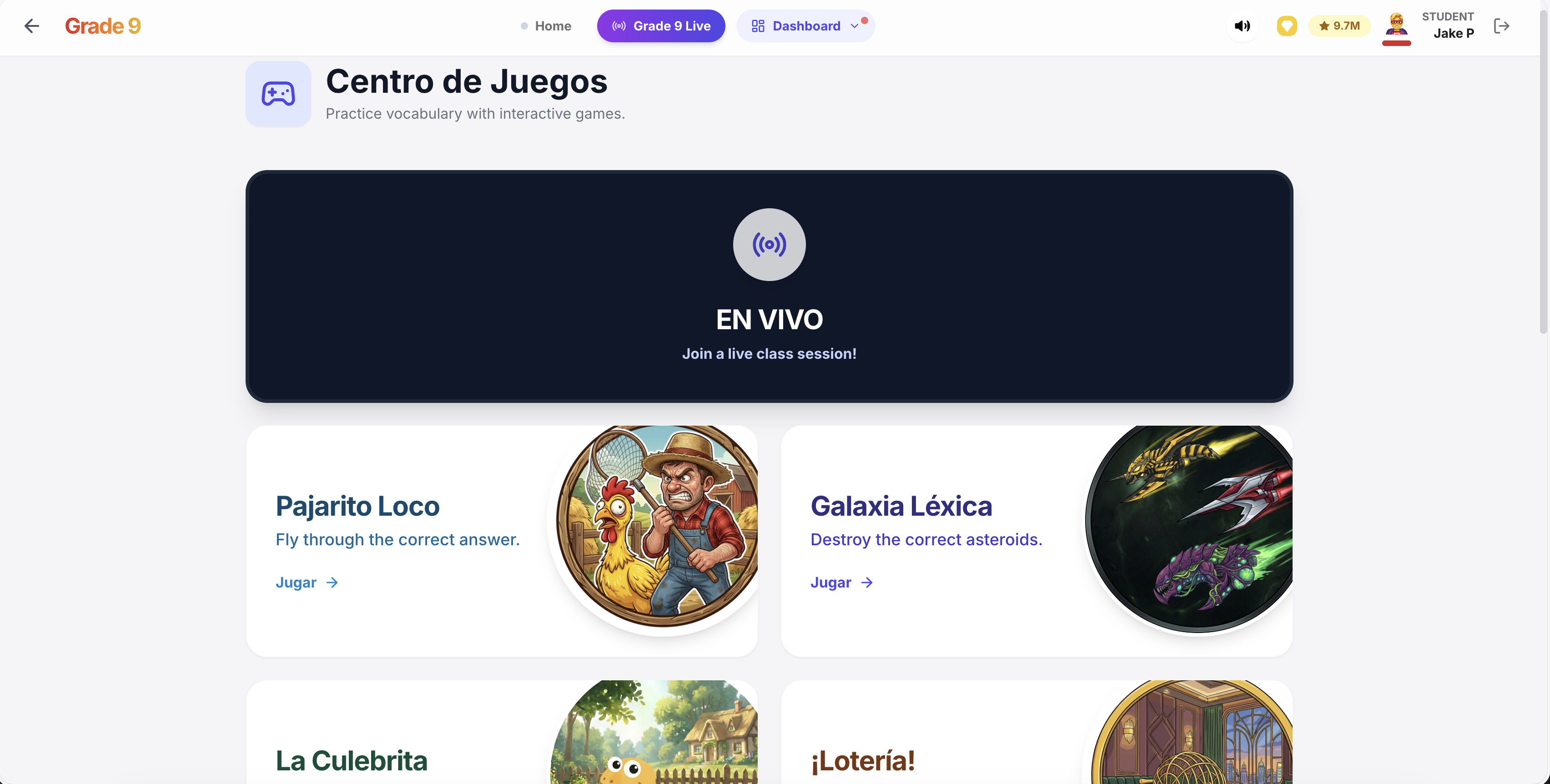
Assignments & tracking
Set work for a whole class or selected students, schedule it and see who has started or finished.
Explore this guide →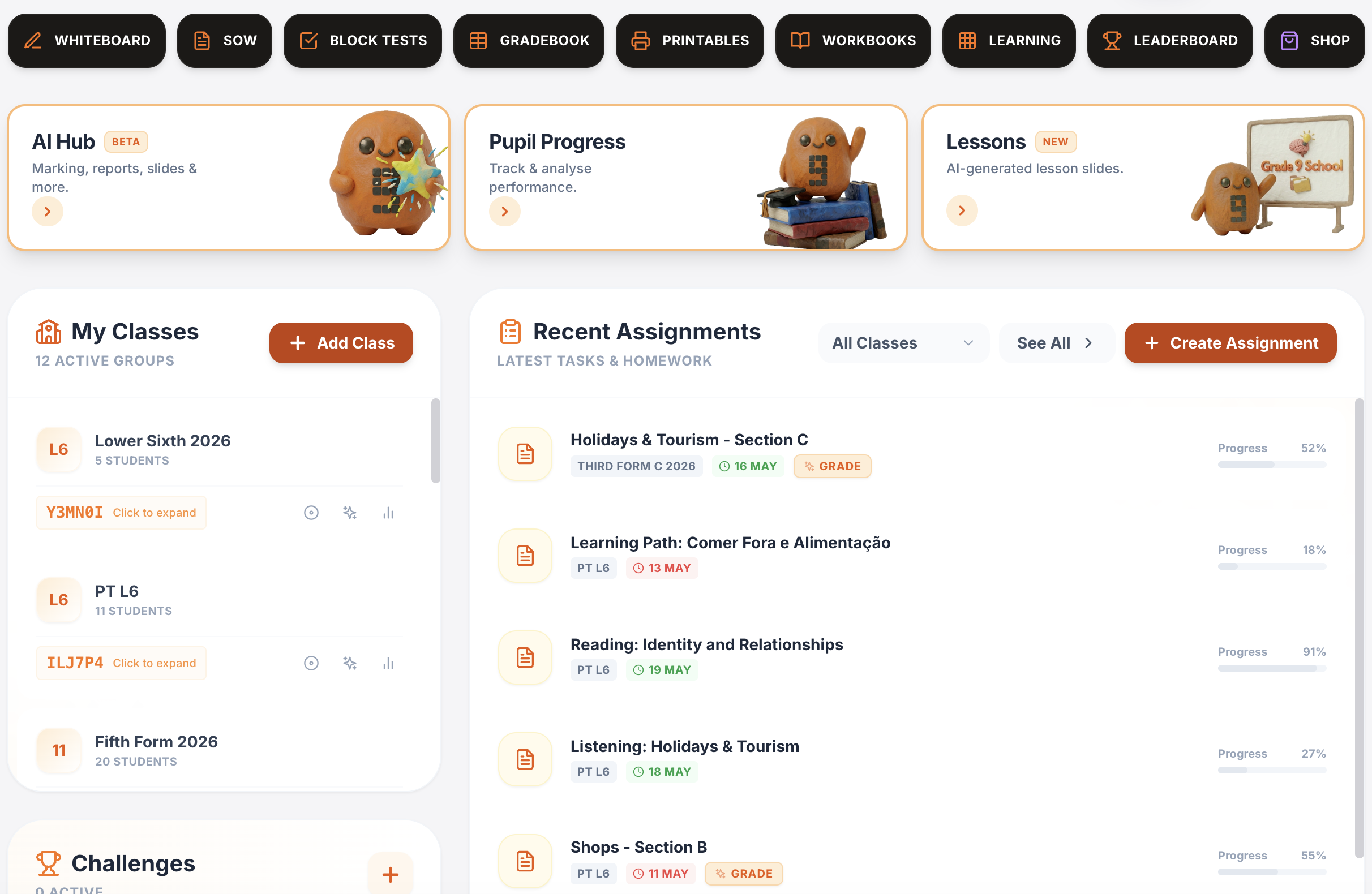
Vocabulary, grammar, translation & independent practice
Structured learning paths, flashcards, vocabulary builders, grammar, verb work, translation and tracked independent learning across supported languages.
Explore this guide →Spanish · French · German · Portuguese · Italian
Use the same platform architecture across the languages your department teaches, while keeping each class in its own language and curriculum context.
Explore language workflows →
From planning to progress, it all connects.
Curriculum management, assignments, AI feedback, printables, gradebook and lesson planning all sit inside the same Grade 9 environment.
Find the detail you need.
Open any section for the key facts, practical detail, examples and sources.
01Think in a practice ladder⌄
A useful vocabulary sequence can move through four stages.
1. Notice
Students connect form and meaning.
Examples:
- word-picture matching;
- target-language/support-language matching;
- sorting by category;
- hearing a word and selecting the meaning.
This stage reduces initial uncertainty. It should not be the final test of learning.
2. Retrieve
Students must produce the word without seeing it.
Examples:
- flashcard recall;
- missing-vowel retrieval;
- first-letter cue;
- quick translation;
- teacher says the meaning, students produce the target-language item.
Retrieval should feel slightly effortful. If the answer is always visible, students are practicing recognition instead.
3. Combine
Students put the word into a chunk or sentence.
Examples:
- complete a sentence builder;
- choose the verb/adjective that makes the sentence true;
- unscramble a sentence;
- substitute one detail while preserving the structure;
- answer a short personal question.
Now vocabulary becomes language.
4. Use
Students need the vocabulary to accomplish a task.
Examples:
- choose a meal and justify it;
- describe a photo;
- compare two school schedules;
- recommend an activity;
- plan a weekend with a partner.
At this stage, the words serve communication rather than appearing because the worksheet asked for them.
02Keep the list teachable⌄
More words do not automatically mean more learning.
Before assigning a set, ask:
- Which words are essential for the communicative goal?
- Which are useful extension?
- Which are near-duplicates students do not need yet?
- Which phrases should stay as chunks rather than being split into isolated words?
- Which words are likely to combine with the grammar or functions in this unit?
A small coherent set used repeatedly can do more work than a giant list students only encounter in one format.
03Mix directions⌄
If students only practice target language → English, they may become good at recognizing words without being able to produce them.
Mix tasks that require:
- target language → meaning;
- meaning → target language;
- audio → written form;
- image → target language;
- sentence context → missing word;
- target-language word → original sentence.
The balance should follow the course goal, not a desire to make every set symmetrical.
04Make students retrieve before showing the answer⌄
Flashcards become passive when the student flips immediately.
A better routine is:
- Read the cue.
- Say or write the answer.
- Commit to the answer.
- Reveal.
- Mark whether recall was actually successful.
- Revisit missed items sooner.
The same principle works on paper and in digital practice.
05Add sentence-level constraints early⌄
Do not wait until every word is “mastered” before using it in language.
Even Level 1 students can use new vocabulary inside a stable frame.
For example:
Quiero ___ porque es ___.
Prefiero ___, pero no me gusta ___.
Después de la escuela, ___ con ___.
The frame lowers the grammatical cost while students retrieve new vocabulary.
06Vocabulary games: keep the retrieval demand⌄
A game is useful when the student still has to retrieve, interpret or use language.
Ask:
What is the student doing mentally to earn the point?
Strong:
- produce the word;
- distinguish meanings;
- complete a sentence;
- identify the odd one out and explain why;
- negotiate a clue.
Weak:
- click the fastest on a screen where the answer is already obvious.
Competition can change energy. It does not automatically change the learning demand.
07A 12-minute retrieval routine⌄
This can work as a warm-up, homework check or end-of-unit reset.
Minutes 0–2:
Students recall as many words as they can from memory.
Minutes 2–5:
Pair compare. Add missing items in a different column.
Minutes 5–8:
Teacher gives meanings or images; students produce the target-language form.
Minutes 8–10:
Students use four items in sentence frames.
Minutes 10–12:
One mini communicative task using at least three items.
The list is now being seen, retrieved, combined and used.
08Connect vocabulary to listening and speaking⌄
Students often “know” a word visually but fail to recognize it in speech.
Add small sound links:
- hear the word before seeing it;
- dictation of a short phrase;
- sort words by sound pattern;
- listen for which items appear in a message;
- use the same vocabulary in a partner task immediately afterward.
That helps prevent vocabulary from becoming a purely written subject.
09A classroom example: Spanish 1, food⌄
Core set:
Twelve high-utility foods and four opinion chunks.
First contact:
Students sort images into categories and match the target-language words.
Retrieval:
Flashcard recall in both directions.
Combine:
Students build six true sentences about preferences.
Use:
Pairs have a small menu and must agree on a shared order.
Follow-up:
Students listen to another person’s order and identify two foods from the original set.
The vocabulary appears in several contexts without needing five disconnected worksheets.
10How to review old vocabulary without losing the new unit⌄
Use a “70/30” mental model rather than a rigid rule: most practice can support the current unit while a smaller portion deliberately retrieves older language.
Ways to bring old vocabulary back:
- one old category in a quick retrieval grid;
- a sentence that combines new content with an old verb;
- mixed flashcards;
- a cumulative listening clip;
- one previous-unit question in partner talk.
The exact ratio should change with the class. The key is that older vocabulary does not disappear when the unit ends.
11How Grade 9 School can support vocabulary practice⌄
Grade 9 includes vocabulary units, flashcards and multiple interactive activity types. A teacher can set a vocabulary unit as an assignment, choose a purposeful subset of activities and see whether students have started or completed that specific assignment.
The documented progress model distinguishes completion from score. A student can finish weakly; another can have strong partial work and still be in progress. Those are different teaching signals.
Grade 9 also supports custom vocabulary lists and reusable activity packs. Product availability varies by language and course context, so a teacher should not assume every language has an identical built-in catalog.
12Common vocabulary-practice mistakes⌄
One-direction practice only
Recognition is not production.
Huge lists because “they will need all of these eventually”
Teachability matters.
Waiting too long to put words into sentences
Students need to learn what words do, not only what they mean.
Treating speed as mastery
Fast recognition is useful, but it does not prove students can use the item in communication.
Letting a game hide the task
Keep the language retrieval visible.