 School




World Language Teaching in US Classrooms: A Practical Guide
Plan world language courses around communication, proficiency, culture and useful practice. A practical guide for US middle and high school teachers.
Grade 9 School brings curriculum, lesson planning, practice, homework, feedback, live activities, printables and progress tracking into one connected teaching workflow.
 Spanish
 French
 German
 Portuguese
 Italian
Practice, feedback and progress in one place.
A strong world language course is a planned progression in what students can understand, say, write, read and do with the language.
Teachers still have to make district curriculum, state standards, ACTFL language, textbook chapters, student gaps, culture, assessment and limited class time fit together. The useful question is not which resource comes next. It is what students should become more able to do.
Explore the topic ↓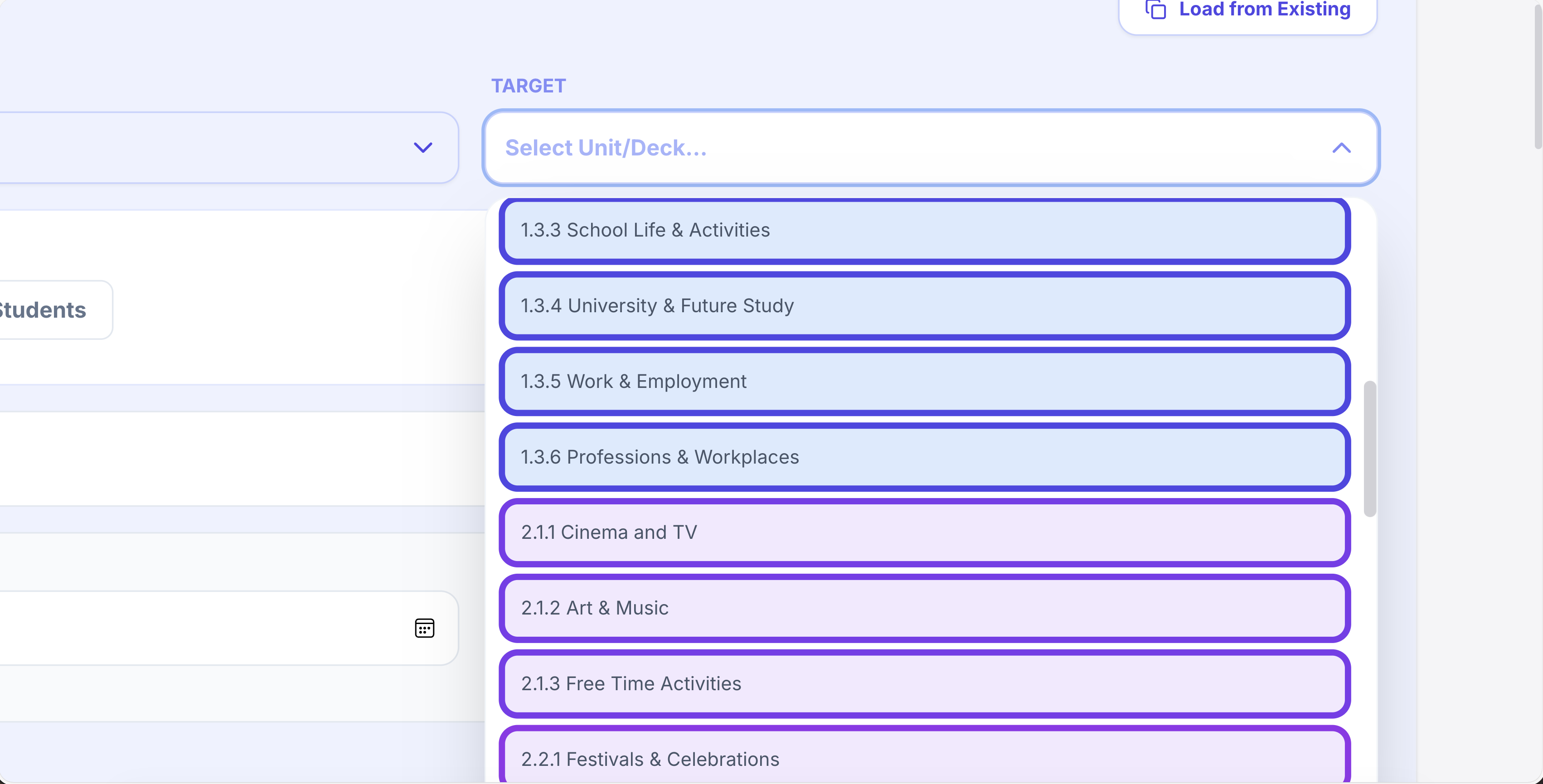
One platform for teaching, practice, feedback and progress.
Plan lessons, set homework, run live activities, generate printables, give AI-supported grading and track progress across Spanish, French, German, Portuguese and Italian.
Writing & speaking grading
Set writing and speaking tasks, collect submissions, generate detailed feedback and keep teacher review in the loop.
Explore this guide →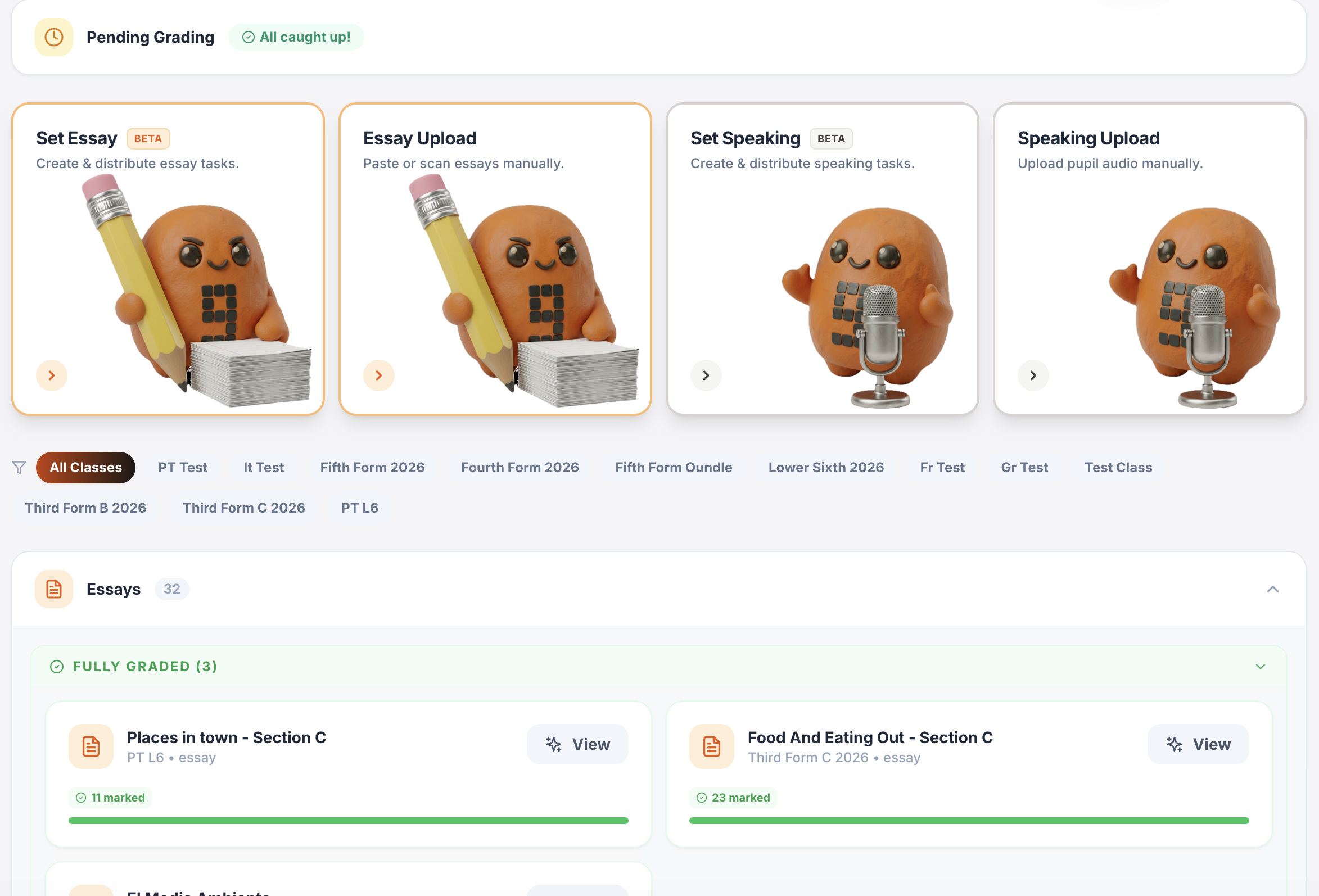
Gradebook & reports
Track scores, completion, engagement and learning evidence across classes.
Explore this guide →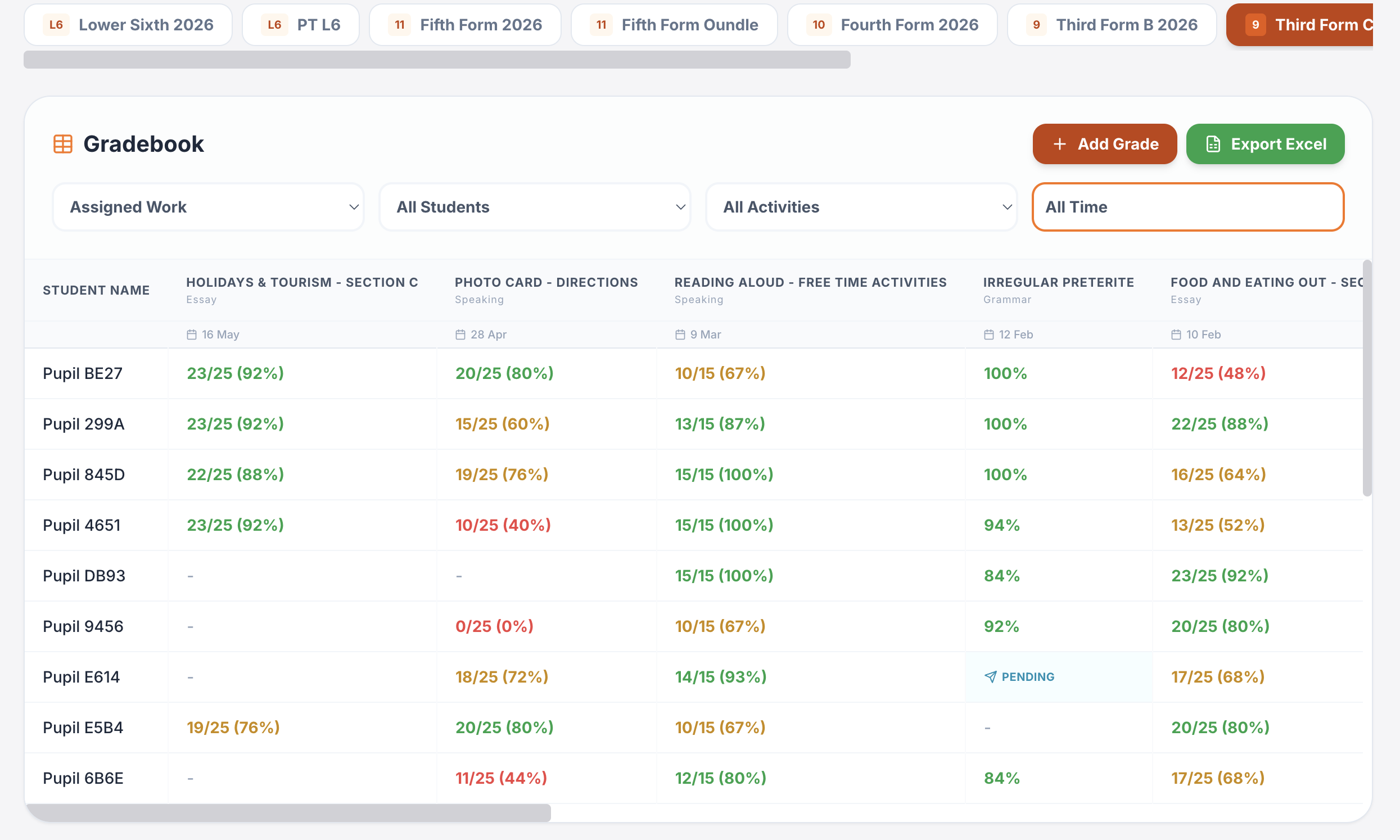
Interactive lessons
Generate, edit, save and reuse complete lesson presentations.
Explore this guide →Printables in seconds
Vocabulary, grammar, translation, reading, listening, worksheets and booklets.
Explore this guide →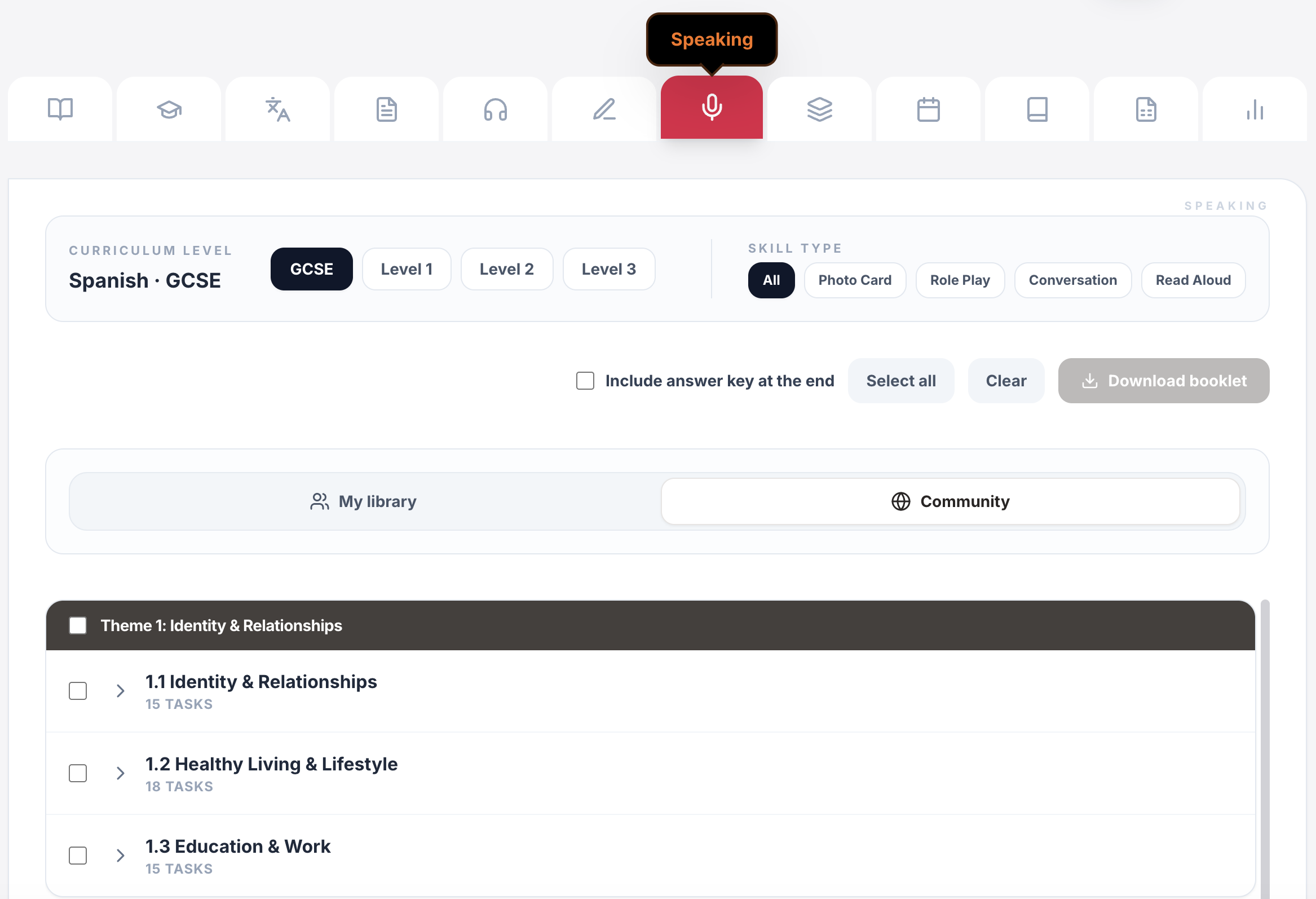
Live games & whiteboards
Turn curriculum content into whole-class competition, retrieval and live response.
Explore this guide →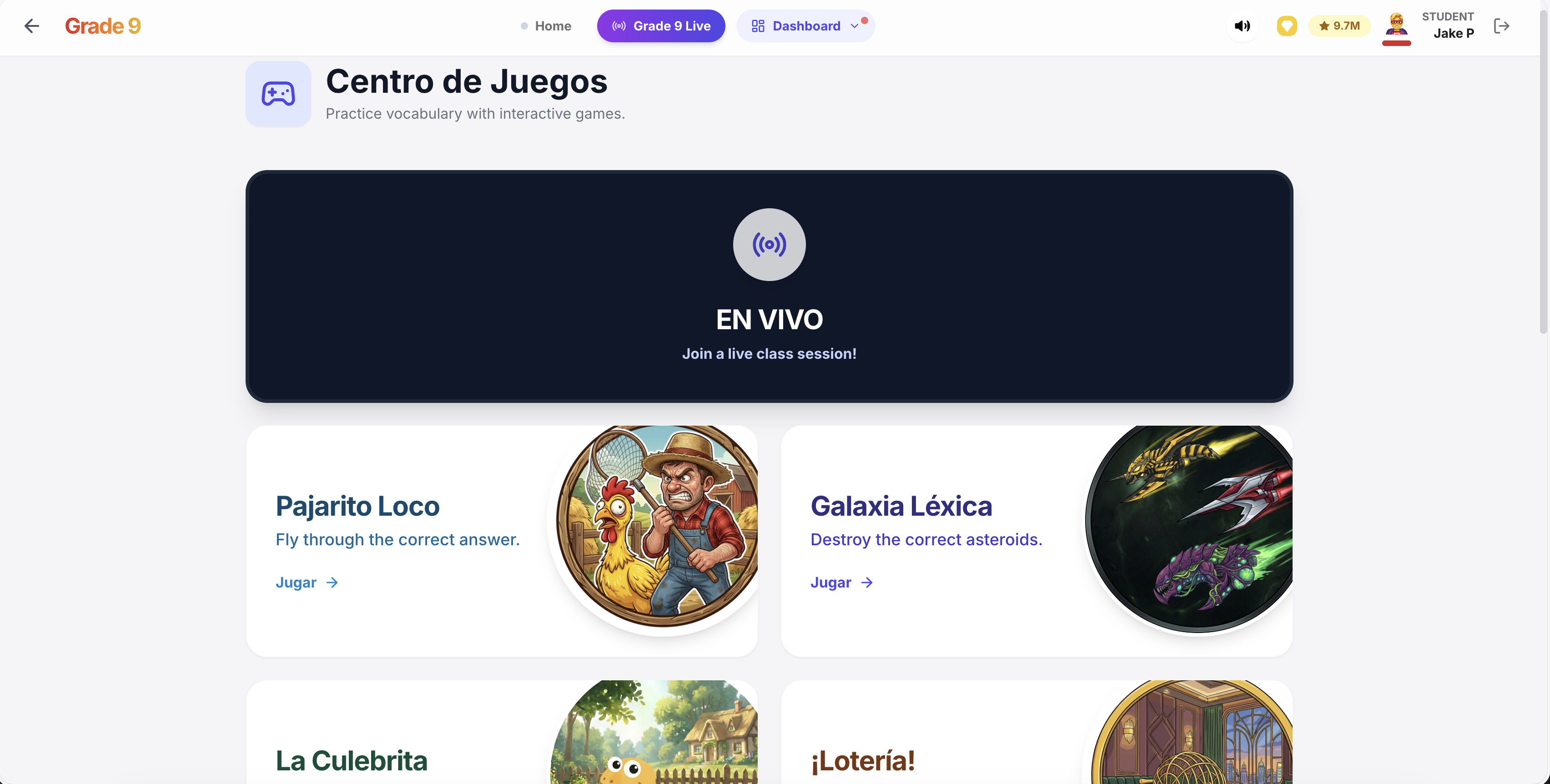
Assignments & tracking
Set work for a whole class or selected students, schedule it and see who has started or finished.
Explore this guide →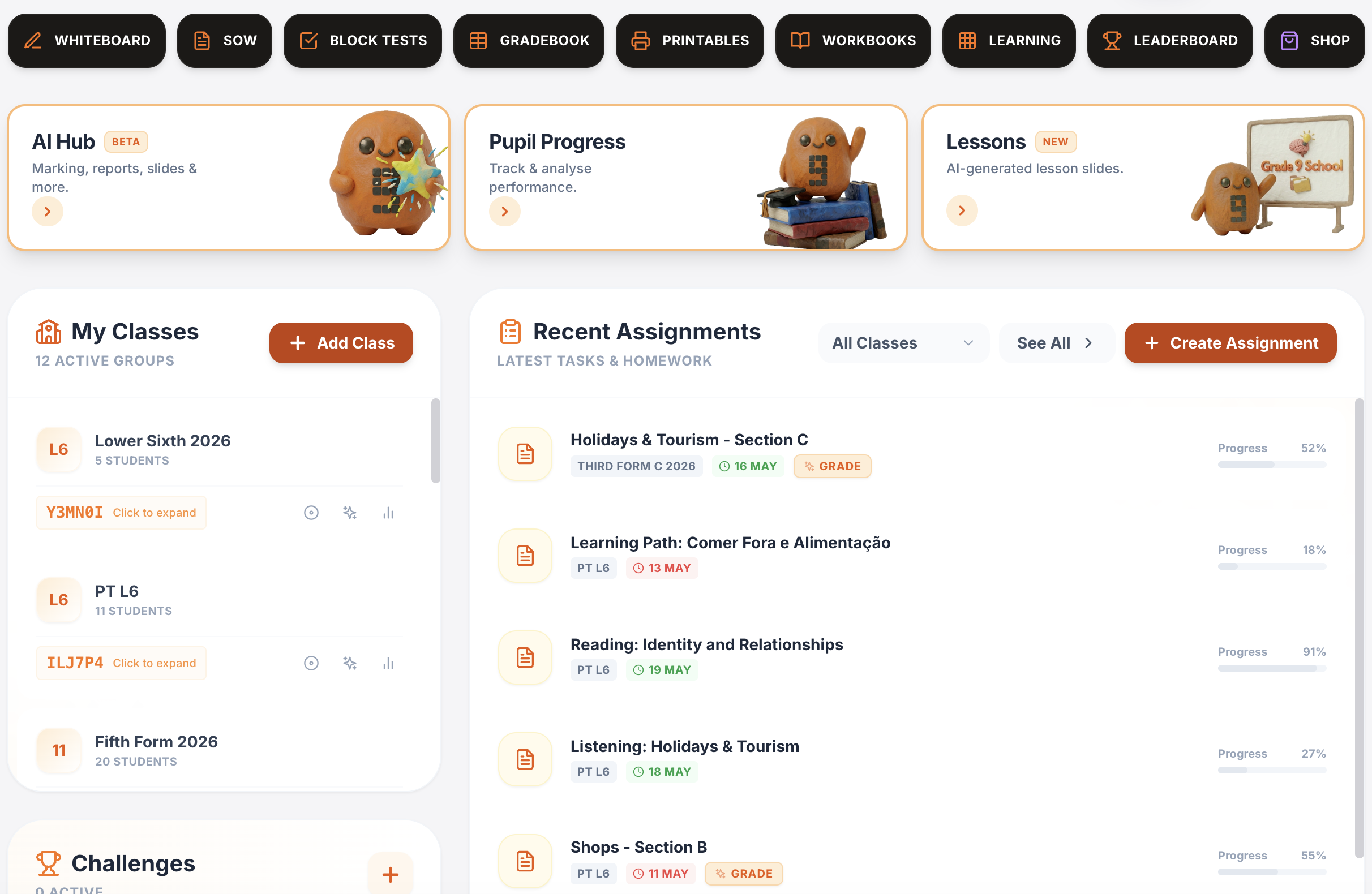
Vocabulary, grammar, translation & independent practice
Structured learning paths, flashcards, vocabulary builders, grammar, verb work, translation and tracked independent learning across supported languages.
Explore this guide →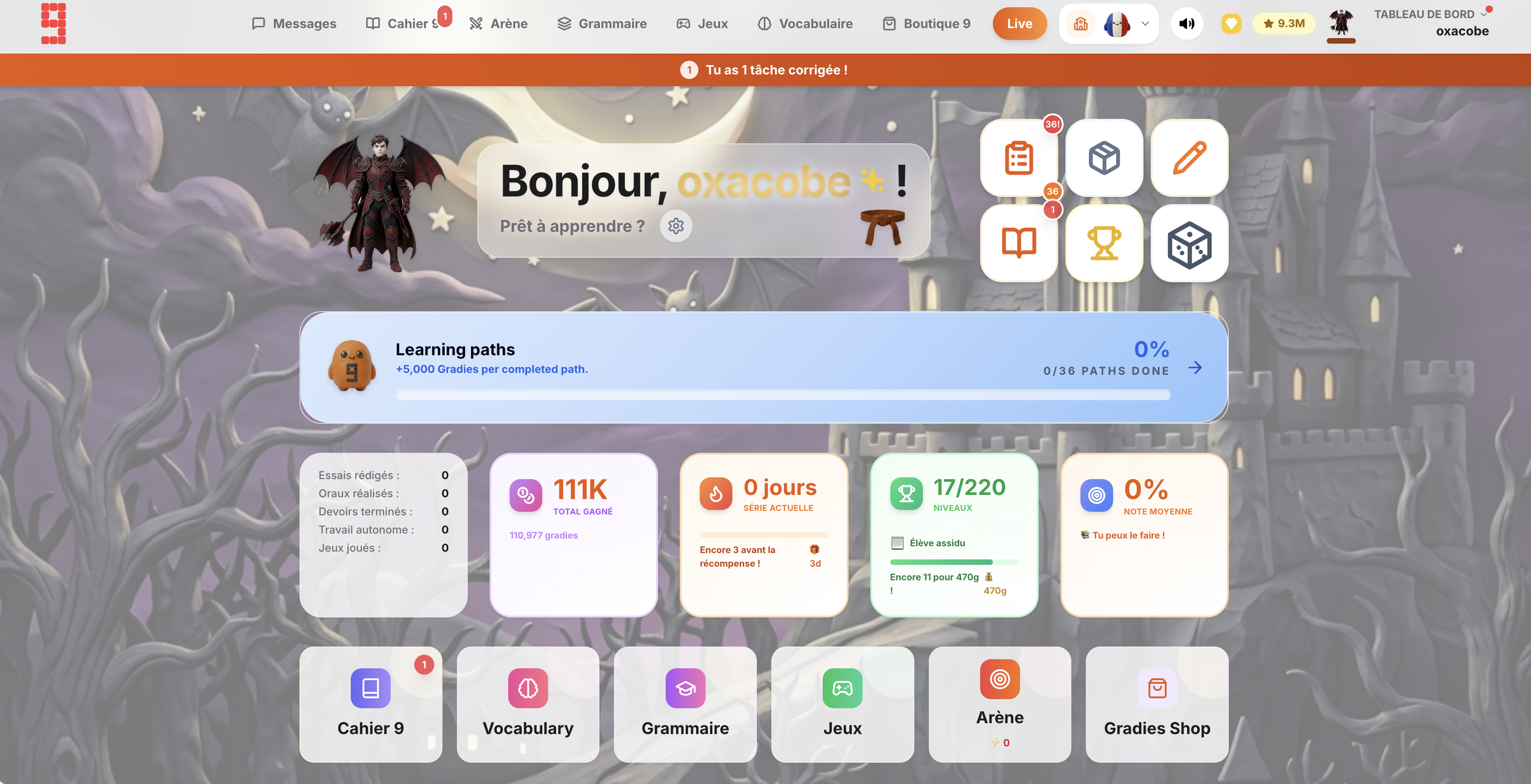
Spanish · French · German · Portuguese · Italian
Use the same platform architecture across the languages your department teaches, while keeping each class in its own language and curriculum context.
Explore language workflows →
From planning to progress, it all connects.
Curriculum management, assignments, AI feedback, printables, gradebook and lesson planning all sit inside the same Grade 9 environment.
Find the detail you need.
Open any section for the key facts, practical detail, examples and sources.
01Start with what students should be able to do⌄
The ACTFL World-Readiness Standards place communication at the center of language learning and describe three modes:
- Interpretive: understanding and making meaning from what students hear, read or view.
- Interpersonal: exchanging meaning with another person through spoken, signed or written interaction.
- Presentational: creating spoken, written or signed communication for an audience.
Those modes sit within the wider five goal areas often called the 5 Cs: Communication, Cultures, Connections, Comparisons and Communities. [S1]
That gives course planning a stronger starting point than a grammar list.
A unit on school life, for example, might ask students to interpret a schedule or short audio, exchange information about classes and preferences, and create a short comparison of their own school day with one from a Spanish-speaking context. Vocabulary and grammar then support those communicative jobs.
02Do not treat course names as proficiency levels⌄
Spanish 1, French 2 or German 3 are course names. They are not nationally standardized proficiency labels.
The 2026 NCSSFL-ACTFL Can-Do Statements and ACTFL Performance Descriptors describe what learners can do across proficiency ranges and communication modes, but the Can-Do examples are not a prescribed curriculum. Programs adapt them to local content and goals. [S2][S3]
Two students arriving in Spanish 2 may therefore have very different first-year experiences.
Before building a course or pacing guide, ask:
- What can students currently understand?
- What can they currently produce without a script?
- What content and cultural contexts are required locally?
- What should they be able to do more independently by the end of the course?
Those answers are more useful than assuming the course title tells you everything.
03Build units across the three communication modes⌄
A unit becomes more coherent when interpretive, interpersonal and presentational work prepare students for one another.
In a novice food-and-preferences unit, students might first interpret a short menu or exchange, then ask and answer preference questions, and finally create a short recommendation or voice recording for an audience.
The language focus follows the tasks: high-frequency food vocabulary, question forms, likes and dislikes, quantities, or structures for making a choice.
For a fuller daily lesson framework, see World language lesson planning.
04Use proficiency language to set the right size of task⌄
ACTFL Performance Descriptors organize classroom performance into Novice, Intermediate and Advanced ranges across the communication modes. [S3]
For novice learners, familiar topics, high-frequency language, visual or contextual support, and relatively short text types are normal parts of the journey. That does not make novice work trivial.
A novice student can still make a real choice, ask a real question, interpret a short authentic item with support, compare familiar cultural products, or create a short message for an audience.
The aim is to make the task cognitively worthwhile while keeping the language demand attainable.
05Keep vocabulary reusable⌄
Students need vocabulary, but a weekly list is only useful if the language becomes available again later.
A stronger course revisits useful words and chunks through meaning, retrieval, listening, reading, sentence-level use and communication. For a practical progression from recognition to retrieval and use, see World language vocabulary practice.
06Teach grammar as a meaning-making tool⌄
A useful grammar question is:
What does this structure allow students to do that they could not do before?
Question forms let students sustain an exchange. Past-time language lets them recount events. Adjective agreement helps them describe more accurately. Comparisons let them evaluate options.
Grammar can remain explicit without becoming the organizing purpose of the whole course.
07Plan culture into the work⌄
The World-Readiness Standards connect communication with cultures, connections, comparisons and communities. [S1]
Culture works best when it is part of what students are trying to understand or communicate rather than a separate trivia slide.
Students might compare school schedules, interpret a menu or transit map, notice how forms of address change by context, or use a cultural source to answer a communicative question.
08Keep the daily planning frame short and purposeful⌄
A lesson should move students toward a clear communicative outcome. Retrieval, input, guided practice, interaction and short independent output can all support that outcome, but every lesson does not need the same six-stage template.
The full planning framework, including a worked lesson example and diagnostic chain, belongs on World language lesson planning.
09Use more than one kind of evidence⌄
Language learning is uneven. One number rarely captures it well.
A student may understand a short audio confidently but struggle to respond spontaneously. Another may write carefully but rely heavily on preparation when speaking.
Useful evidence can come from:
- short interpretive checks;
- interpersonal exchanges;
- presentational speaking or writing;
- retrieval practice;
- longer performance tasks;
- samples of student work;
- teacher observation.
The 2026 Can-Do Statements emphasize performance demonstrated consistently over time rather than one isolated task. [S2]
For a fuller treatment of completion, performance and proficiency evidence, see Student progress tracking in world languages.
10Feedback should lead to a next piece of learning⌄
A writing score or correction only becomes useful when it changes what the student does next. Good feedback should stay connected to the communicative task, identify a manageable growth target and give the student a chance to act on it.
See World language writing feedback for the full feedback-to-revision workflow.
11Where technology helps, and where it does not⌄
Technology can reduce mechanical work around language teaching. It can help teachers build practice, organize assignments, create or adapt resources, collect responses and review class patterns.
It does not decide:
- whether the language is right for this group;
- whether a cultural comparison is thoughtful;
- whether a generated example is accurate and natural;
- whether a student is ready for less scaffolding;
- whether a score reflects the learning that matters.
The teacher still owns those judgments.
12How Grade 9 School fits this workflow⌄
Grade 9 School’s US experience uses a Level 1–4 curriculum structure rather than UK course labels.
Teachers can work with curriculum-aligned vocabulary and grammar practice, create assignments for a whole class or selected students, schedule work and review saved progress. The Presentation Generator can build a structured lesson from a selected language, curriculum level, topic, optional grammar focus and final task. Generated lessons are saved for editing and reuse.
Generated material still needs teacher review. Structural checks cannot prove that every sentence, cultural reference or teaching choice is right for a particular class.