 School





World Language Speaking Practice That Gets More Students Talking
Build better world language speaking practice with clear communicative tasks, rehearsal, feedback and practical routines for middle and high school classes.
Grade 9 School brings curriculum, lesson planning, practice, homework, feedback, live activities, printables and progress tracking into one connected teaching workflow.
 Spanish
 French
 German
 Portuguese
 Italian
Practice, feedback and progress in one place.

Speaking practice is easy to under-design.
A teacher says, “Talk to your partner about the weekend,” gives students three minutes, and discovers that half the room has finished after 25 seconds. A few confident students improvise. Others read from notes, switch to English or wait for their partner to do the work.
The problem is not that students need a more entertaining prompt. They need a speaking task with a clear communicative job, enough language to enter the task, a reason to listen, and a way to try again.
ACTFL’s World-Readiness Standards distinguish Interpersonal Communication from Presentational Communication. In interpersonal work, students interact and negotiate meaning with another person. In presentational work, they prepare language for an audience. Those are different classroom demands, and speaking practice improves when the teacher is clear about which one students are doing.
Explore the topic ↓
One platform for teaching, practice, feedback and progress.
Plan lessons, set homework, run live activities, generate printables, give AI-supported grading and track progress across Spanish, French, German, Portuguese and Italian.
Writing & speaking grading
Set writing and speaking tasks, collect submissions, generate detailed feedback and keep teacher review in the loop.
Explore this guide →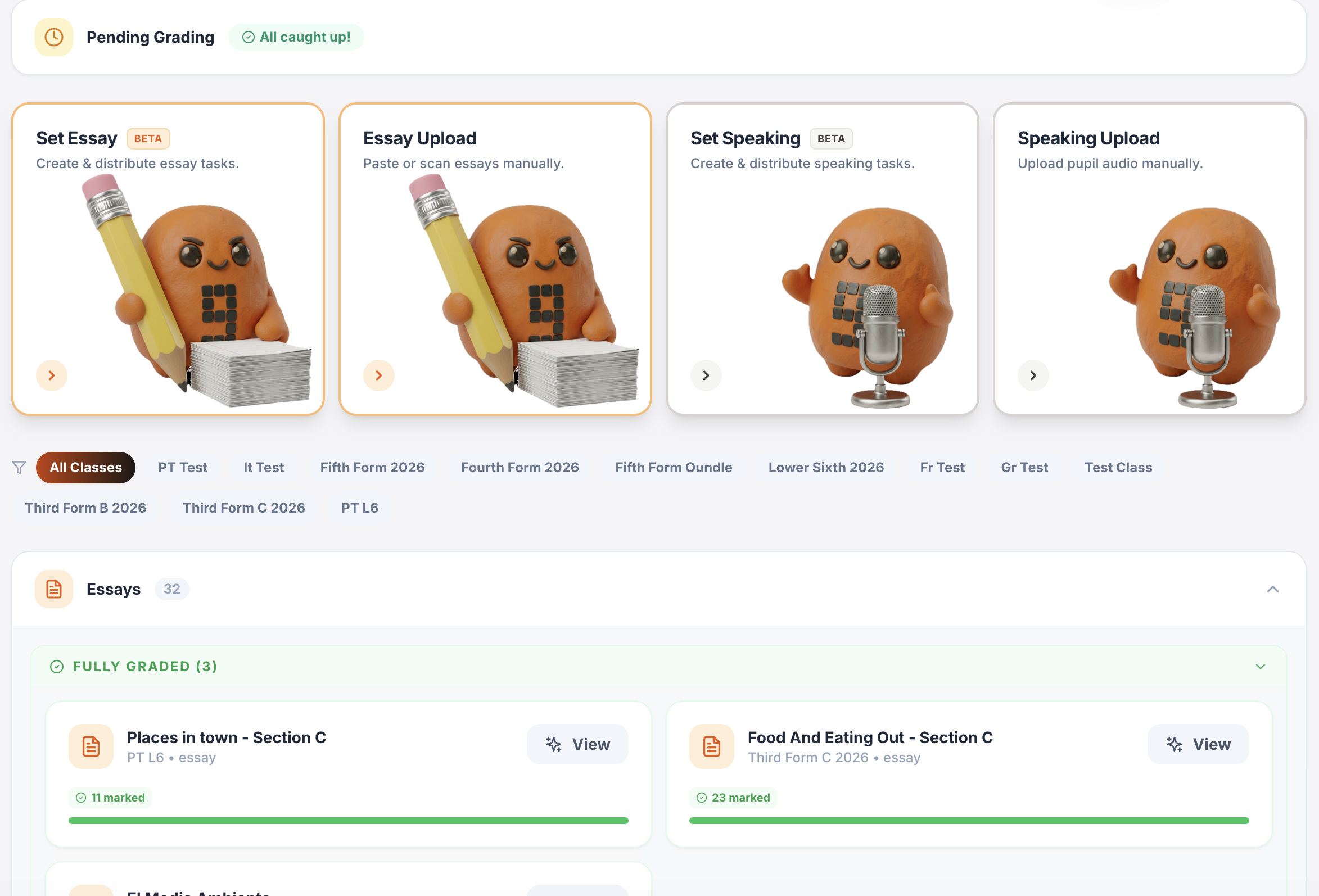
Gradebook & reports
Track scores, completion, engagement and learning evidence across classes.
Explore this guide →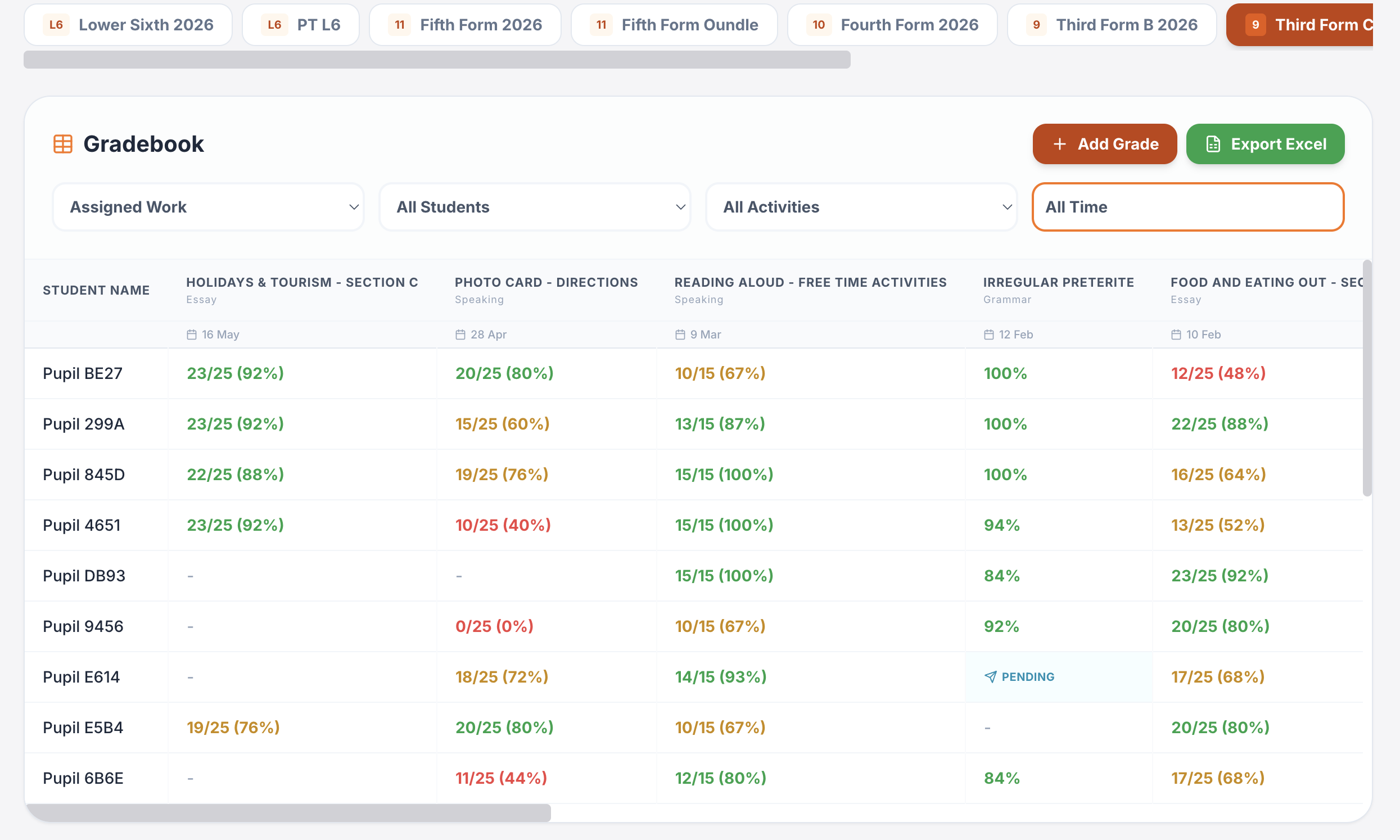
Interactive lessons
Generate, edit, save and reuse complete lesson presentations.
Explore this guide →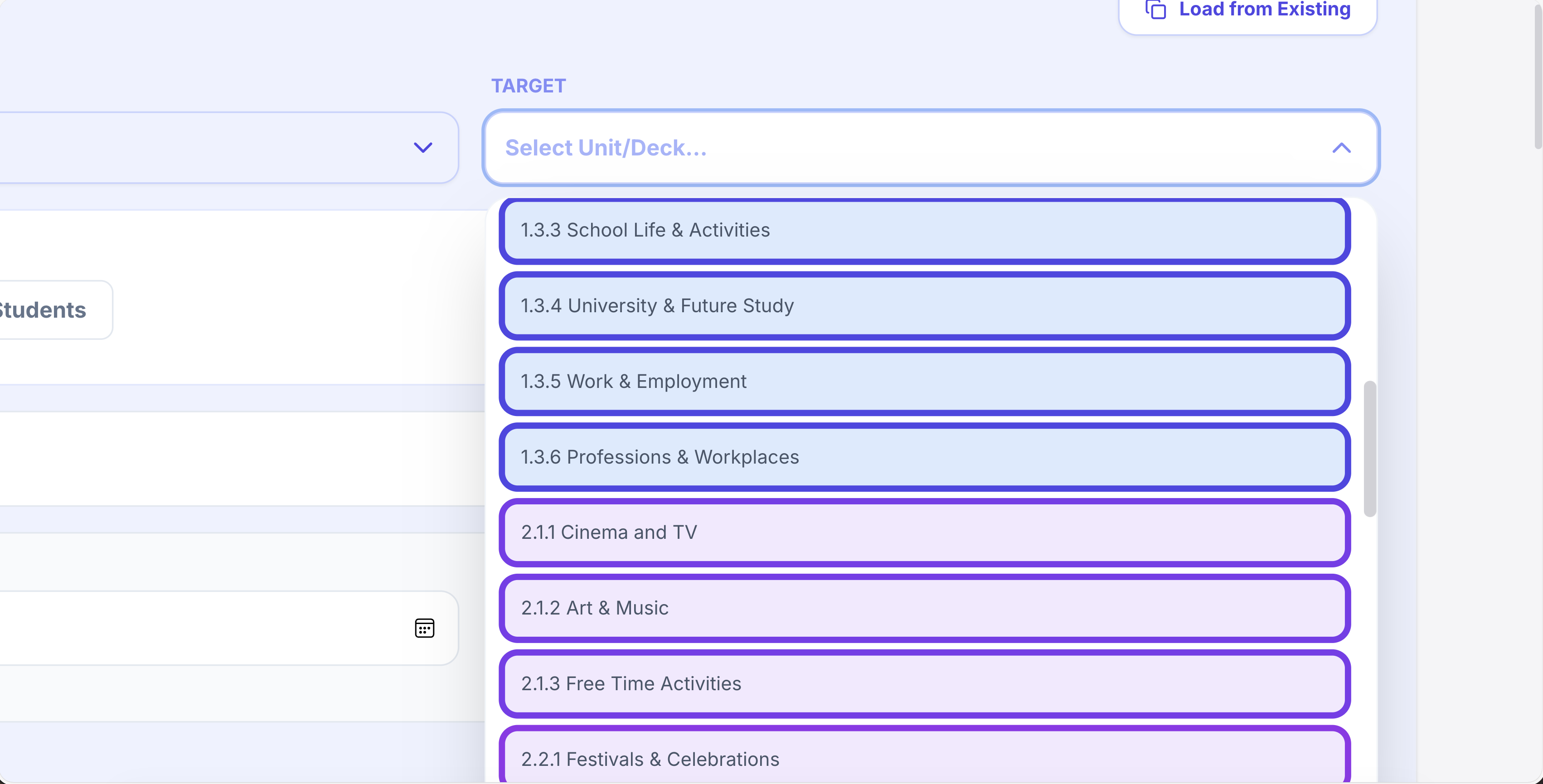
Printables in seconds
Vocabulary, grammar, translation, reading, listening, worksheets and booklets.
Explore this guide →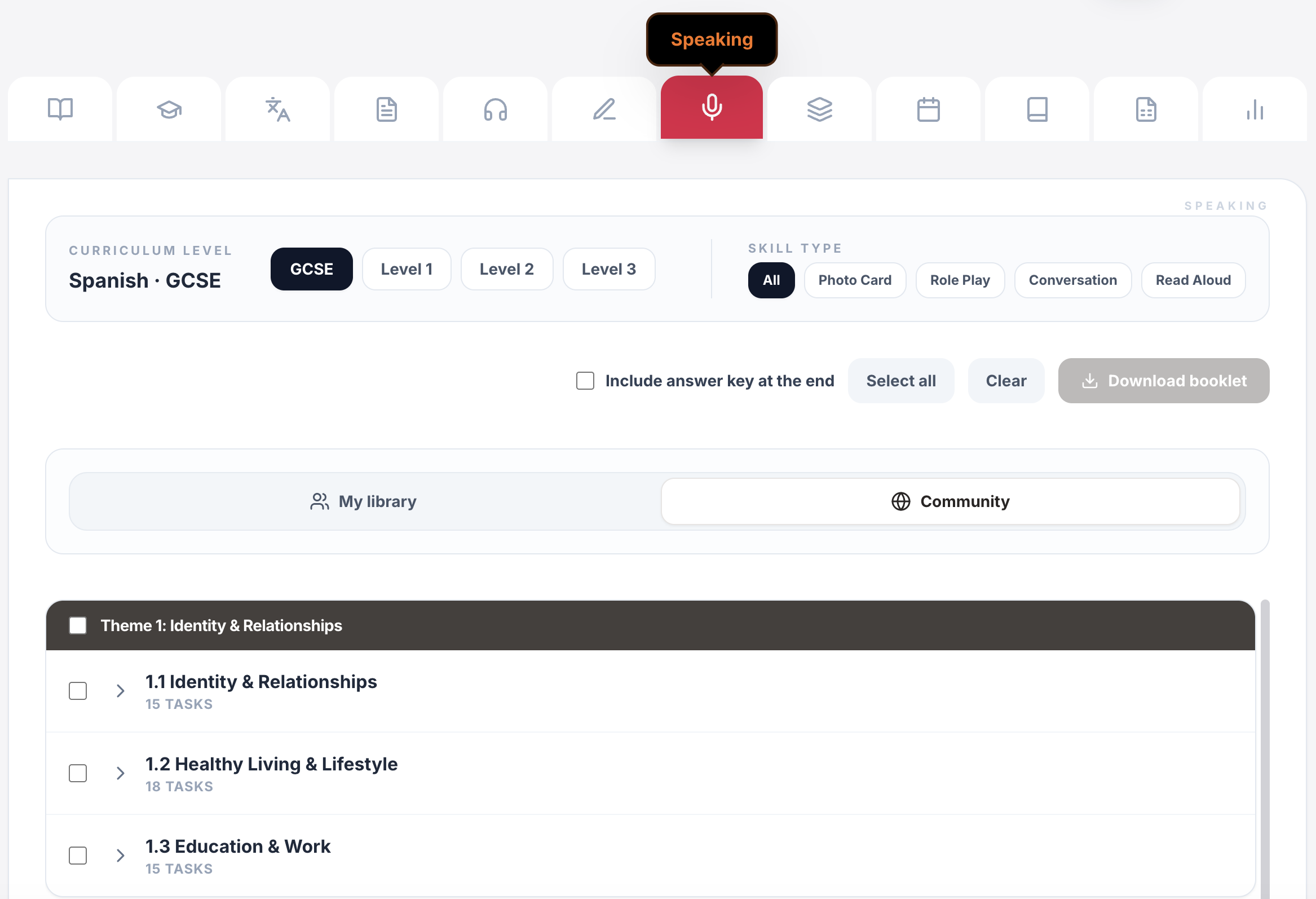
Live games & whiteboards
Turn curriculum content into whole-class competition, retrieval and live response.
Explore this guide →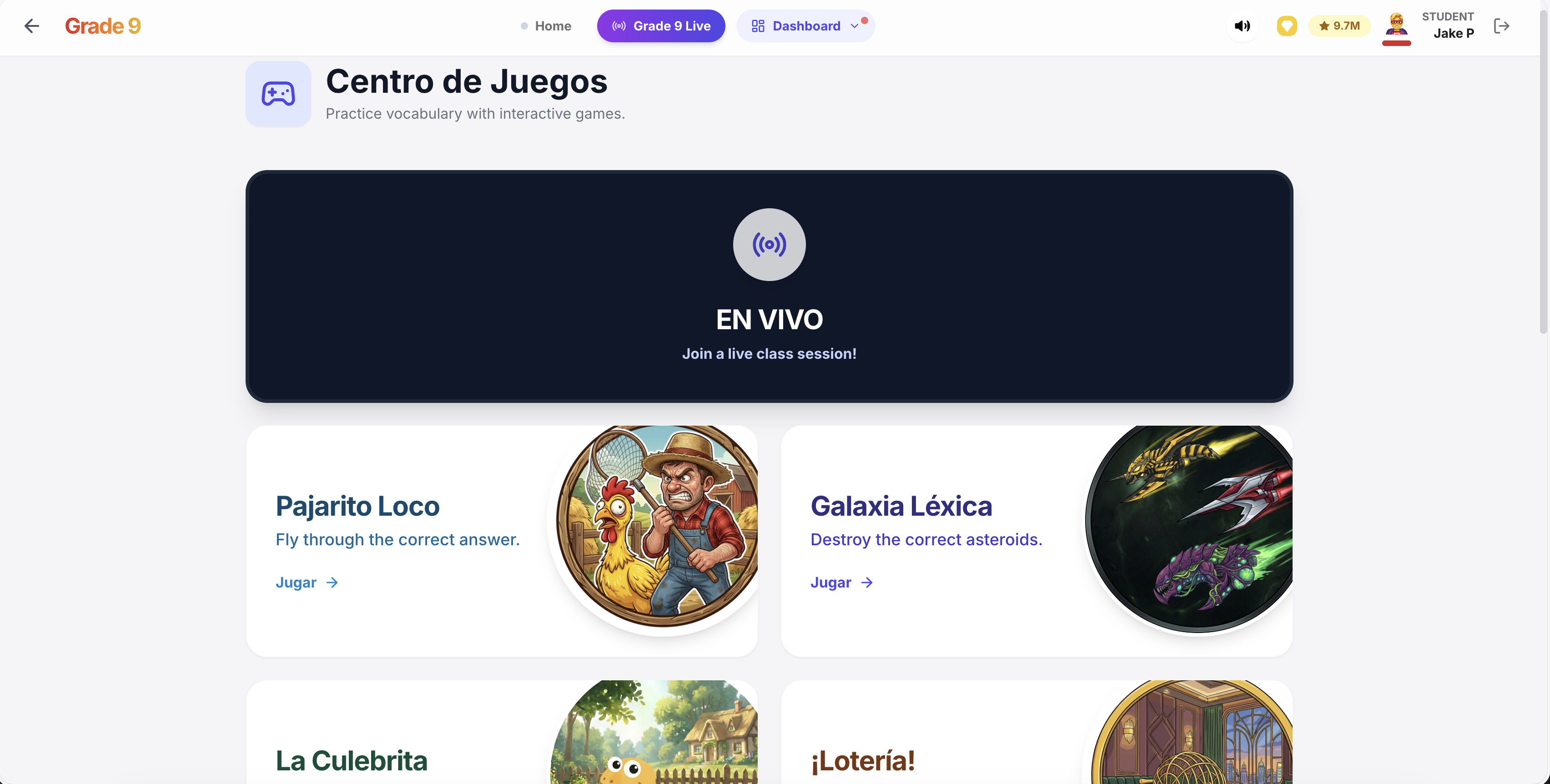
Assignments & tracking
Set work for a whole class or selected students, schedule it and see who has started or finished.
Explore this guide →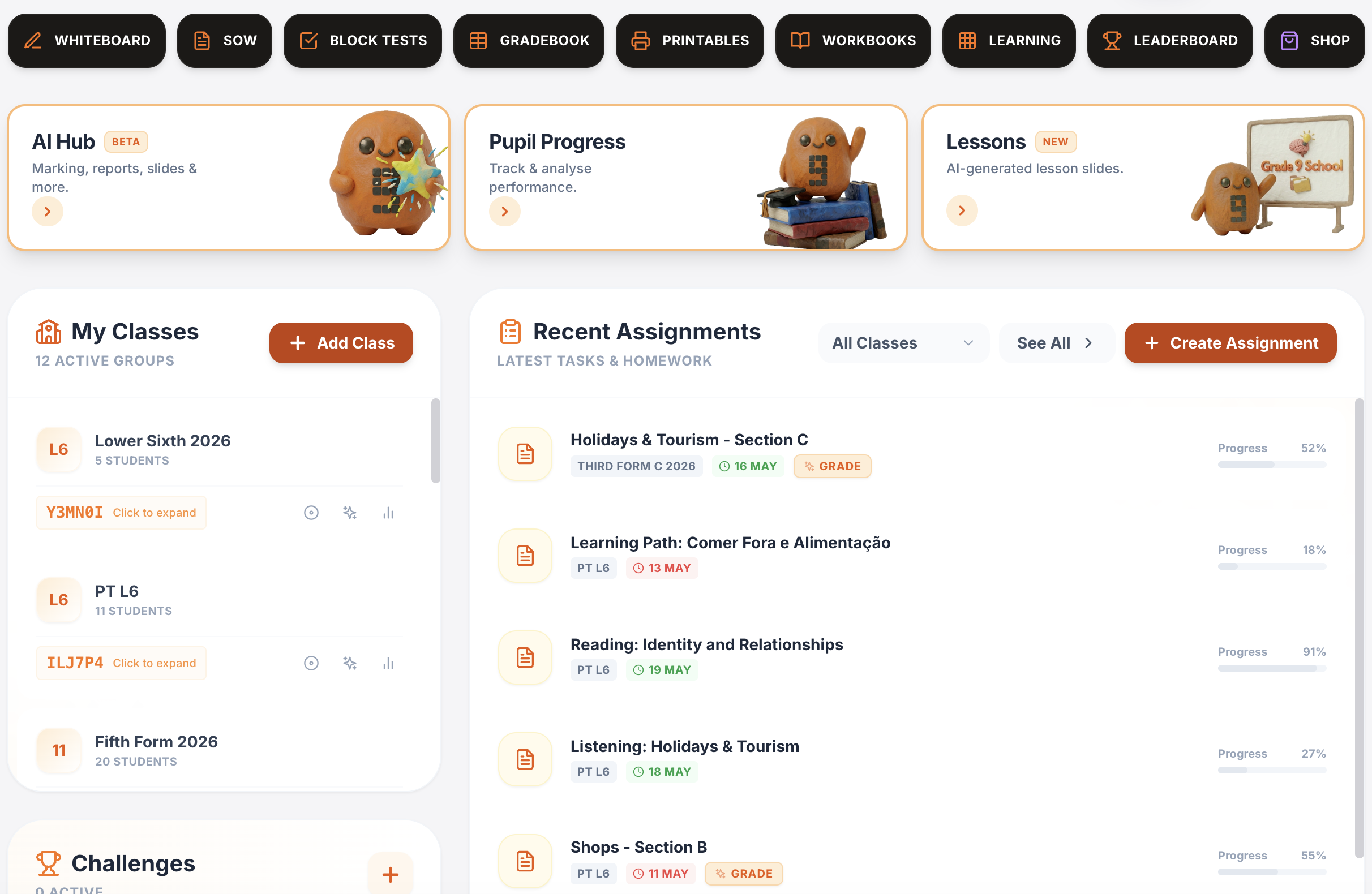
Vocabulary, grammar, translation & independent practice
Structured learning paths, flashcards, vocabulary builders, grammar, verb work, translation and tracked independent learning across supported languages.
Explore this guide →Spanish · French · German · Portuguese · Italian
Use the same platform architecture across the languages your department teaches, while keeping each class in its own language and curriculum context.
Explore language workflows →
From planning to progress, it all connects.
Curriculum management, assignments, AI feedback, printables, gradebook and lesson planning all sit inside the same Grade 9 environment.
Find the detail you need.
Open any section for the key facts, practical detail, examples and sources.
01Start with the speaking job, not the topic⌄
“Food” is a topic. It is not yet a speaking task.
A stronger prompt tells students what they are trying to accomplish.
For example:
- Find three things you and your partner both eat during the school week.
- Decide which of four restaurants your group should choose and justify the decision.
- Ask follow-up questions until you can introduce your partner to the class.
- Leave a 45-second voice message explaining what changed in your plans.
- Compare two images and explain which place you would rather visit.
The topic supplies vocabulary. The communicative job supplies purpose.
A useful test is simple: if students can complete the activity without listening to the other person, it may not really be interpersonal.
02Give students an entry ramp⌄
Students often go quiet because the first sentence feels expensive.
Before pair work, give them a short entry ramp. This does not mean scripting the entire conversation. It means making the first move easier.
A practical sequence is:
- Recycle the few words or structures that matter most.
- Model one short exchange.
- Give students 30–60 seconds to prepare a first response.
- Run the conversation once with visible support.
- Remove some support and run a second version.
- Ask for one new detail, follow-up question or change of partner.
The second attempt matters. Students should not have to spend the whole activity merely figuring out the rules.
03Build listening into speaking⌄
A partner activity should have an information reason to listen.
Try adding one of these requirements:
- You must report one thing your partner said.
- You may not repeat a question your partner has already answered.
- You need two points of agreement and one difference.
- Your next question must come from the previous answer.
- At the end, your partner decides whether you understood them accurately.
This turns speaking from parallel monologues into interaction.
04Match the support to the course, not to your ambition⌄
Support is useful when it helps students produce language they are almost ready to use.
Support becomes a problem when students can complete the task by reading a paragraph aloud without making any decisions.
For a Level 1 class, useful support might include:
- a small phrase bank;
- question stems;
- visual prompts;
- a model exchange;
- a limited choice of time frames.
For a more experienced class, support can shift toward:
- discourse starters;
- follow-up-question stems;
- circumlocution strategies;
- challenge cards;
- required time frames or functions.
The goal is not “no scaffolding.” The goal is that students do more of the linguistic work as the task progresses.
05Separate rehearsal from performance⌄
Not every speaking attempt needs a score.
A healthy speaking sequence might contain:
- private rehearsal;
- pair practice;
- a changed partner;
- a short recorded attempt;
- teacher or peer feedback;
- a final improved attempt.
That sequence gives students room to improve without turning every hesitation into a grade.
ACTFL’s Proficiency Guidelines describe what speakers can do with language in terms of functions and tasks, accuracy, context/content and text type. They are not a script for grading every classroom conversation. Use them to keep the destination communicative, while treating daily speaking as practice.
06Four speaking routines that scale⌄
1. Ask, answer, extend
Student A asks a question.
Student B answers with one detail.
Student A must extend with a follow-up question based on the answer.
Then roles switch.
The follow-up requirement prevents a worksheet-style interview from becoming five disconnected questions.
2. Same task, new partner
Students complete a short task with Partner 1.
Then they repeat it with Partner 2, but one condition changes: a new opinion, a new image, a new problem, or one less support box.
Students gain fluency because the communicative frame is familiar, but the second round is not a memorized replay.
3. Listen, reconstruct, respond
Play or read a short message.
Students first identify the key information.
Then they tell a partner what they understood and agree on a response.
This connects interpretive listening to interpersonal speaking instead of treating skills as separate weekly boxes.
4. Record, notice, redo
Students record a brief response.
Before receiving teacher feedback, they listen back and identify one thing they would improve.
Then they record again.
The first recording is evidence. The second is improvement. The gap between them is the learning.
07What to listen for as the teacher⌄
Trying to correct everything during a speaking activity usually kills the speaking.
Choose a narrow listening focus.
For one round, it might be:
- Are students extending answers?
- Are questions comprehensible?
- Are students relying on one memorized tense?
- Can they repair a breakdown?
- Are they using the target structure when it matters?
Collect two or three examples for whole-class feedback. Let the conversation keep moving.
08Common speaking-practice mistakes⌄
Too much preparation, too little speaking
If students spend 12 minutes writing a perfect paragraph and 45 seconds reading it, the task has become a writing task with audio.
“Free conversation” before students have enough language
Open choice feels liberating to fluent speakers. For novices it can feel like an empty room. Narrow the communicative job.
One attempt only
A first attempt often measures task familiarity as much as language. Repetition with a small change gives students a chance to use feedback immediately.
Scoring every error
Students need accuracy work, but they also need enough uninterrupted production to build confidence and automaticity.
Ignoring the listener
If the partner has no job, students can speak without communicating.
09A classroom example: Spanish 2, making plans⌄
Goal:
Students can make a plan, react to a suggestion and negotiate one change.
Round 1:
Students receive three possible weekend activities and a phrase bank for suggesting, agreeing, disagreeing and asking why.
Round 2:
They switch partners. One activity is now unavailable, so the plan must change.
Round 3:
Each pair records a 60-second summary of the final plan.
Reflection:
Each student writes one phrase they used successfully and one moment where they had to find another way to express meaning.
The task stays manageable because the language and purpose are stable. The second round forces genuine adjustment.
10Where recorded speaking fits⌄
Recorded speaking is useful when you need every student to produce evidence, not only the students you happened to hear while circulating.
A recording can support:
- self-listening;
- teacher review;
- a second improved attempt;
- a portfolio entry;
- targeted feedback.
It should not replace live interpersonal work. A recorded response and a conversation show different things.
11How Grade 9 School can support this workflow⌄
Grade 9 School can be used to create speaking assignments, collect student recordings and review submissions from the teacher side. In the current documented workflow, a submitted recording is stored as student evidence before any AI analysis happens.
Where a teacher chooses AI-supported speaking feedback, the system creates a teacher-side draft. The teacher can listen to the original audio, check the transcript, edit the proposed marks or feedback, and approve only the result they accept. The handbook is explicit that audio quality, accents, hesitations and background noise can affect automated transcription or analysis.
Use that workflow as support for teacher judgment, not as a reason to stop listening to students.