 School





GCSE Spanish grammar: make the forms usable
A practical GCSE Spanish grammar guide for AQA and Edexcel: organise the required grammar, build retrieval and apply it across exam skills.
Grade 9 School brings curriculum, lesson planning, practice, homework, feedback, live activities, printables and progress tracking into one connected teaching workflow.
 Spanish
 French
 German
 Portuguese
 Italian
Practice, feedback and progress in one place.

A long grammar checklist can be accurate and still be a poor revision plan.
The current GCSE specifications define the grammar pupils are expected to understand and use, with different requirements by tier and board. Those official lists should control coverage.
But coverage is only the first question.
The more useful teaching question is:
Can the pupil recognise this structure, form it, choose it when the meaning requires it, and still use it when vocabulary and topic change?
Grammar becomes secure when the answer is yes across more than one activity.
Explore the topic ↓
One platform for teaching, practice, feedback and progress.
Plan lessons, set homework, run live activities, generate printables, give AI-supported marking and track progress across Spanish, French, German, Portuguese and Italian.
Writing & speaking marking
Set writing and speaking tasks, collect submissions, generate detailed feedback and keep teacher review in the loop.
Explore this guide →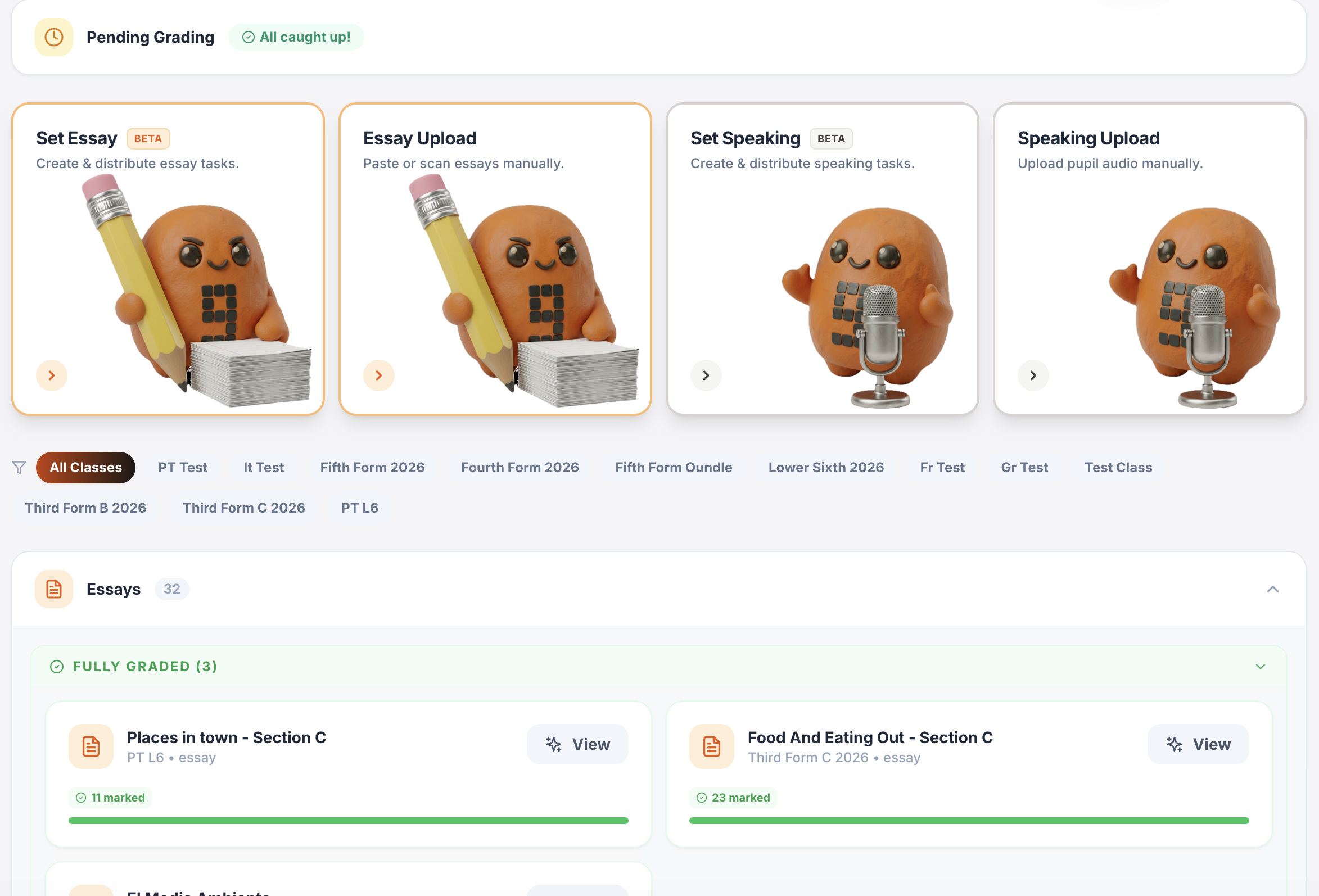
Gradebook & reports
Track scores, completion, engagement and learning evidence across classes.
Explore this guide →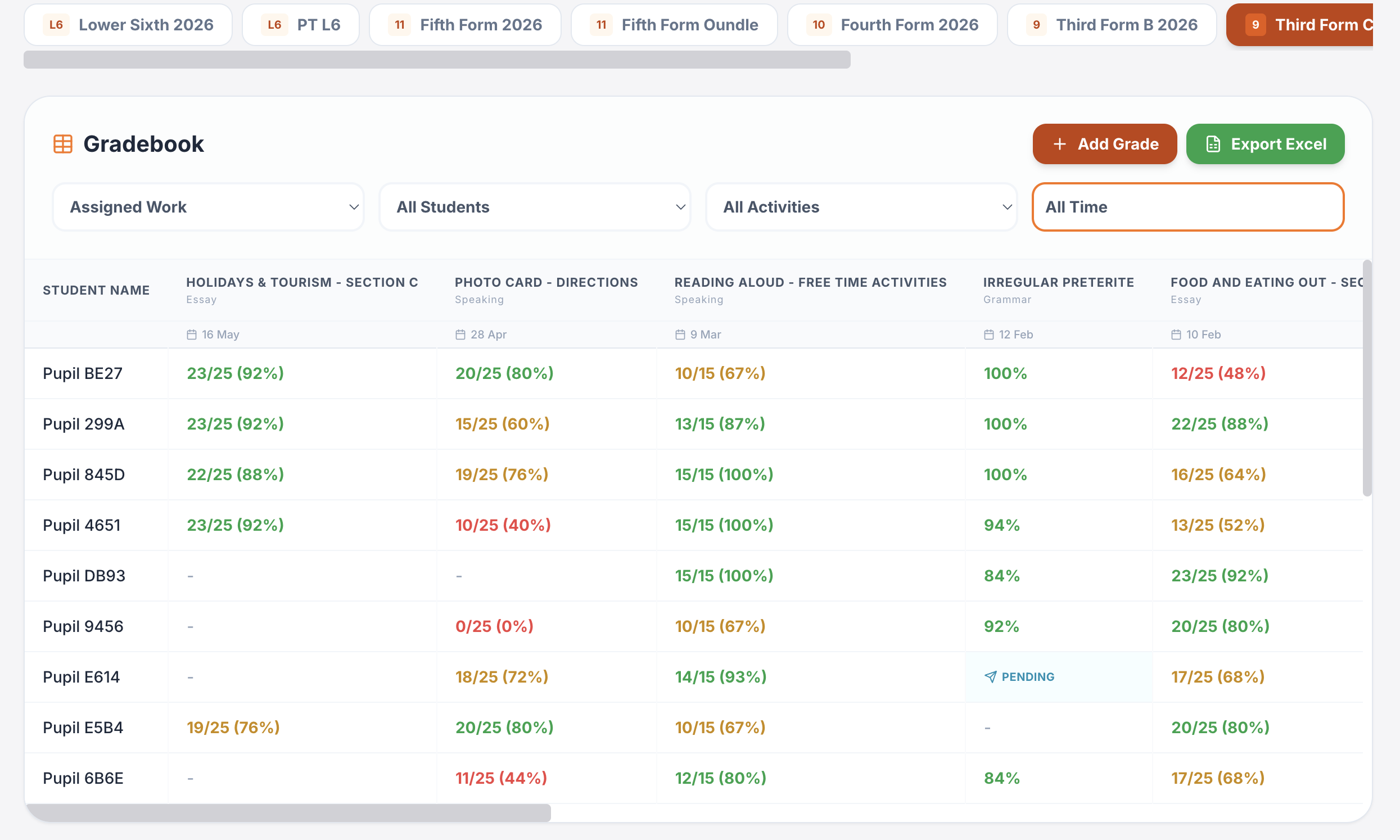
Interactive lessons
Generate, edit, save and reuse complete lesson presentations.
Explore this guide →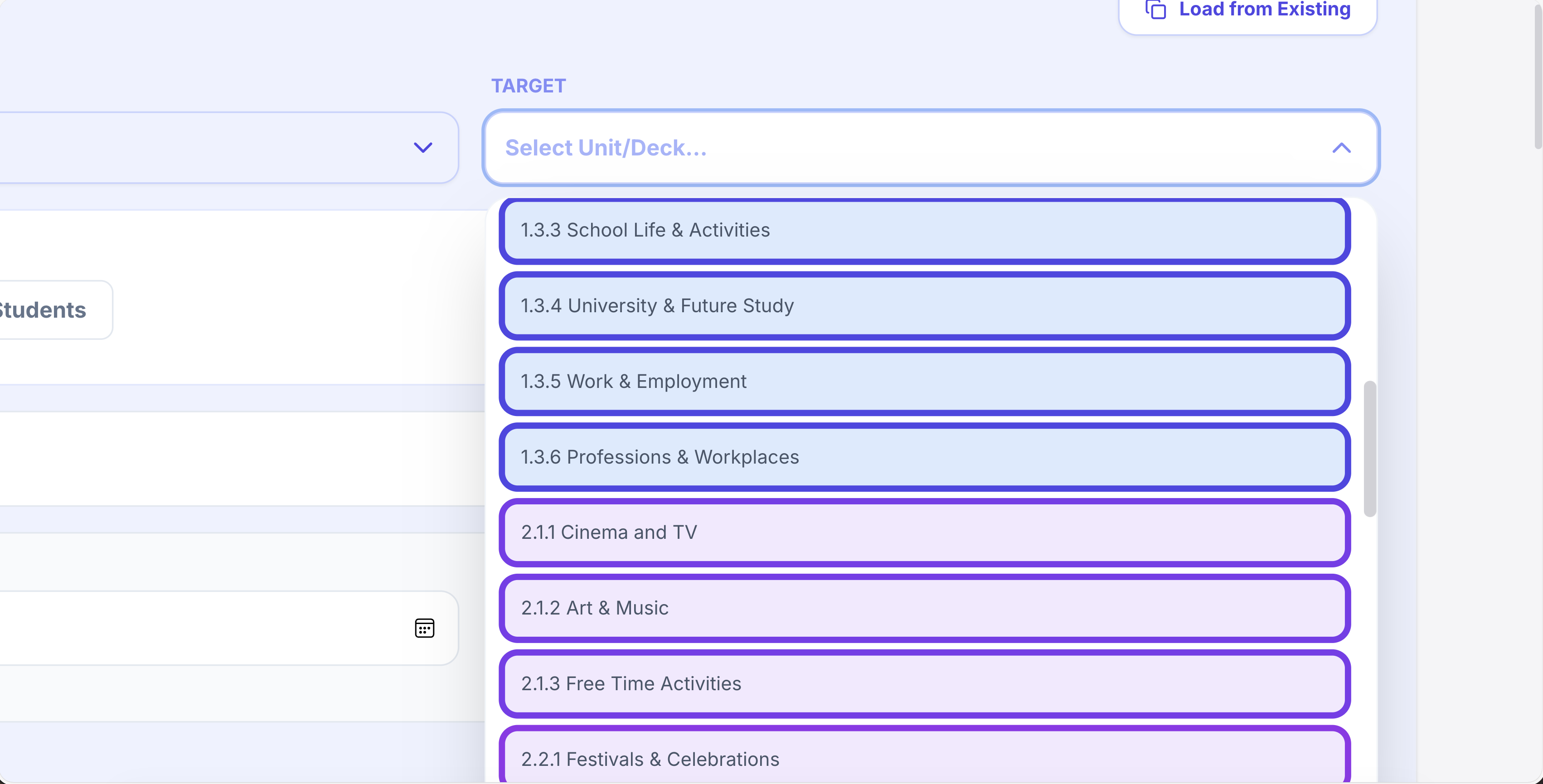
Printables in seconds
Vocabulary, grammar, translation, reading, listening, worksheets and booklets.
Explore this guide →Live games & whiteboards
Turn curriculum content into whole-class competition, retrieval and live response.
Explore this guide →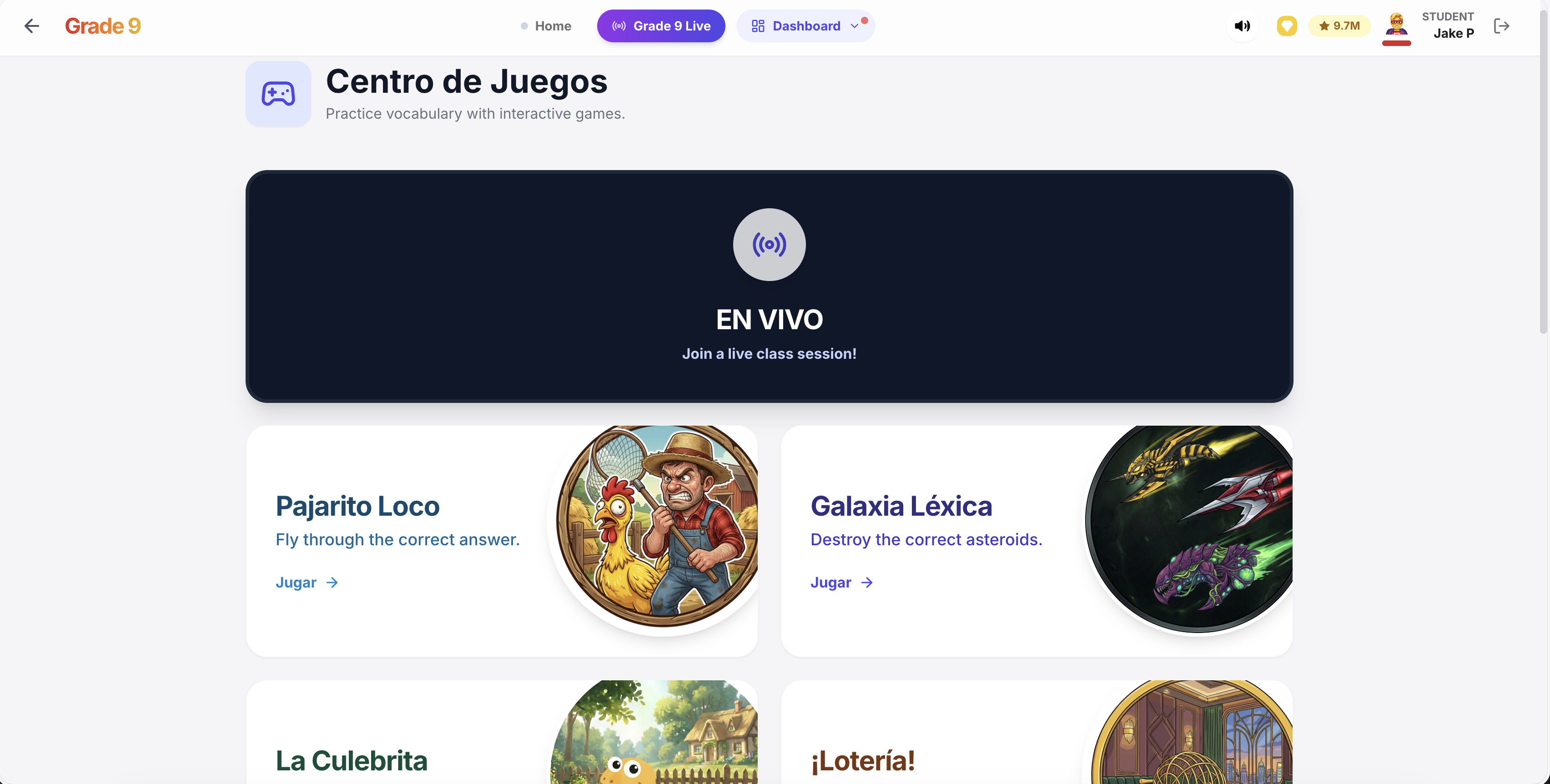
Assignments & tracking
Set work for a whole class or selected pupils, schedule it and see who has started or finished.
Explore this guide →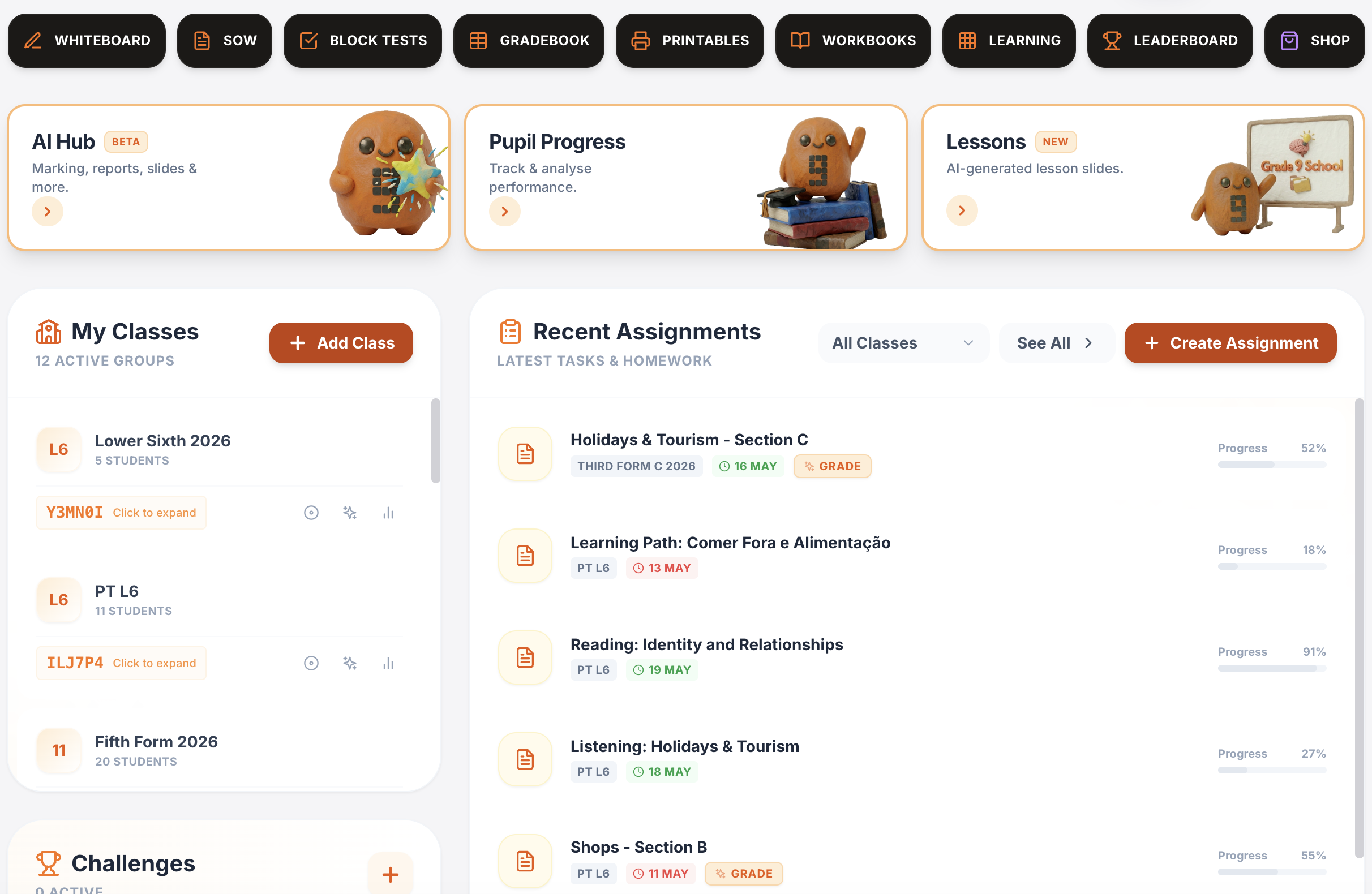
Vocabulary, grammar, translation & independent practice
Structured learning paths, flashcards, vocabulary builders, grammar, verb work, translation and tracked independent learning across supported languages.
Explore this guide →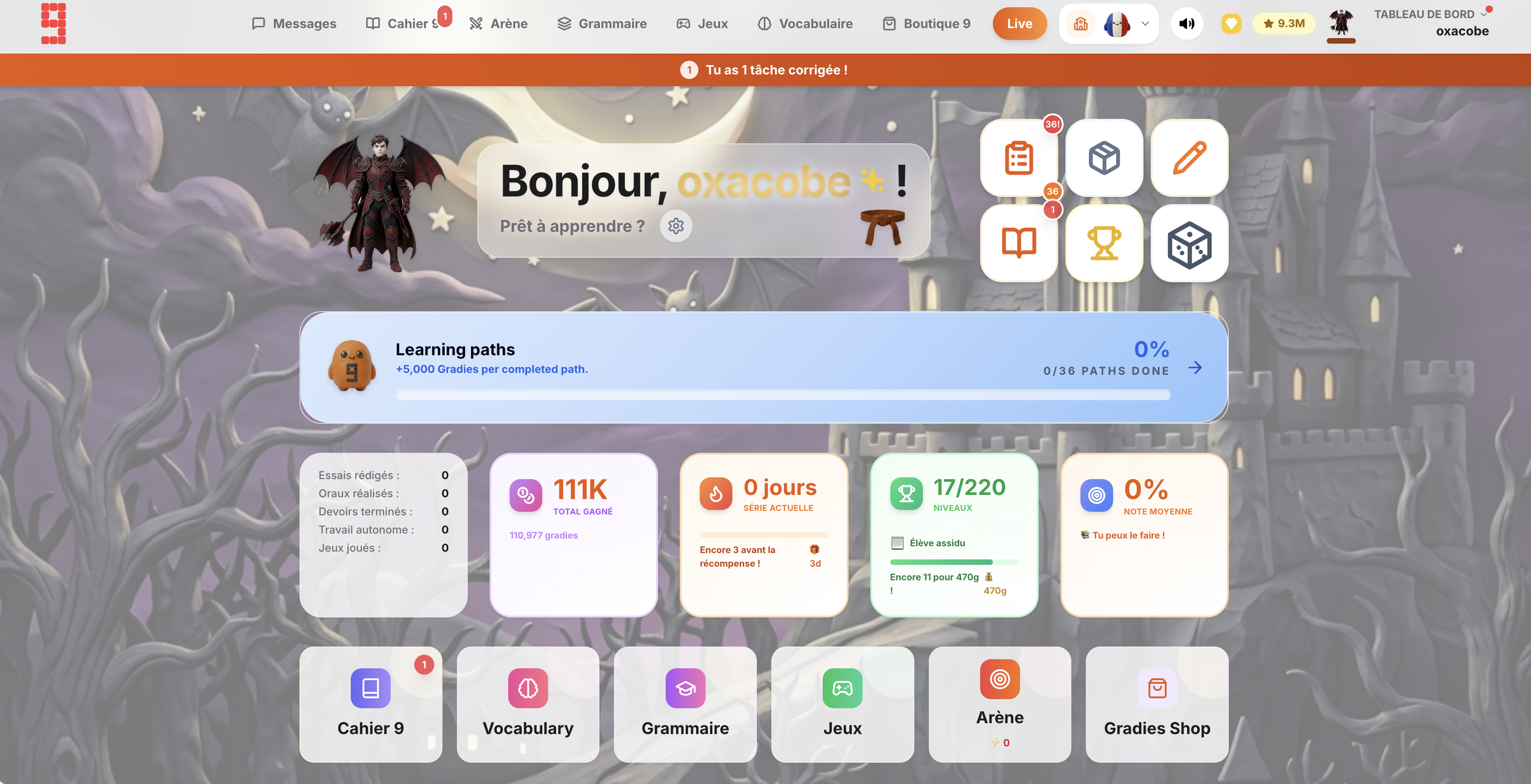
Spanish · French · German · Portuguese · Italian
Use the same platform architecture across the languages your department teaches, while keeping each class in its own language and curriculum context.
Explore language workflows →
From planning to progress, it all connects.
Curriculum management, assignments, AI feedback, printables, gradebook and lesson planning all sit inside the same Grade 9 environment.
Find the detail you need.
Open any section for the key facts, practical detail, examples and sources.
01Use the exam-board grammar list as the coverage map⌄
For AQA GCSE Spanish 8692, the grammar requirements are divided by tier. Higher tier includes the Foundation grammar as well as the additional Higher requirements. AQA states that pupils are expected to use the prescribed grammar across a range of contexts and assessment tasks and to develop both receptive and productive knowledge of it.
Pearson Edexcel’s current specification likewise samples the vocabulary and grammar listed in its appendices across the papers. Its grammar appendix and vocabulary/grammar guide should be the reference for exact required forms.
That means two things.
First, do not teach from a generic internet “all Spanish tenses” checklist and assume it matches the course.
Second, do not turn the official appendix itself into the lesson sequence. The specification tells you what must be known. Teachers still need to decide the order, examples, retrieval and cumulative practice that make it learnable.
02Build a grammar map, not a grammar mountain⌄
A practical department map can group requirements into a small number of recurring families.
The exact contents should come from your board and tier, but useful teaching families include:
Nouns, articles and agreement
Can pupils reliably manage:
- gender and number;
- definite and indefinite articles;
- regular adjective agreement;
- common determiner patterns?
These are high-frequency features. Small agreement errors can appear in almost any topic, so they need distributed practice rather than one “adjectives lesson” in Year 10.
Negation and questions
Can pupils understand and form:
- simple negatives;
- common negative expressions;
- question words;
- question word order?
These patterns matter in receptive skills as well as in speaking and writing.
High-frequency present-tense verb patterns
Secure frequent verbs and the regular patterns pupils need, but do not stop at a conjugation table.
The useful progression is:
form → meaning → sentence → changed subject → changed context
Past reference
Teach the past forms required by the board and tier, then repeatedly contrast them with present and future reference.
The examination does not usually announce:
This sentence is testing the preterite.
Pupils must recognise from meaning and context which form is needed.
Future reference
Move from a familiar future expression to any additional future morphology required by the course, always tied to meaning.
Pronouns, reflexives and word order
These become much easier when they are practised inside high-frequency sentences rather than as labels.
Higher complexity
At Higher tier, use the exact additional grammar list for the board rather than adding structures simply because they sound impressive.
Complexity that pupils cannot control is not automatically better Spanish.
03Teach grammar through contrast⌄
A form becomes easier to choose when pupils compare it with a plausible alternative.
Teacher-created progression:
Estudio español todos los días.
Ayer estudié español en casa.
Mañana voy a estudiar con mi amiga.
Now ask:
- Which sentence describes a routine?
- Which one is completed past time?
- Which one expresses a future plan?
- What in the sentence tells you?
- Change the subject.
- Make one sentence negative.
- Replace the time phrase and choose the form again.
This is more useful than asking for three disconnected conjugations because the pupil has to connect form with meaning.
Use only structures that belong to the relevant board and tier. The examples above are a teaching progression, not a replacement for the specification.
04A six-step grammar practice cycle⌄
1. Notice the pattern
Start from a short set of examples.
Ask pupils what changes and what stays the same.
2. Retrieve the form
Remove the model.
Prompt:
nosotros + hablar + present
The pupil produces the required form.
Keep this stage short and accurate.
3. Manipulate one variable
Give a correct sentence and change one thing:
- subject;
- time phrase;
- positive to negative;
- singular to plural;
- noun gender;
- person.
This reduces cognitive load while forcing grammar to move.
4. Translate a short sentence
Translation reveals whether the pupil can select the structure without the Spanish model already present.
Keep the sentence focused enough that the error can be diagnosed.
5. Hear or read the structure
Grammar must also be receptive.
Use a short listening, dictation or reading item and ask pupils to identify what the form tells them.
For example:
How do you know the speaker is referring to the past?
The answer should point to language evidence, not simply “because the topic is holidays”.
6. Produce in a new context
Return to the structure in a different topic a few lessons later.
If a pupil can use a form only inside the original sentence builder, the grammar is not yet flexible.
05Conjugation tables are useful — but they are not the end point⌄
Conjugation practice can make verb forms fast and accurate. That matters.
But a pupil who can complete:
hablo, hablas, habla...
may still fail to choose the correct form in a sentence.
Move from paradigm recall to constrained decisions.
For example:
- give the pronoun and infinitive;
- add a time marker;
- remove the pronoun;
- place the verb inside a sentence;
- mix two or three time frames;
- include an irregular form already required by the course.
The point is to make form retrieval serve meaning.
06Use grammar in listening and dictation⌄
Dictation is a particularly good grammar diagnostic.
A pupil hears:
Ayer estudié con mi hermana.
The final vowel in estudié is not a decorative spelling detail. It carries grammatical information.
Likewise, articles, adjective endings, negatives and pronouns can help a pupil decide what a partly heard sentence must contain.
When correcting dictation, ask:
What grammatical evidence could have helped you?
This stops listening, vocabulary and grammar becoming three separate subjects.
See the GCSE Spanish listening and dictation guide for a full classroom routine.
07Use translation to find the real gap⌄
Short English-to-Spanish translation is excellent at exposing what a pupil cannot yet retrieve.
Teacher-created example:
I usually play football, but yesterday I went to the cinema.
A mistake may come from:
- vocabulary;
- the chosen past form;
- adverb position;
- article use;
- conjunctions;
- spelling.
Do not simply mark the final sentence right or wrong. Classify the error and set the next practice accordingly.
Spanish-to-English translation is also useful because it tests whether pupils recognise grammatical meaning in a form they did not produce themselves.
08Interleave old grammar with new vocabulary⌄
A common curriculum problem is that each topic appears to own one grammar point.
Pupils then learn:
Topic A = present tense
Topic B = preterite
Topic C = future
That creates strong contextual cues but weak selection.
Instead, once a grammar feature has been taught, keep asking for it with later vocabulary.
A new topic should provide a new context for old grammar.
For example, a past-time contrast first practised through holidays can reappear later in school, free time, technology or relationships.
The language changes. The grammatical decision stays alive.
09A practical grammar retrieval routine⌄
A ten-minute start-of-lesson routine can include:
2 minutes — form retrieval
Four rapid items from previously taught grammar.
2 minutes — sentence manipulation
Change subject, time or polarity.
2 minutes — translation
One short sentence from English to Spanish.
2 minutes — listening or dictation
One sentence containing the same pattern.
2 minutes — explanation
Pupils identify the evidence that makes the form correct.
This is deliberately small. Grammar improves through repeated successful retrieval more reliably than through occasional enormous revision lessons.
10Common GCSE grammar mistakes⌄
Teaching the label instead of the decision
The pupil can define “preterite” but cannot decide when to use it.
Better: contrast meanings and contexts.
One grammar point, one topic, then never again
The form looks secure at the end of the unit and disappears three months later.
Better: cumulative retrieval across later topics.
Conjugation without sentences
Forms are accurate in tables but not selected in communication.
Better: move quickly from form recall to sentence decisions.
Production only
Pupils can write a memorised structure but fail to recognise it in listening or reading.
Better: practise grammar receptively and productively.
Correcting the answer without diagnosing the cause
A pupil receives the right form but does not know why their choice was wrong.
Better: classify the error as form, meaning, agreement, word order, vocabulary or spelling.
Adding impressive Higher structures before foundations are stable
The pupil accumulates phrases but cannot control ordinary agreement and verb forms.
Better: use the exact tier requirements and build complexity on secure foundations.
Treating vocabulary and grammar as separate revision seasons
Pupils revise a word list in one week and a tense booklet in another.
Better: make vocabulary carry grammar and grammar operate on real vocabulary.
11Using Grade 9 for grammar and conjugation practice⌄
Grade 9’s Grammar area is scoped by the current target language and curriculum combination. Where grammar content is not available for that context, the interface does not pretend otherwise by exposing empty units.
Where grammar is available, pupils can move through the curriculum structure and saved grammar progress can contribute to their learning evidence.
The broader platform also includes conjugation and flashcard practice, and teacher progress views can filter saved activity by categories including Grammar and Verb Drills.
The limitation is important: the existence of a Grammar area does not mean every target language and every curriculum level has identical grammar content. Teachers should keep the exam-board specification as the coverage authority.