 School






MFL lesson planning: a practical framework for lessons that go somewhere
A practical MFL lesson-planning framework for KS3 and GCSE teachers, from final task and language load to retrieval, modelling, practice and review.
Grade 9 School brings curriculum, lesson planning, practice, homework, feedback, live activities, printables and progress tracking into one connected teaching workflow.
 Spanish
 French
 German
 Portuguese
 Italian
Practice, feedback and progress in one place.

A good MFL lesson does not need fifteen activities. It needs a clear destination.
Start by deciding what pupils should be able to understand or produce by the end. Then work backwards:
- What language must already be secure?
- What new language is genuinely needed?
- Where will pupils hear and read it?
- Where will they retrieve, manipulate and say it?
- What final task will show whether they can use it with less support?
That sequence is more useful than starting with a worksheet, a game or a slide deck and hoping the lesson eventually acquires a purpose.
Ofsted’s languages research review describes progression through the connected development of phonics, vocabulary and grammar, with planned revisiting and practice across the language skills. The KS3 National Curriculum likewise expects growing competence in listening, speaking, reading and writing on a foundation of core grammar and vocabulary. [1][2]
Explore the topic ↓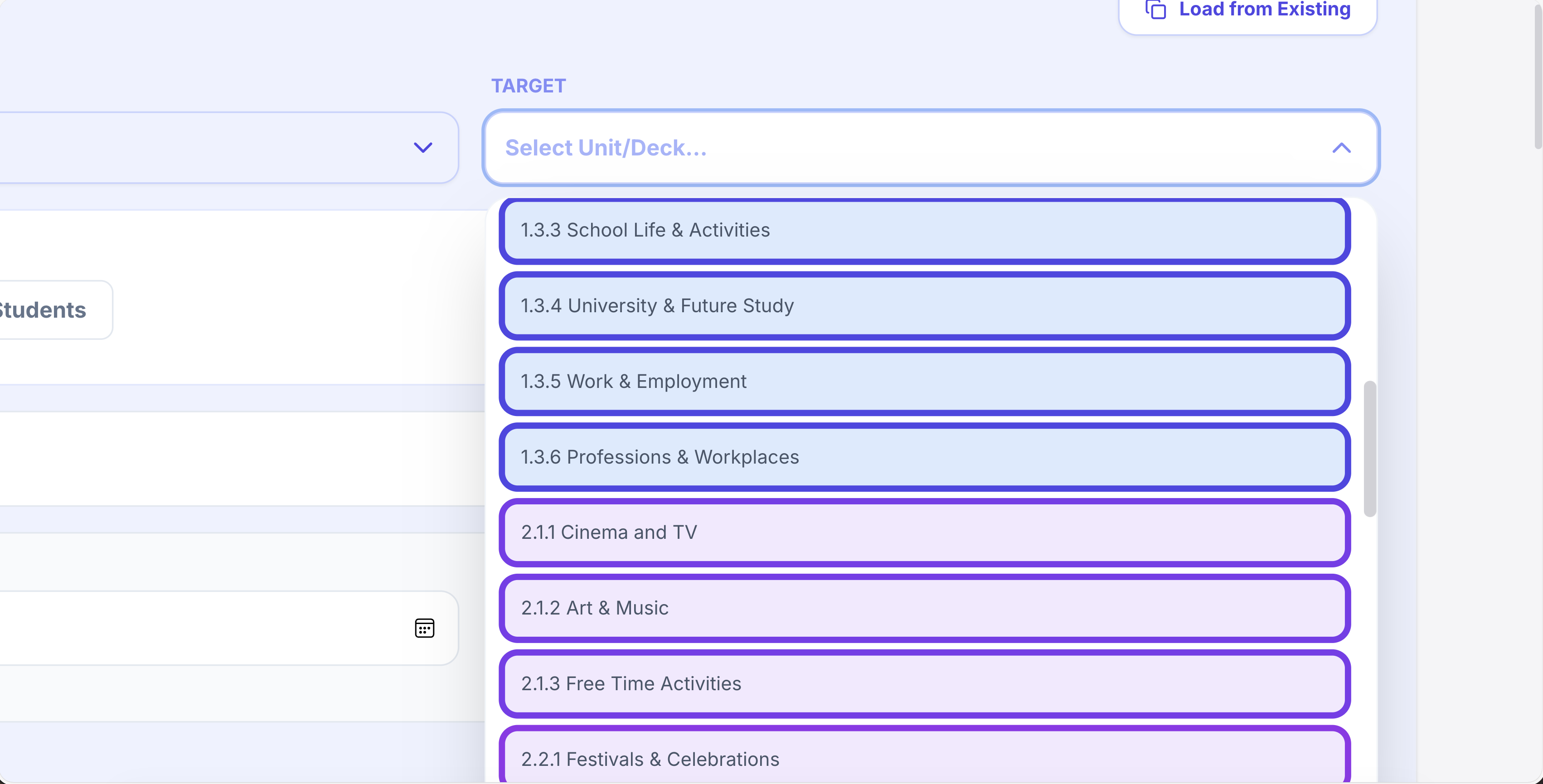
One platform for teaching, practice, feedback and progress.
Plan lessons, set homework, run live activities, generate printables, give AI-supported marking and track progress across Spanish, French, German, Portuguese and Italian.
Writing & speaking marking
Set writing and speaking tasks, collect submissions, generate detailed feedback and keep teacher review in the loop.
Explore this guide →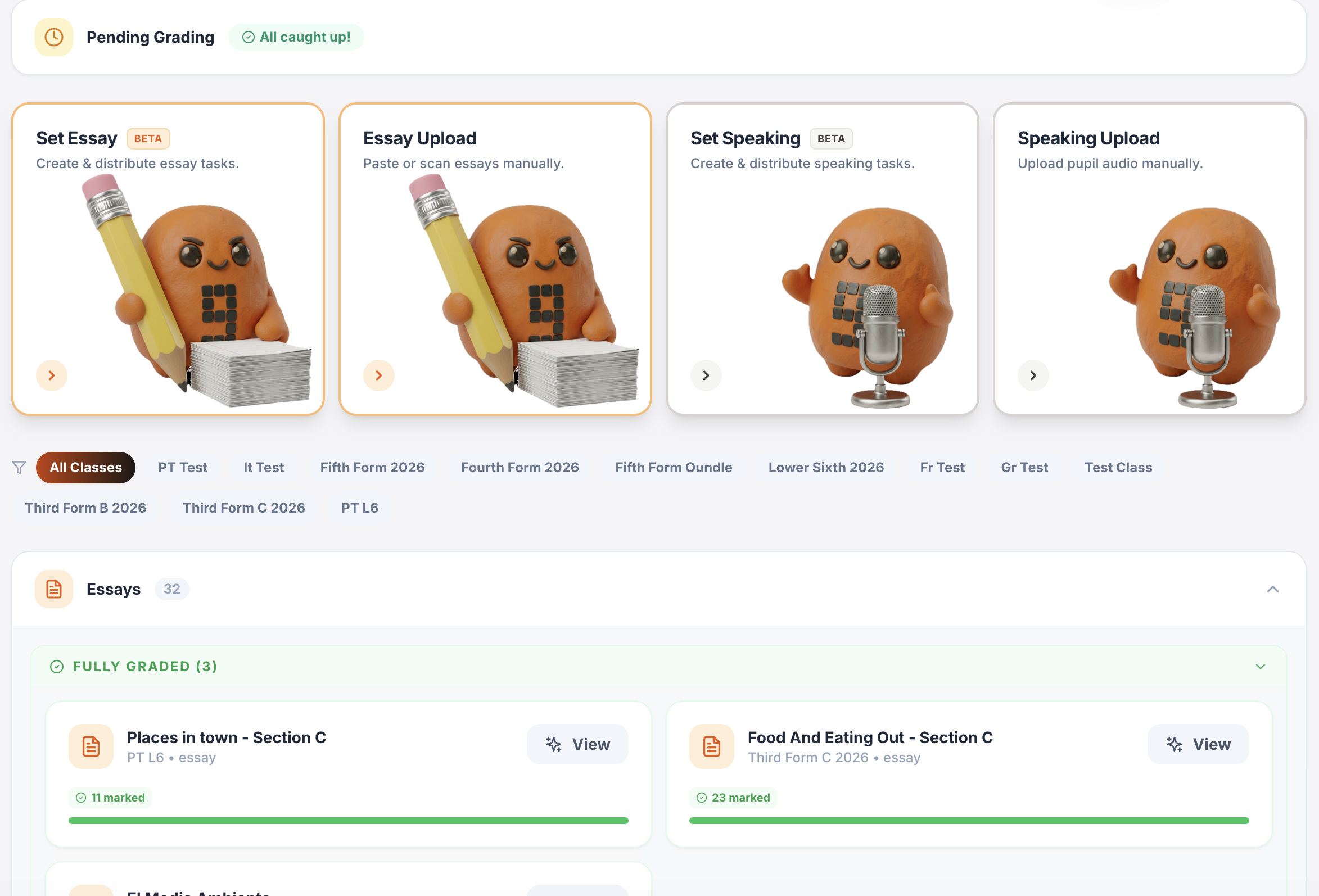
Gradebook & reports
Track scores, completion, engagement and learning evidence across classes.
Explore this guide →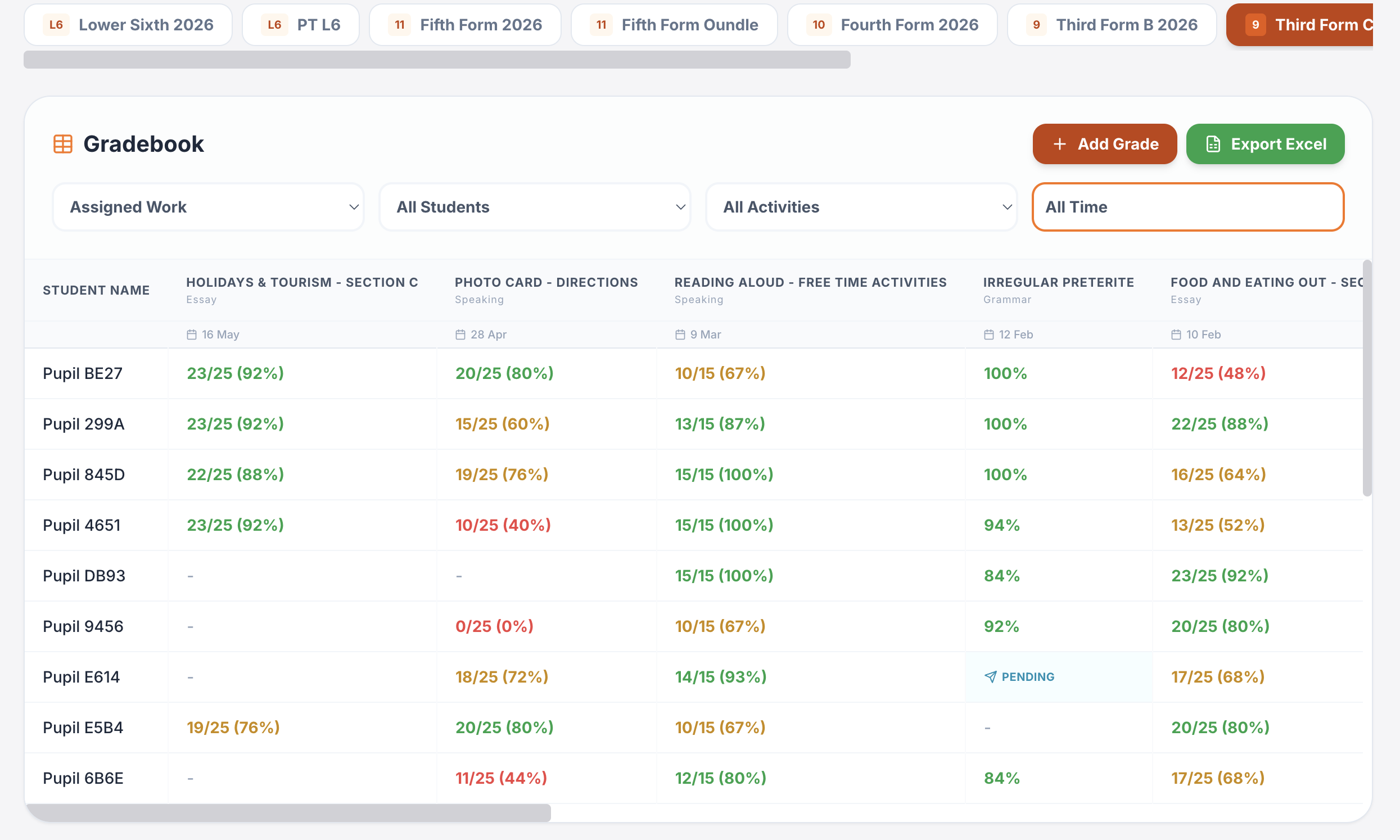
Interactive lessons
Generate, edit, save and reuse complete lesson presentations.
Explore this guide →Printables in seconds
Vocabulary, grammar, translation, reading, listening, worksheets and booklets.
Explore this guide →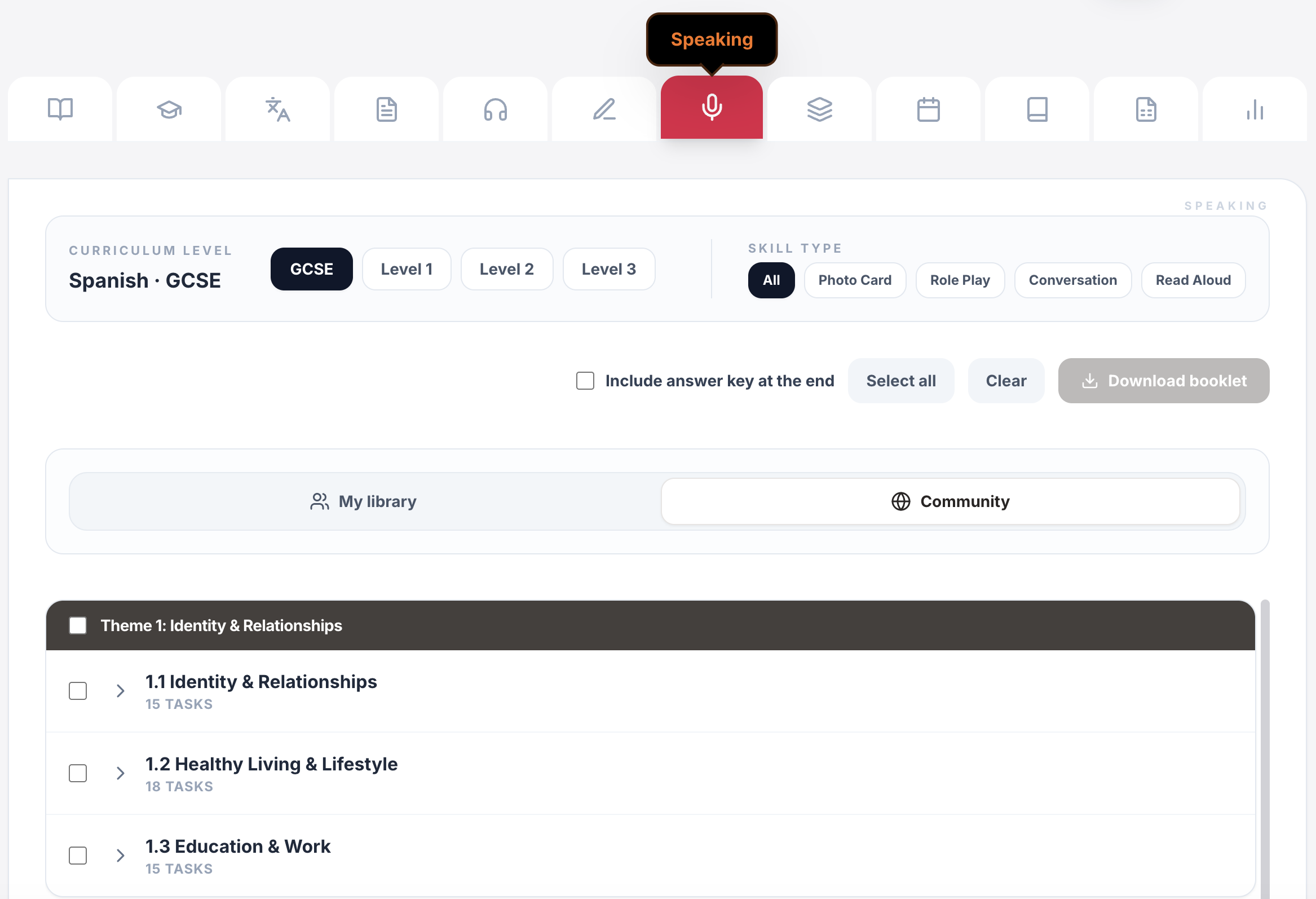
Live games & whiteboards
Turn curriculum content into whole-class competition, retrieval and live response.
Explore this guide →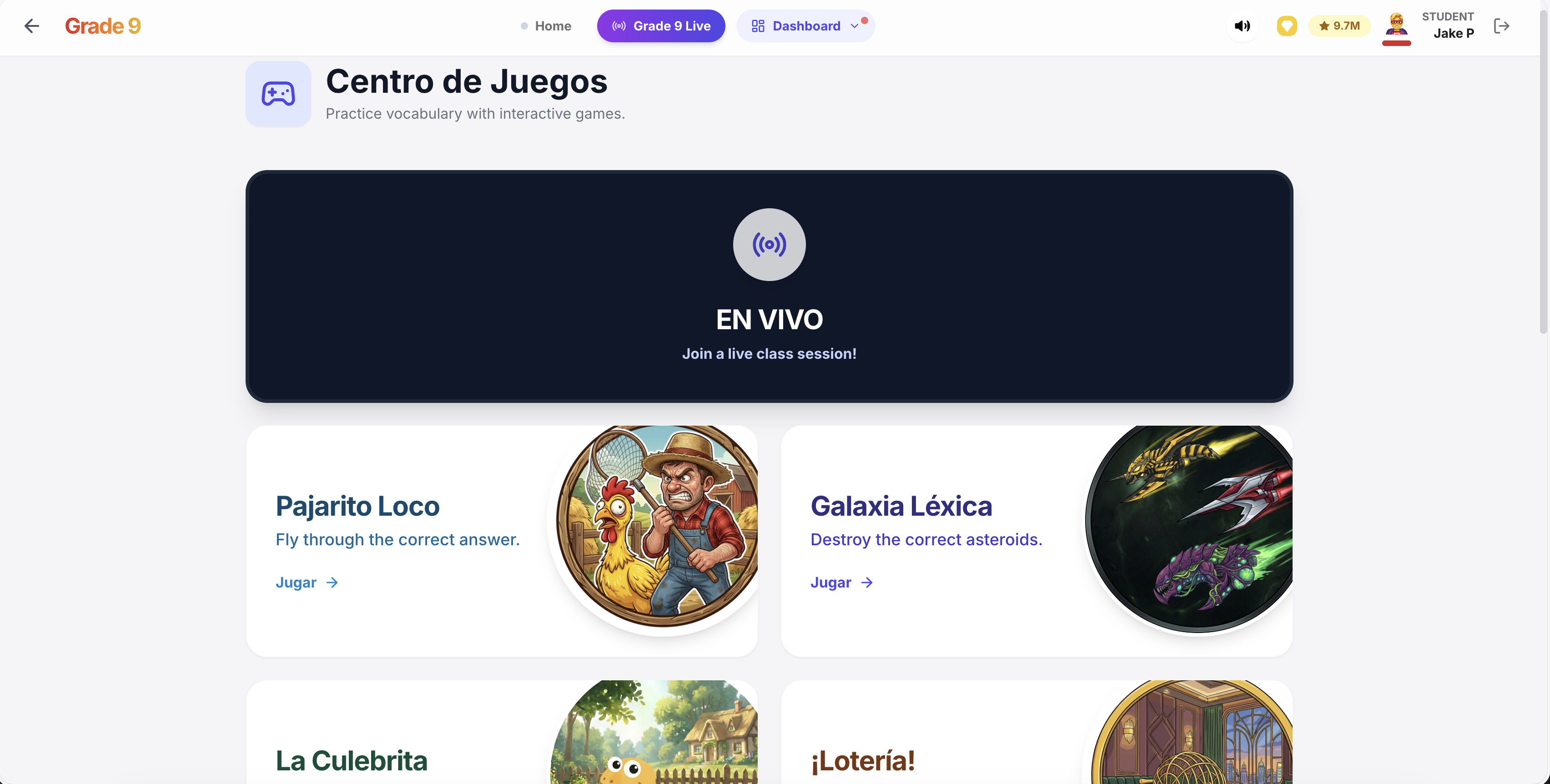
Assignments & tracking
Set work for a whole class or selected pupils, schedule it and see who has started or finished.
Explore this guide →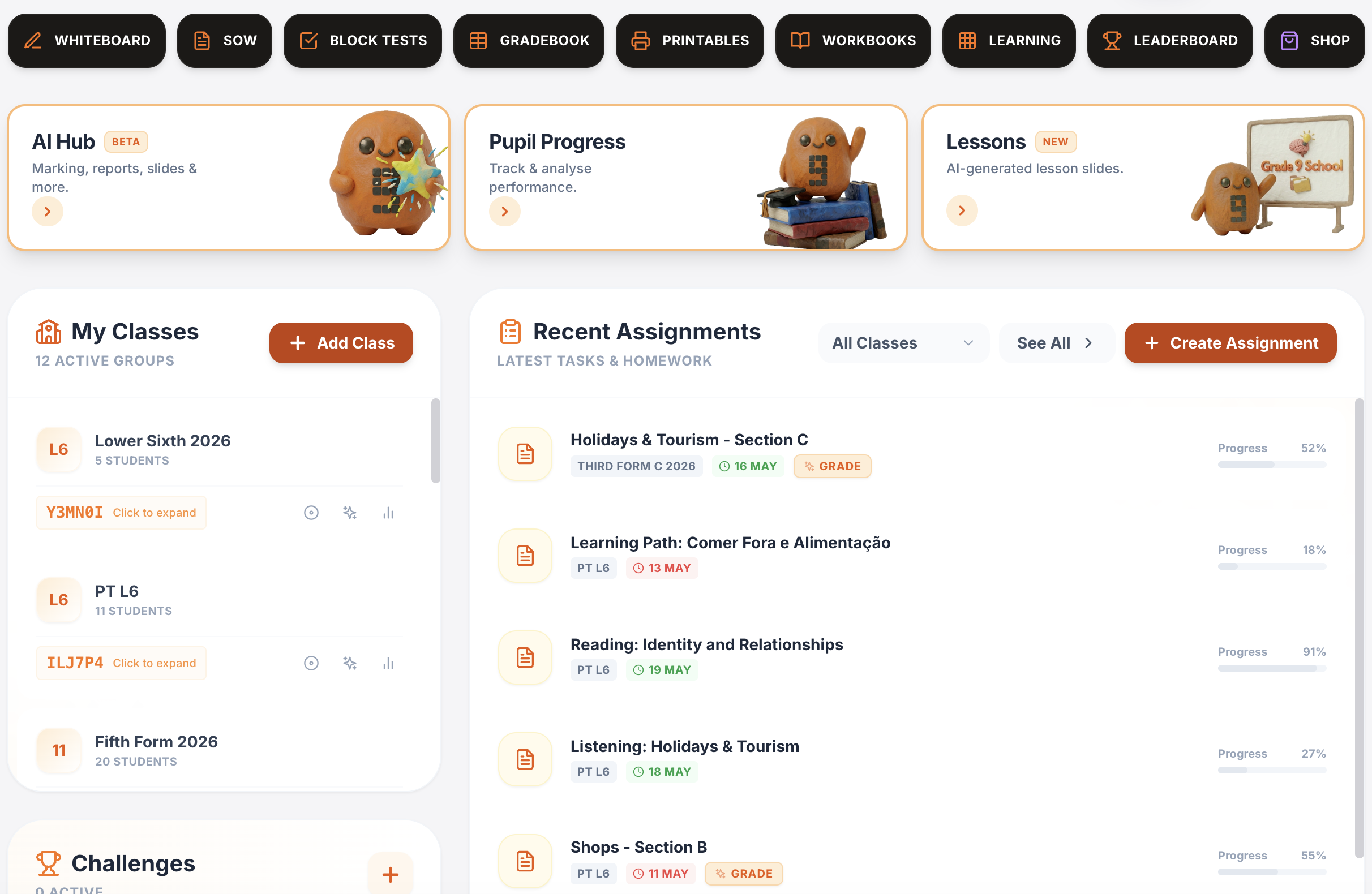
Vocabulary, grammar, translation & independent practice
Structured learning paths, flashcards, vocabulary builders, grammar, verb work, translation and tracked independent learning across supported languages.
Explore this guide →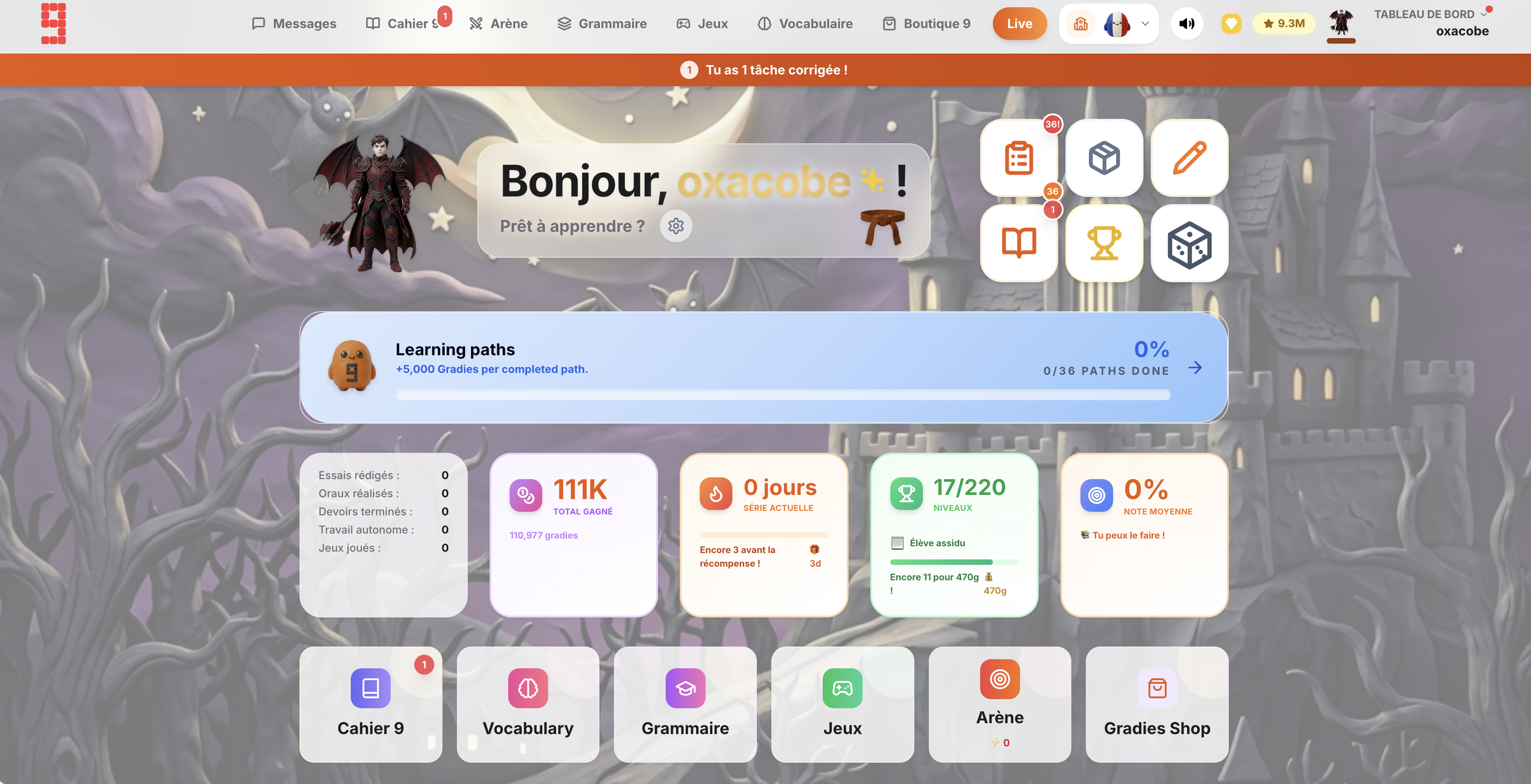
Spanish · French · German · Portuguese · Italian
Use the same platform architecture across the languages your department teaches, while keeping each class in its own language and curriculum context.
Explore language workflows →
From planning to progress, it all connects.
Curriculum management, assignments, AI feedback, printables, gradebook and lesson planning all sit inside the same Grade 9 environment.
Find the detail you need.
Open any section for the key facts, practical detail, examples and sources.
01Start with the final task⌄
The fastest way to make a lesson coherent is to decide what pupils will do near the end.
For example:
Final task: Tell a partner what you did last weekend, give two opinions and ask one follow-up question.
That immediately creates planning decisions.
Pupils will need:
- a small set of high-utility past-tense verbs;
- time expressions;
- opinion phrases;
- question forms;
- enough listening and reading input to see the language working;
- structured oral rehearsal before the freer exchange.
Now the earlier activities have a job. They are not there because “we normally do a gap fill after the starter”. They are there because each one removes a barrier to the final task.
A useful test
Before adding an activity, ask:
If I remove this, are pupils less prepared for the final task?
If the answer is no, the activity may be optional, decorative or simply in the wrong lesson.
02Control the language load⌄
Language lessons become difficult very quickly when the amount of new material is not controlled.
A planning grid can be as simple as this:
| Keep secure | Introduce or reactivate | Expect pupils to produce |
|---|---|---|
| familiar opinions | 4–6 target verbs | 3 connected sentences |
| known connectives | one useful time phrase | one follow-up question |
| core pronunciation pattern | one grammatical contrast | a short spoken exchange |
The exact amount changes with the class, but the principle is stable: make a deliberate distinction between what pupils are meant to recognise, what they are meant to retrieve and what they are expected to produce.
If every word, grammar point and task format is new at once, the lesson is hard to diagnose. You cannot easily tell whether a pupil is struggling with the language, the instructions, the reading load or the task itself.
03Build the lesson in a purposeful sequence⌄
There is no single correct MFL lesson template. A practical sequence often moves through six broad phases.
1. Retrieve what the new learning depends on
Use a short task that brings required prior language back into working memory.
Good retrieval is specific. If today’s lesson needs opinions and past-tense verbs, retrieve those. Do not spend ten minutes revising colours simply because colours are easy to test.
2. Model the new language in context
Pupils need to encounter the target language before they are expected to manipulate it independently.
This might be:
- a short listening passage;
- a teacher model;
- a sentence builder;
- a narrow reading;
- a worked dialogue;
- a small set of example sentences.
The model should make the target pattern visible without drowning it in unnecessary language.
3. Check understanding
Use a task where you can tell quickly whether pupils have understood the sound, vocabulary, grammar or meaning that the lesson depends on.
Examples:
- true/false with justification;
- match sentence halves;
- choose the correct verb form;
- spot the difference between two near-identical sentences;
- mini-whiteboard translation of one controlled phrase.
4. Move into controlled production
Now pupils begin to produce the language, but with enough structure to experience success.
Examples:
- substitution from a sentence builder;
- sentence reconstruction;
- short translations;
- cue-card speaking;
- changing one element of a model sentence;
- question-and-answer chains.
5. Reduce the support
This is where the lesson starts to reveal whether the language is becoming available rather than merely copied.
Remove part of the scaffold. Change the context. Ask for a new combination. Introduce a short information gap. Give pupils a choice of content.
6. Return to the final task
The final task should feel like the reason for the lesson, not a surprise extension for the fastest pupils.
It can be brief. A two-minute speaking exchange, a short paragraph, a listening response or a small translation can all work if they genuinely show the intended learning.
04Plan challenge without making the language inaccessible⌄
“More difficult” is not the same as “more useful”.
A demanding final task can still begin with accessible language. In fact, pupils are more likely to take on a challenging outcome when the first minute of the lesson lets them retrieve something successfully.
Useful ways to raise challenge include:
- removing scaffolds gradually;
- increasing choice;
- requiring pupils to combine familiar structures;
- switching from recognition to production;
- changing time frame or person;
- asking for justification;
- adding an unprepared follow-up question.
Less useful ways include:
- adding large amounts of unknown vocabulary;
- making instructions complicated;
- hiding the target structure inside dense text;
- asking for long output before pupils have rehearsed the building blocks.
05Plan listening and reading as teaching, not only testing⌄
A common planning trap is to use receptive tasks only to find out what pupils cannot understand.
Listening and reading can also model the exact language pupils will later need.
A short passage can:
- recycle target vocabulary;
- demonstrate word order;
- expose pronunciation or sound-spelling patterns;
- show the grammatical structure in context;
- provide phrases pupils can later adapt.
This is especially useful before speaking or writing. The receptive phase gives pupils something to work with rather than asking them to invent language from a blank page.
06Keep the oral phase deliberate⌄
MFL lessons can become visually busy while pupils themselves say very little.
When planning, mark the points at which every pupil will need to produce language aloud.
For example:
- whole-class choral response;
- rapid paired retrieval;
- sentence-builder substitution;
- information gap;
- rehearsal before a final response;
- brief unscripted follow-up.
The question is not “Does the lesson contain a speaking activity?” It is “How much successful target-language production will each pupil actually get?”
07Reuse before you rebuild⌄
Planning time is easily wasted recreating a resource that is already almost right.
A useful decision rule is:
- Reuse when the existing resource already fits the class.
- Edit when only local changes are needed.
- Copy when a colleague’s resource is useful but you need your own adaptable version.
- Generate or build from scratch when the lesson genuinely needs a different structure.
The Grade 9 Activity Library follows this logic. Teachers can preview saved work, reuse their own resources and, where available, copy school or community material before adapting it. A saved lesson can be reopened and edited rather than regenerated because one sentence needs changing.
08A worked MFL lesson-planning example⌄
A Year 9 Spanish class is moving from present-tense opinions to talking about what they did at the weekend.
Final task: pupils give a 30–45 second answer about the weekend and ask their partner one question.
Language needed:
- four high-frequency past-tense verbs;
- two sequencing phrases;
- two opinion phrases;
- one question frame.
Lesson sequence:
- Retrieve familiar weekend vocabulary and opinions.
- Hear a short teacher model containing the four target verbs.
- Match the verbs to meaning and identify the time markers.
- Build controlled sentences from a sentence builder.
- Rehearse in pairs with prompts, then remove half the prompts.
- Complete the final paired response and note one thing to improve.
The lesson can be playful, fast and varied. Its coherence comes from the fact that every activity prepares the same outcome.
09Where lesson planning goes wrong⌄
Too many disconnected activities
A lesson can be entertaining and still feel fragmented. If the tasks do not build on one another, pupils repeatedly start again instead of developing one piece of language.
The final task requires language that was never practised
If pupils suddenly need a tense, question form or vocabulary set that was absent from the lesson, the scaffold has failed.
Everything is equally supported
If pupils finish using the exact model they started with, you have not learned much about what they can retrieve independently.
Everything is equally unsupported
Removing all support too early can turn productive practice into guessing, silence or English.
The plan confuses quantity with challenge
Ten activities, three grammar points and forty new words do not automatically create a stronger lesson.
The generated resource is treated as finished
A structurally complete deck can still contain an awkward example, an unsuitable language choice or a task that does not fit your class. Review it before teaching.
10How Grade 9 School can support this workflow⌄
Grade 9’s Presentation Generator is built around selected curriculum content, activity choices, optional grammar focus and an optional final task. When a final task is generated, the current workflow creates that outcome first and then builds the earlier lesson activities to prepare for it.
Generated lessons are saved, can be reopened in the lesson player and can be edited. The useful part is not “AI made slides”. It is the planning loop:
choose the outcome → build the sequence → review the language → teach → reuse or adapt later
The teacher remains responsible for the actual language, examples, pacing and pedagogical decisions.
12Sources⌄
[1] Ofsted, Research review series: languages:
https://www.gov.uk/government/publications/curriculum-research-review-series-languages/curriculum-research-review-series-languages
[2] Department for Education, National curriculum in England: languages programmes of study:
https://www.gov.uk/government/publications/national-curriculum-in-england-languages-progammes-of-study/national-curriculum-in-england-languages-progammes-of-study
Further search-intent context:
British Council TeachingEnglish, Lesson plans:
https://www.teachingenglish.org.uk/professional-development/teachers/planning-lessons-and-courses/lesson-plans