 School

GCSE Spanish listening and dictation: what pupils need to do
Teach and revise GCSE Spanish listening and dictation for current AQA and Edexcel courses, with exam format, practice routines, common errors and examples.
Grade 9 School brings curriculum, lesson planning, practice, homework, feedback, live activities, printables and progress tracking into one connected teaching workflow.
 Spanish
 French
 German
 Portuguese
 Italian
Practice, feedback and progress in one place.

Dictation is not a spelling test bolted onto the end of GCSE Spanish listening. It sits at the point where several things meet: hearing the sounds accurately, segmenting a sentence into words, knowing what those words probably mean, and using enough grammar to write a plausible Spanish sentence.
That is why pupils who “understand the gist” can still find dictation difficult, and why doing more full listening papers is not always the quickest fix.
The useful preparation sequence is smaller and more deliberate:
- hear and identify the message;
- divide the speech into meaningful chunks;
- map sounds onto likely spellings;
- use vocabulary and grammar to check the transcription;
- listen again to confirm, rather than simply adding more words.
One platform for teaching, practice, feedback and progress.
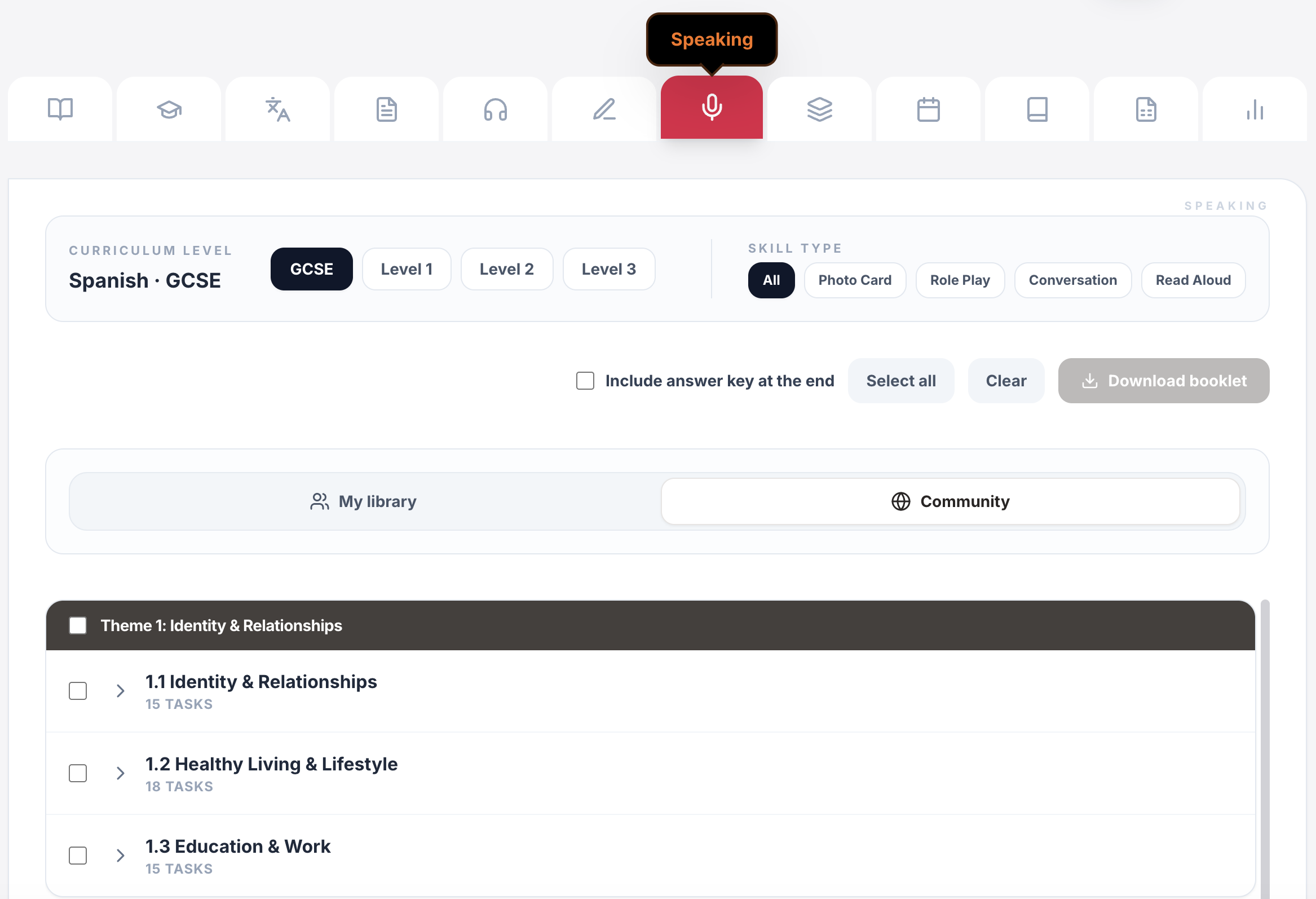
Plan lessons, set homework, run live activities, generate printables, give AI-supported marking and track progress across Spanish, French, German, Portuguese and Italian.
Writing & speaking marking
Set writing and speaking tasks, collect submissions, generate detailed feedback and keep teacher review in the loop.
Explore this guide →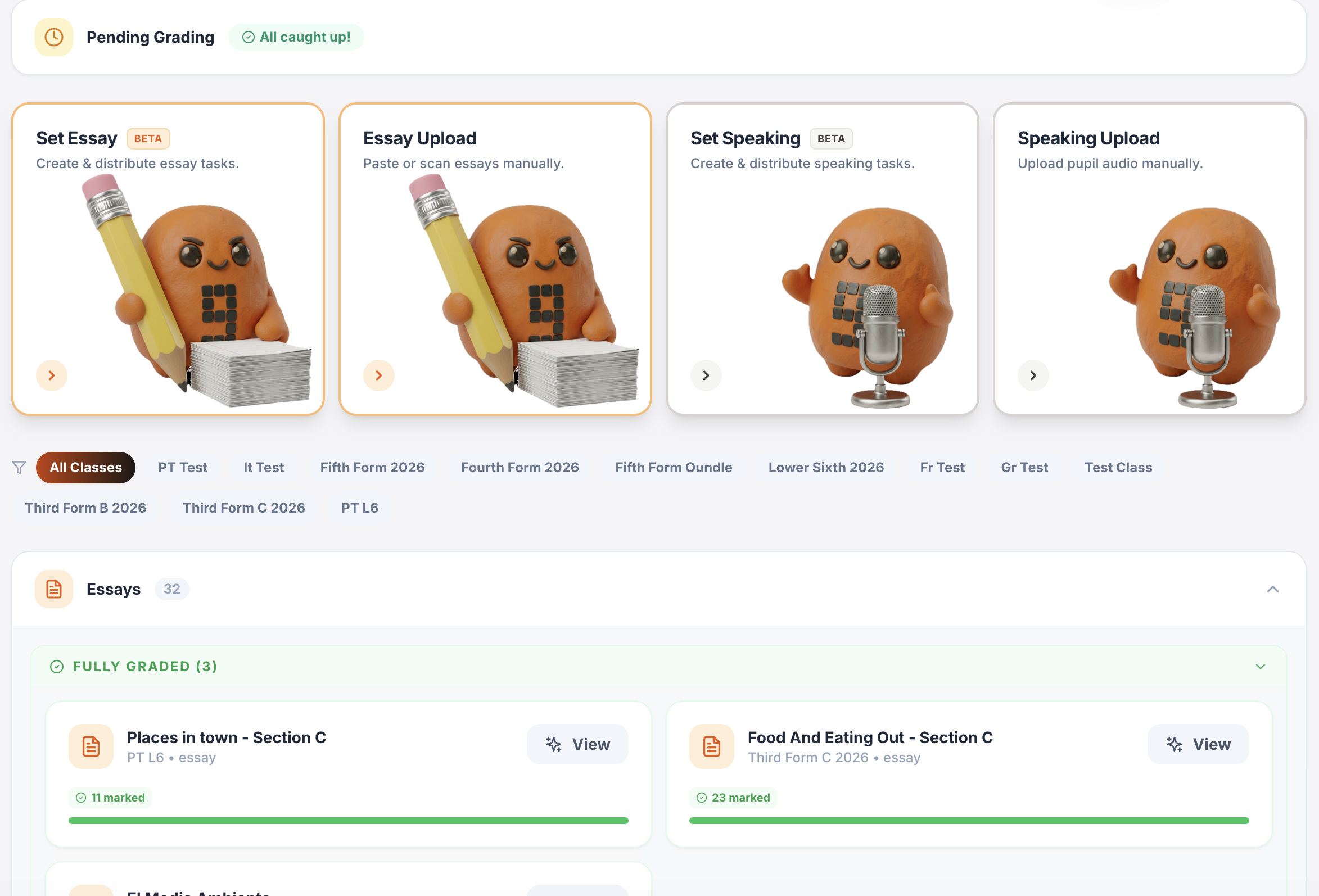
Gradebook & reports
Track scores, completion, engagement and learning evidence across classes.
Explore this guide →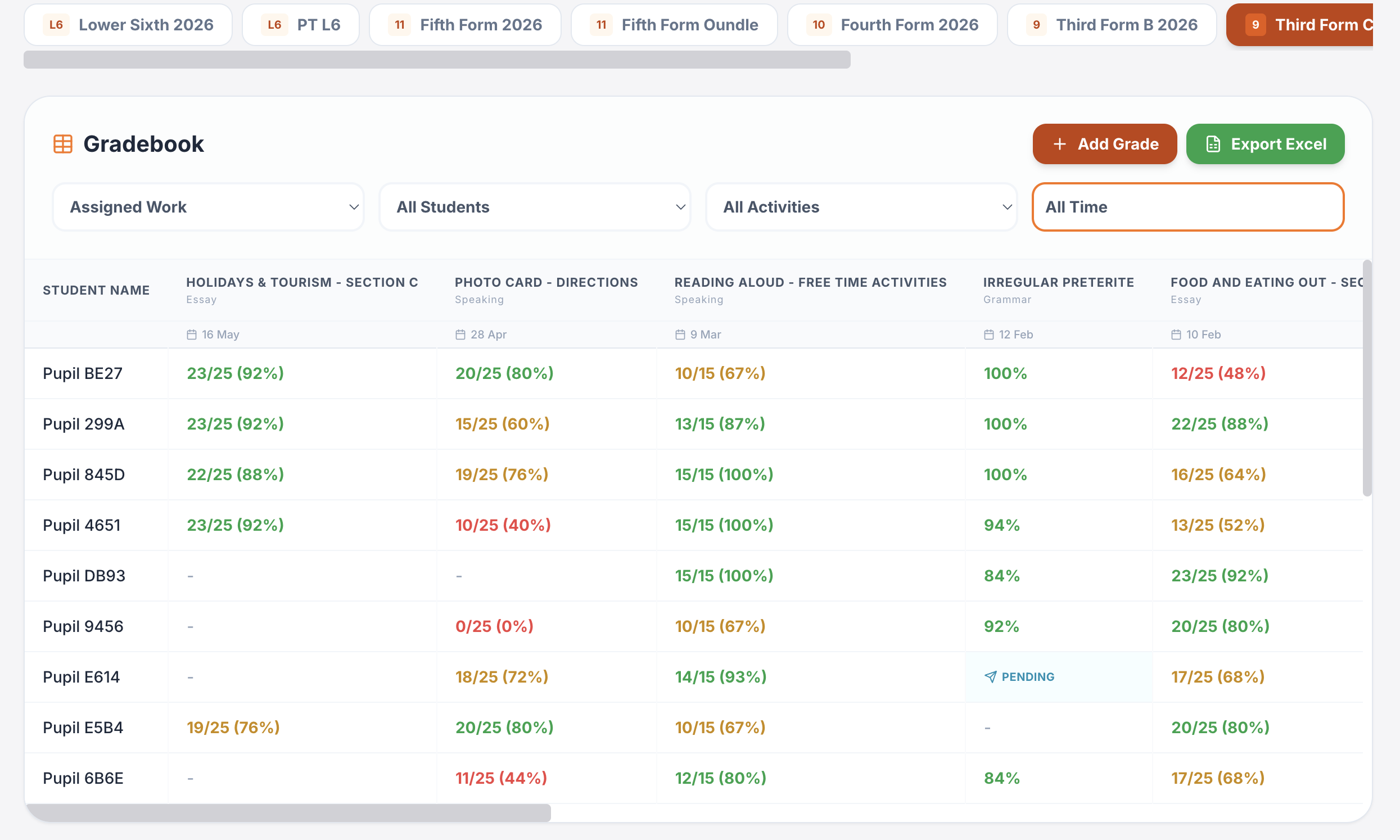
Interactive lessons
Generate, edit, save and reuse complete lesson presentations.
Explore this guide →
Printables in seconds
Vocabulary, grammar, translation, reading, listening, worksheets and booklets.
Explore this guide →Live games & whiteboards
Turn curriculum content into whole-class competition, retrieval and live response.
Explore this guide →
Assignments & tracking
Set work for a whole class or selected pupils, schedule it and see who has started or finished.
Explore this guide →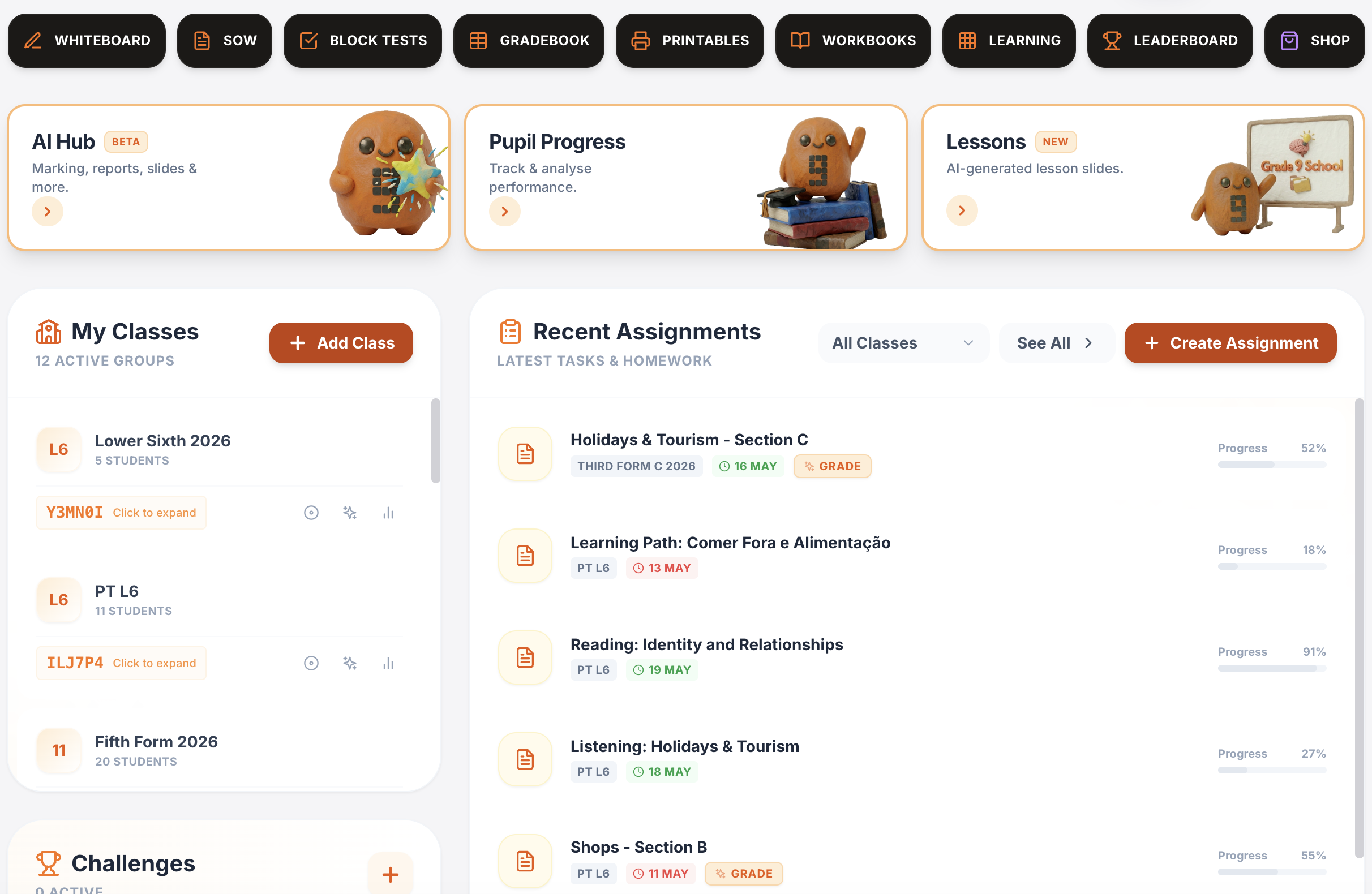
Vocabulary, grammar, translation & independent practice
Structured learning paths, flashcards, vocabulary builders, grammar, verb work, translation and tracked independent learning across supported languages.
Explore this guide →
Spanish · French · German · Portuguese · Italian
Use the same platform architecture across the languages your department teaches, while keeping each class in its own language and curriculum context.
Explore language workflows →
From planning to progress, it all connects.
Curriculum management, assignments, AI feedback, printables, gradebook and lesson planning all sit inside the same Grade 9 environment.
Find the detail you need.
Open any section for the key facts, practical detail, examples and sources.
01What does the current GCSE listening paper look like?⌄
AQA and Pearson Edexcel both include listening comprehension and dictation, but the papers are not identical.
| AQA GCSE Spanish 8692 | Pearson Edexcel GCSE Spanish 1SP1 | |
|---|---|---|
| Listening paper | Paper 1 | Paper 2 |
| Foundation | 35 minutes, 40 marks | 45 minutes including 5 minutes reading time, 50 marks |
| Higher | 45 minutes, 50 marks | 60 minutes including 5 minutes reading time, 50 marks |
| Listening comprehension | 32 marks Foundation / 40 Higher | 40 marks |
| Dictation | 8 marks Foundation / 10 Higher | 10 marks |
| Repetitions | Listening items are heard twice; dictation sentences three times | Each extract is played three times |
| Dictation emphasis | Meaning, transcription and grammatical accuracy | Transcription with spelling accuracy based on sound-symbol correspondences |
AQA includes 5 minutes’ reading time at the start; the recording also leaves 2 minutes at the end for checking.
For AQA, the dictation contains at least 20 words at Foundation and at least 30 at Higher. Two words outside the prescribed vocabulary list are included at both tiers. Each dictation sentence is heard first as a whole sentence, then in short sections, then once more as a whole sentence.
The detail matters because pupils should practise the task they will actually face. But the underlying skill is broader than any one board: turn spoken Spanish into meaning, then use sound, vocabulary and grammar together to reconstruct what was said.
02Teach sound-to-spelling as a system, not as a list of tricks⌄
Spanish spelling is relatively transparent, but “relatively transparent” is not the same as automatic.
Pupils need repeated experience of common sound-symbol correspondences in real words and sentences. For example, AQA’s current sound-symbol list includes contrasts and patterns such as:
- ce / ci and z;
- que / qui;
- ge / gi and j;
- gue / gui;
- ñ;
- r and rr;
- silent h.
The point is not to chant a chart until it is memorised. It is to make pupils notice the correspondence while vocabulary is being learned.
If a pupil hears hospital and writes ospital, the problem is not just spelling. The word has not been stored strongly enough as both sound and written form. If a pupil hears porque but writes por que in a context where porque is required, vocabulary and grammar are involved as well.
03A practical dictation routine for class⌄
A useful dictation does not need to be long. Five carefully chosen sentences can expose more than twenty minutes of passive listening.
1. Give a short context first
Before playing the sentence, tell pupils the broad context.
For example:
You are going to hear one sentence about a weekend trip into town.
That gives them somewhere to place what they hear without revealing the wording.
2. First listen: meaning before perfect spelling
Ask pupils to jot only the message or the chunks they are confident about.
Teacher-created example:
El sábado fui al centro con mi hermana, pero no compré nada.
A first-listen note might simply be:
Saturday / went centre / sister / bought nothing
That is useful evidence. The pupil has understood the message even if the transcription is not ready.
3. Second listen: build the Spanish sentence
Now pupils reconstruct the wording.
Questions worth asking themselves are:
- Where are the word boundaries?
- Is that fui or fue?
- Does the noun need an article?
- Is the speaker saying no compré or no compra?
- Does a familiar word contain a silent h?
- Is the final vowel an ending carrying grammatical information?
The listening and grammar pages should meet here. A pupil who knows the preterite form compré has a better chance of transcribing it accurately than a pupil trying to spell a stream of sound with no grammatical hypothesis.
4. Third listen: prove or disprove the sentence
The final listen is not for adding random extra letters. Pupils should compare what they have written with the audio and actively test uncertain choices.
A good annotation rule is:
- underline the part you heard clearly;
- circle the part you inferred from vocabulary or grammar;
- put a question mark where you still need evidence.
That makes the next correction more useful than simply displaying the answer.
5. Correct by cause, not just by answer
When the correct sentence is revealed, classify the error.
Was it:
- a sound-symbol problem?
- a word-boundary problem?
- unknown vocabulary?
- a grammatical ending?
- an accent or spelling rule?
- loss of attention after an unfamiliar word?
The same wrong answer can come from different causes. The follow-up should match the cause.
04Build dictation from small units before full exam practice⌄
A sensible progression is:
Micro-dictation
One phrase or clause.
con mis amigos
no me gusta
el fin de semana
Useful for sound-symbol correspondences and word boundaries.
Partial dictation
Give most of the sentence and remove a high-value section.
Ayer ________ al cine con mi hermano.
This lets the teacher target one listening or grammar feature without overwhelming weaker pupils.
Full-sentence dictation
One complete sentence with familiar vocabulary and one deliberate challenge.
Mixed dictation
Use old and new vocabulary together so pupils cannot succeed simply because they know the lesson topic.
Exam-style dictation
Only once pupils can use the process independently should the task look and feel fully like the examination.
The mistake is to begin with the finished exam task and then repeat it until scores rise. Practice should make the component skills more secure, not just make pupils more familiar with the layout.
05Listening comprehension needs a different habit⌄
Dictation and listening comprehension overlap, but they are not the same task.
In comprehension, pupils do not need to reconstruct every word. They need to identify what the question is asking for and extract the relevant meaning.
A useful three-stage routine is:
- before listening, predict the type of information the question requires;
- on the first hearing, capture the overall message and the likely answer;
- on later hearing or hearings, confirm the exact evidence and reject plausible distractors.
Pupils often lose marks because they try to translate the entire recording in real time. That overloads working memory and makes them miss the detail that actually answers the question.
A better question is:
What do I need to know by the end of this extract?
That might be an opinion, a reason, a change of plan, a time, a person, or one specific detail.
06Train pupils not to panic at one unknown word⌄
AQA explicitly includes a small number of words outside the prescribed list in dictation, and unfamiliar language can appear in controlled ways elsewhere depending on the task and board.
That makes one classroom habit especially valuable: keep listening after the unknown word.
A pupil who mentally stops the recording to think “I don’t know that” often misses the next six words. Practise letting an uncertain item remain uncertain temporarily while the sentence continues.
Meaning elsewhere in the sentence may resolve it later.
07Common listening and dictation mistakes⌄
Writing frantically from the first sound
The pupil tries to transcribe before understanding the sentence.
Better: establish meaning and chunks first, then refine the writing.
Teaching phonics separately from vocabulary
Pupils can recite a sound-symbol rule but do not recognise it inside known words.
Better: revisit the sound whenever that vocabulary appears in flashcards, reading, speaking and dictation.
Practising only with the teacher’s voice
Pupils become excellent at understanding one familiar speaker.
Better: use clear, appropriate recordings from different speakers while keeping difficulty under control.
Pausing every two words in classroom practice
This makes the exercise easier in a way the real task may not be.
Better: scaffold heavily at first, then remove artificial pauses as pupils improve.
Correcting spelling without discussing grammar
A wrong verb ending may show that the pupil did not know what grammatical form was plausible.
Better: ask what the sentence means and why that form fits.
Using only full past papers
Past-paper practice checks performance. It does not automatically teach the weak subskill.
Better: move between micro-practice and exam-style practice.
08A simple 15-minute listening and dictation lesson⌄
You can do useful work without devoting the whole lesson to listening.
Minutes 0–3: sound retrieval
Five known words containing one or two target sound-symbol correspondences.
Minutes 3–7: micro-dictation
Three short phrases. Pupils compare, explain one spelling decision and correct.
Minutes 7–11: full sentence
One sentence heard under more exam-like conditions.
Minutes 11–13: meaning check
Two comprehension questions on a short related extract.
Minutes 13–15: error log
Each pupil records one error under sound, vocabulary, grammar, attention or spelling.
The next lesson can begin with retrieval from those categories.
09How Grade 9 can support this workflow⌄
Grade 9’s listening creator keeps the main stages separate: the teacher can generate or edit a listening script, generate activities, and then create the audio.
That order is useful pedagogically as well as technically. Proofread the Spanish before producing the audio. If the script contains a weak example, awkward wording or a mistake, fix the text first rather than building practice around it.
The current workflow supports both worksheet-style listening and dictation mode. Saved listening resources can also be reused in a new delivery context rather than regenerated from scratch.
AI-generated scripts or questions still require teacher review. A structurally complete listening task is not evidence that every sentence is linguistically or pedagogically right.