 School





GCSE Spanish vocabulary: how to make it retrievable
A practical GCSE Spanish vocabulary guide for AQA and Edexcel: organise retrieval, move from recognition to production and avoid list-learning traps.
Grade 9 School brings curriculum, lesson planning, practice, homework, feedback, live activities, printables and progress tracking into one connected teaching workflow.
 Spanish
 French
 German
 Portuguese
 Italian
Practice, feedback and progress in one place.
A GCSE vocabulary list is a specification document, not a teaching sequence.
If pupils are given hundreds of words and told to “learn them”, the strongest often invent a revision system for themselves. Everyone else can spend a great deal of time looking at Spanish without doing much retrieval.
A better question is:
What would it mean for this pupil to know this word well enough to use it under pressure?
Usually, the answer includes more than one thing:
- recognise the written form;
- recognise the spoken form;
- recall the meaning;
- produce the Spanish from an English cue where required;
- spell it accurately enough for the task;
- use regular inflected forms when the grammar requires them;
- place it inside a phrase or sentence;
- retrieve it again after a delay.
Vocabulary revision becomes much easier to design once “know” is defined that way.
Explore the topic ↓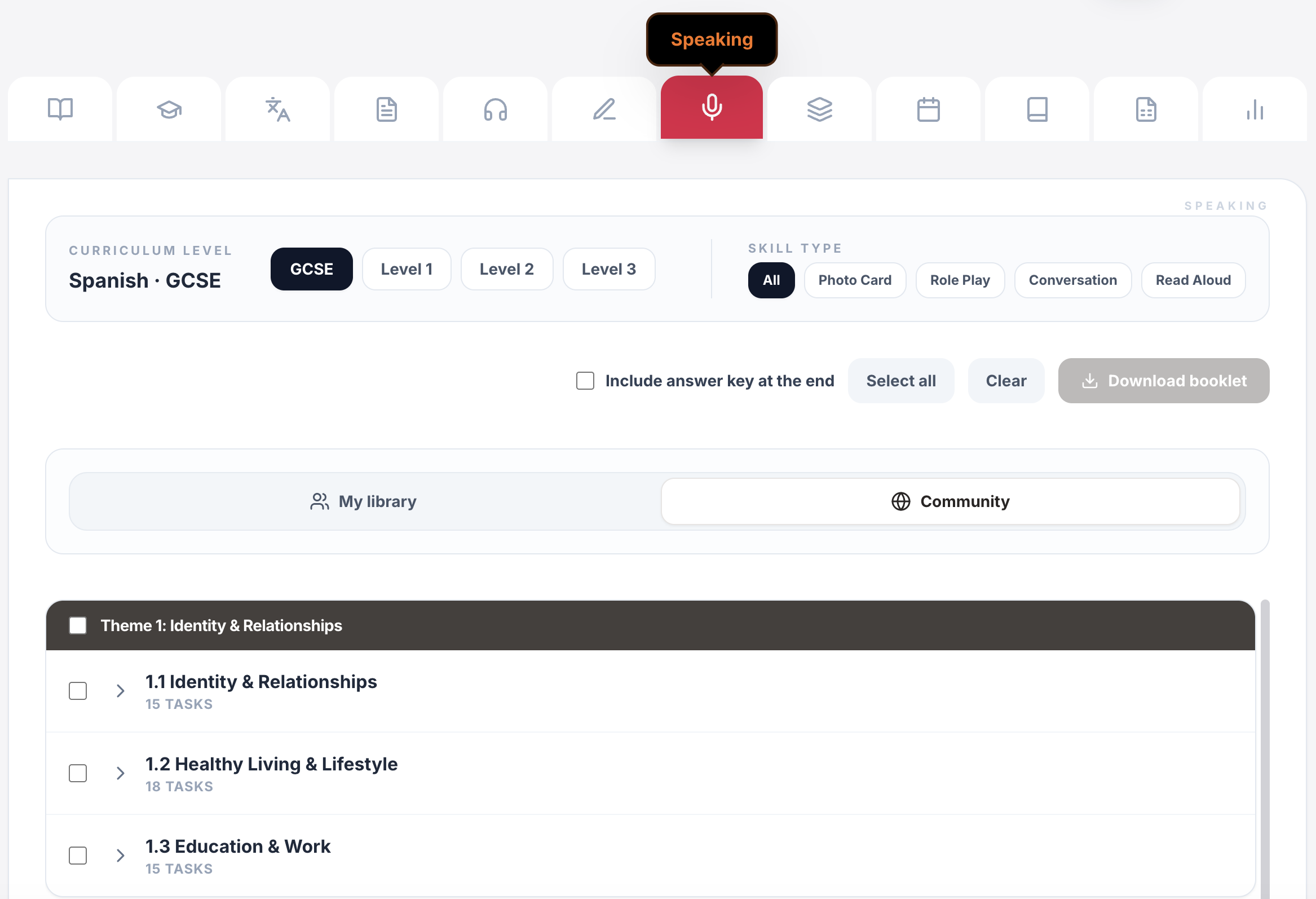
One platform for teaching, practice, feedback and progress.
Plan lessons, set homework, run live activities, generate printables, give AI-supported marking and track progress across Spanish, French, German, Portuguese and Italian.
Writing & speaking marking
Set writing and speaking tasks, collect submissions, generate detailed feedback and keep teacher review in the loop.
Explore this guide →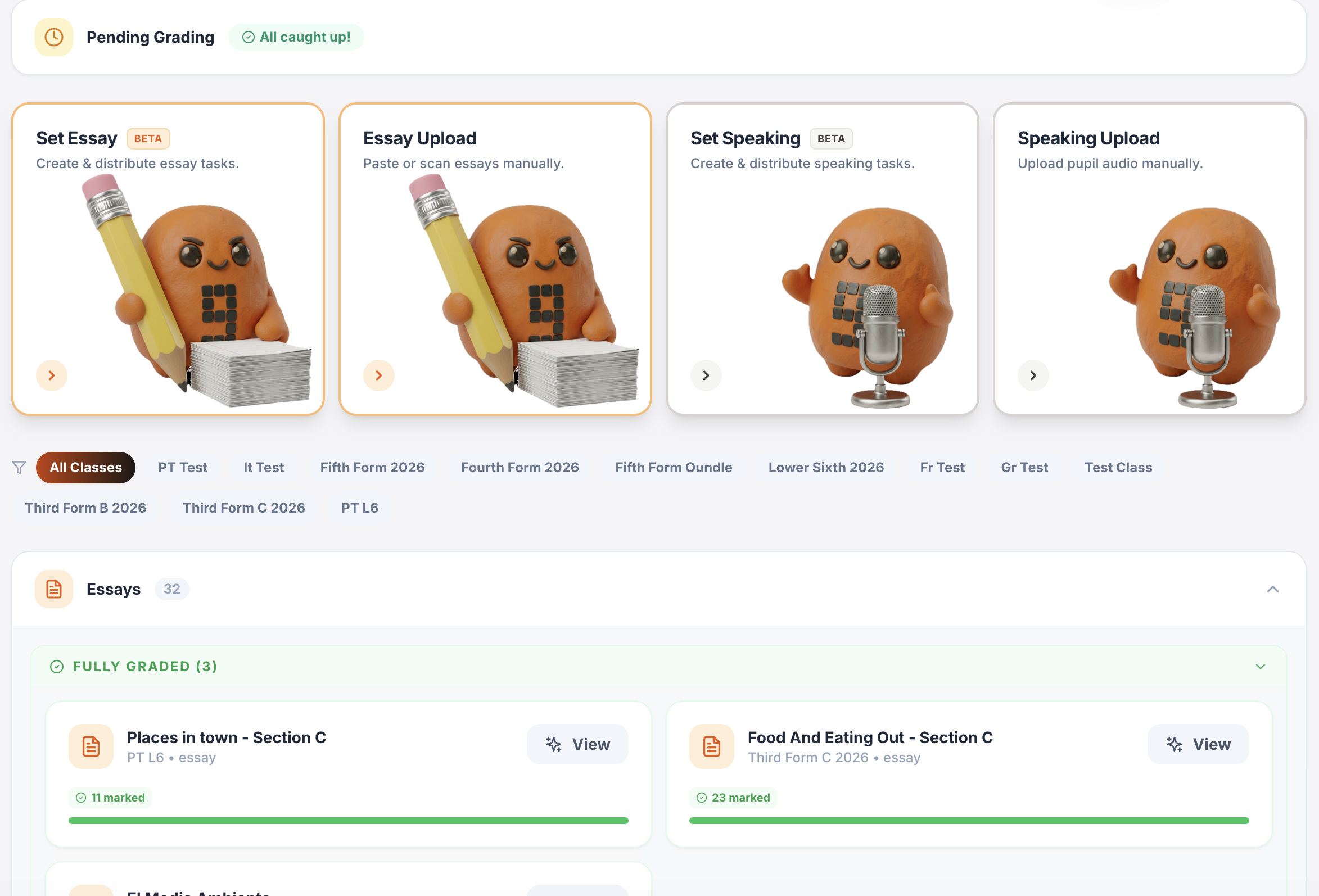
Gradebook & reports
Track scores, completion, engagement and learning evidence across classes.
Explore this guide →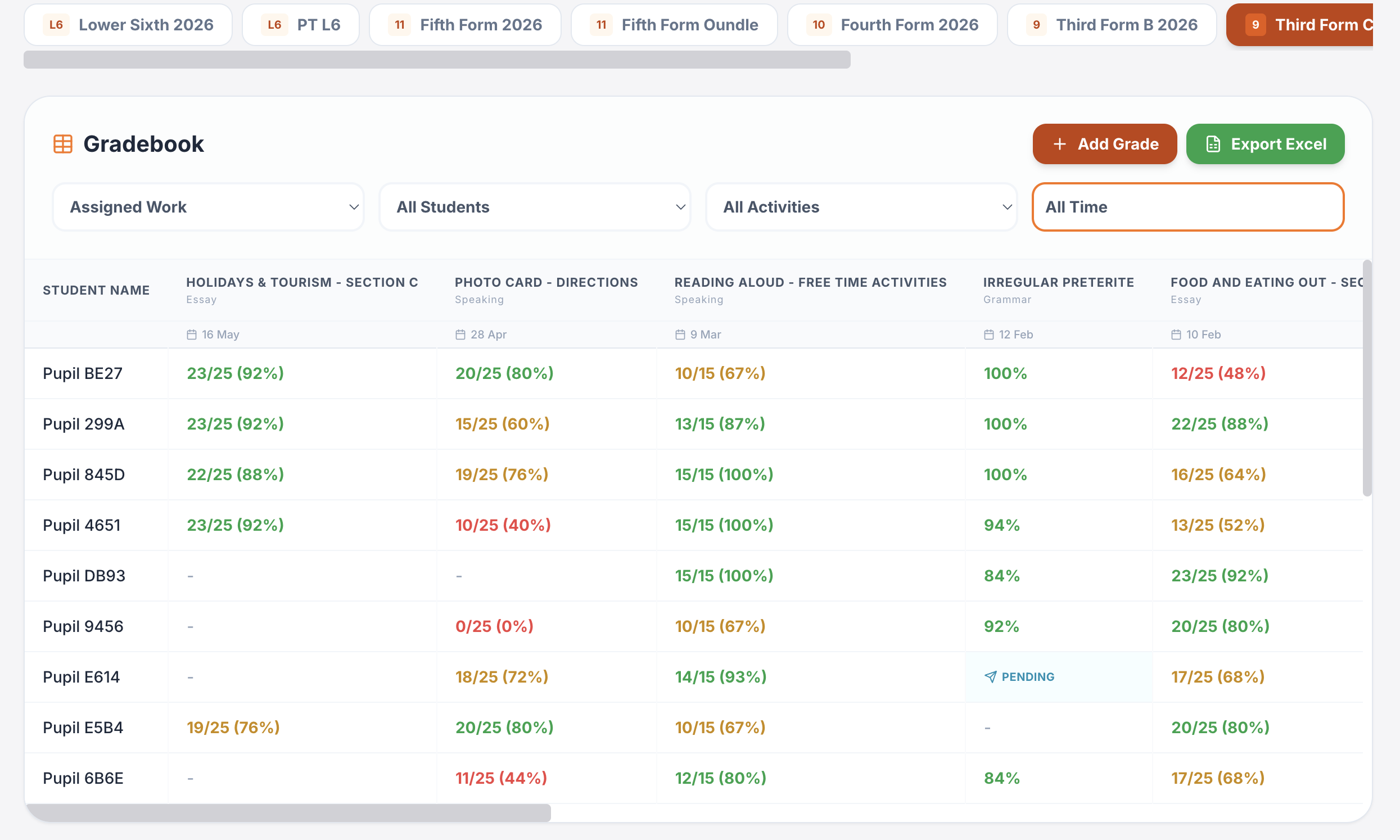
Interactive lessons
Generate, edit, save and reuse complete lesson presentations.
Explore this guide →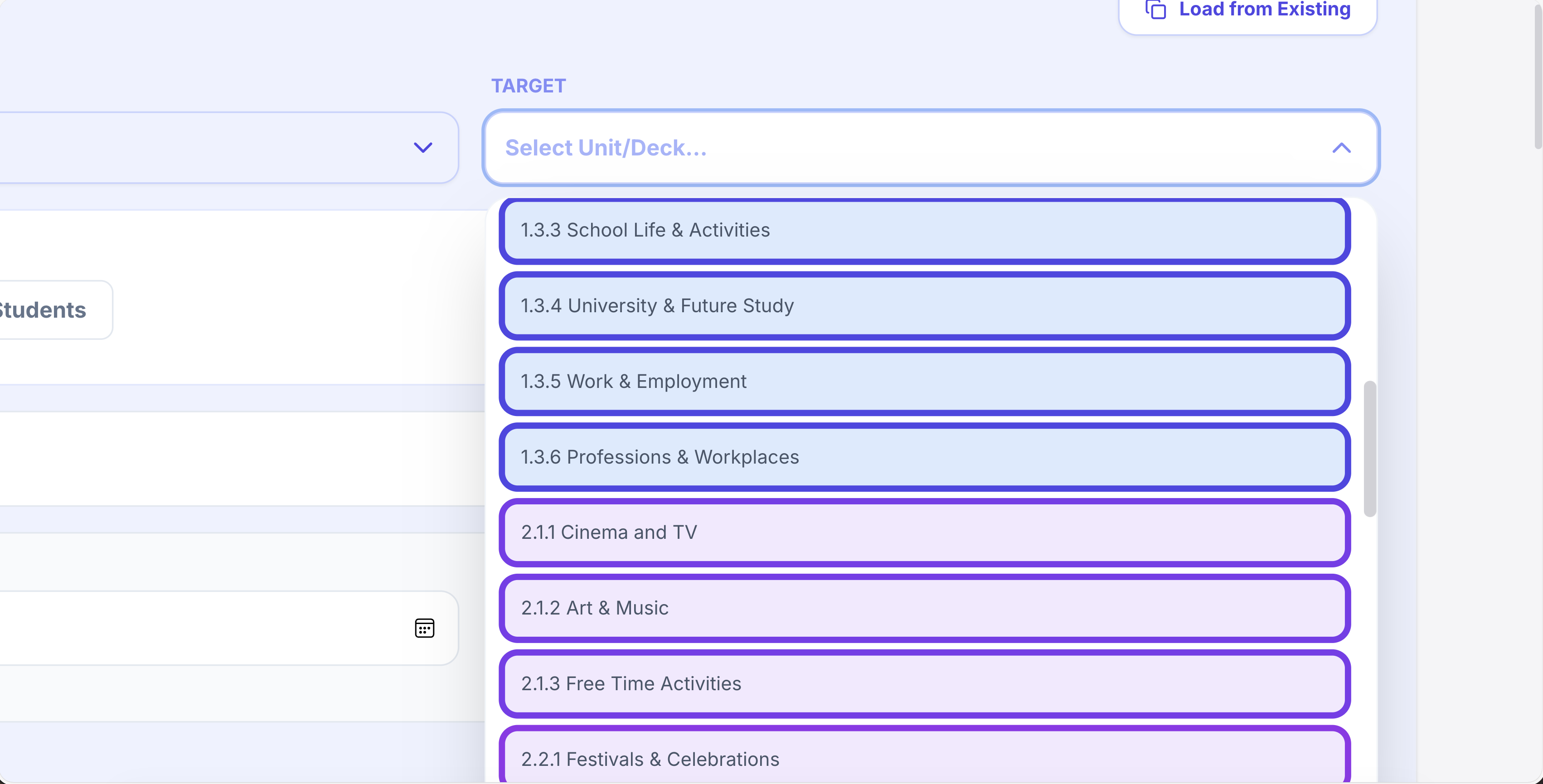
Printables in seconds
Vocabulary, grammar, translation, reading, listening, worksheets and booklets.
Explore this guide →Live games & whiteboards
Turn curriculum content into whole-class competition, retrieval and live response.
Explore this guide →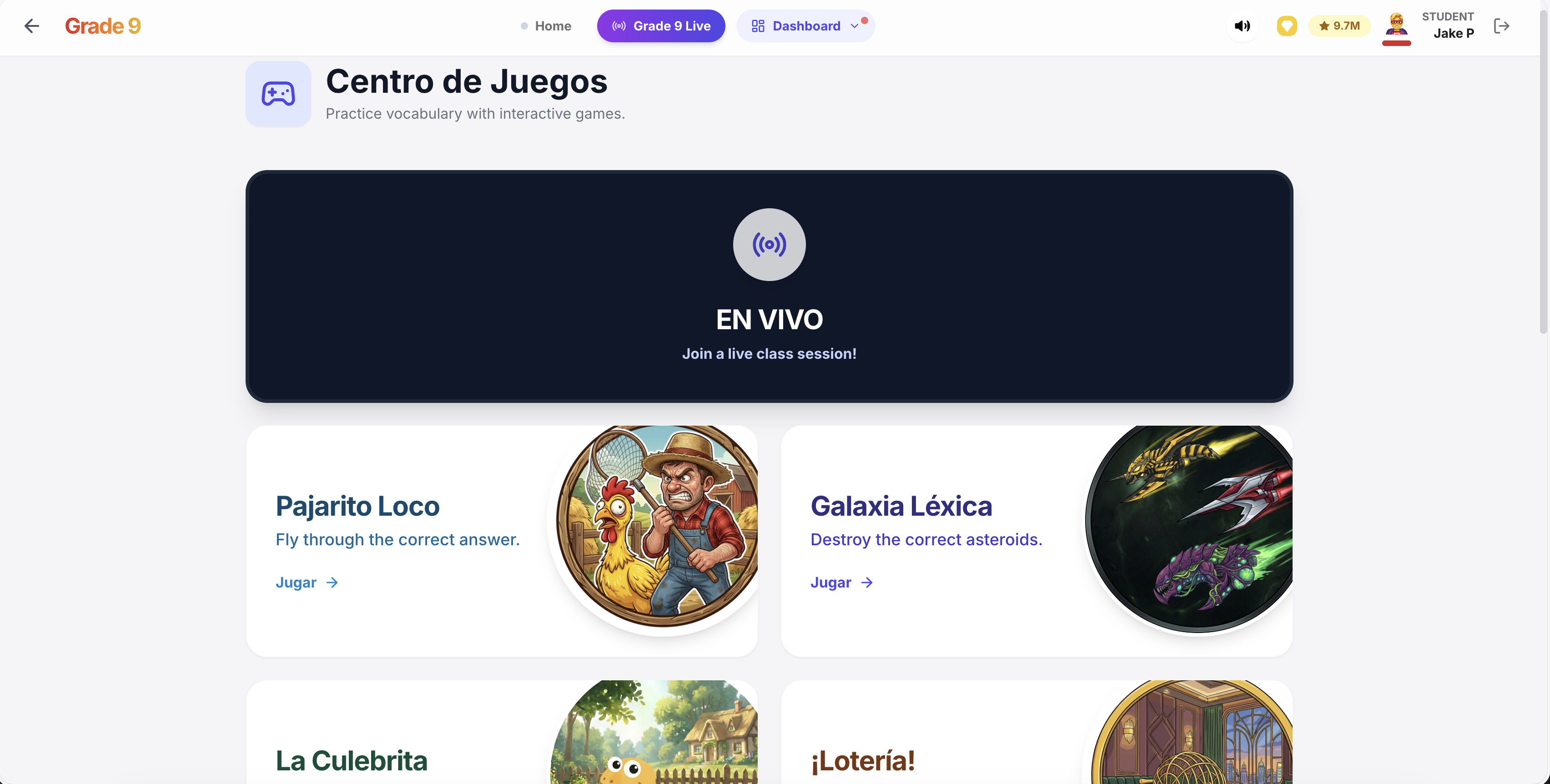
Assignments & tracking
Set work for a whole class or selected pupils, schedule it and see who has started or finished.
Explore this guide →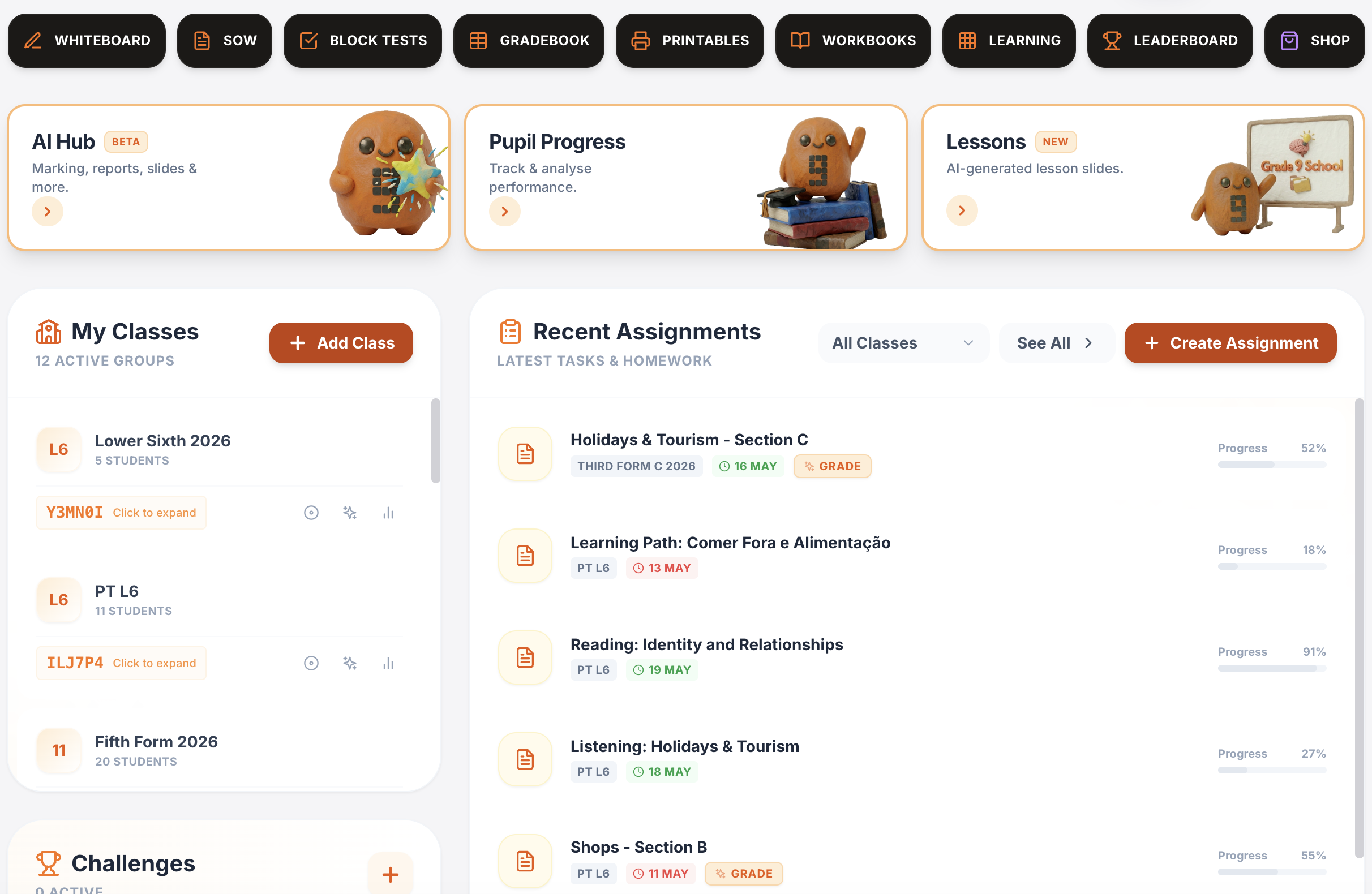
Vocabulary, grammar, translation & independent practice
Structured learning paths, flashcards, vocabulary builders, grammar, verb work, translation and tracked independent learning across supported languages.
Explore this guide →
Spanish · French · German · Portuguese · Italian
Use the same platform architecture across the languages your department teaches, while keeping each class in its own language and curriculum context.
Explore language workflows →
From planning to progress, it all connects.
Curriculum management, assignments, AI feedback, printables, gradebook and lesson planning all sit inside the same Grade 9 environment.
Find the detail you need.
Open any section for the key facts, practical detail, examples and sources.
01Start with the correct current specification⌄
For the current AQA GCSE Spanish 8692 course, pupils are expected to know 1,200 lexical items at Foundation tier and a further 500 at Higher tier. AQA also expects regular inflected forms that follow the specified grammar, with the precise rules and exceptions set out in the specification.
Pearson Edexcel’s current GCSE Spanish course likewise uses defined vocabulary and grammar. Its vocabulary and grammar guide explains the 1,200 / 1,700 framework and, importantly, how regularly inflected and irregular forms are treated.
That matters because a vocabulary list should not be read as “one row equals one form the pupil will ever meet”.
For example, if a noun, adjective or verb changes in a regular way that the required grammar says pupils should know, the examination can test the inflected form even when every predictable form is not separately presented as a new headword.
So use the official list for the board and tier you teach. Do not build a current course around an old legacy vocabulary booklet simply because it is familiar.
02Do not teach 1,200 words as one problem⌄
The number can look intimidating. In practice, teaching is easier when vocabulary is organised into coherent, revisitable sets.
A useful unit might contain language for:
- one communicative context;
- a small family of high-frequency verbs;
- a few opinion/reason structures;
- time and frequency language;
- nouns and adjectives that combine naturally with those verbs.
The set should be small enough to retrieve repeatedly, but rich enough to build sentences.
The goal is not to “finish the list”. The goal is to create a cycle in which new vocabulary becomes old vocabulary and old vocabulary keeps coming back.
03A six-stage vocabulary sequence⌄
1. Establish meaning and sound
Before testing recall, make sure pupils know what they are trying to learn.
Present the word or phrase with:
- a clear meaning;
- an accurate spoken model;
- relevant gender or form information;
- one useful context where necessary.
At this stage, recognition is acceptable. It is only the beginning.
2. Retrieve from Spanish to English
This is often the easiest direction and gives early success.
Show or play:
viajar
The pupil retrieves:
to travel
Keep it quick. The purpose is to strengthen the link, not to turn every card into a discussion.
3. Retrieve from English to Spanish
Now remove the stronger cue.
to travel
The pupil must produce:
viajar
Typing or writing is useful here because it exposes spelling uncertainty that a vague “I knew it” feeling can hide.
4. Add the spoken form
A word known only from a printed list is not fully available for GCSE Spanish.
Use short listening retrieval:
[audio only]
Pupil response:
viajar — to travel
Then reverse it: show the English and require the Spanish aloud.
This is where vocabulary work begins to support listening, dictation, speaking and reading aloud at the same time.
5. Put the item inside a sentence
Once the item is retrievable, make it do something.
Teacher-created example set:
- viajar
- el fin de semana
- con mi familia
- a menudo
- porque
Possible progression:
Viajo a menudo.
Viajo con mi familia.
El fin de semana voy a viajar con mi familia porque me encanta conocer lugares nuevos.
The sentence is not there to make the flashcard “more advanced”. It tests whether the vocabulary survives contact with grammar.
6. Bring it back later
Same-day success is weak evidence of durable learning.
Re-test after:
- a few minutes;
- the next lesson;
- the end of the week;
- several weeks;
- a different topic.
The useful question is not “Did they get it right once?” but “Can they still retrieve it when the lesson no longer tells them which set it came from?”
04Recognition is necessary but not sufficient⌄
One of the easiest vocabulary traps is to confuse familiarity with recall.
A pupil sees:
el medio ambiente
and thinks:
Yes, I know that.
But when asked to produce “the environment” from memory, nothing arrives.
That is not failure. It is diagnostic information.
Use different practice modes deliberately:
| Practice | What it checks |
|---|---|
| Spanish → English | recognition and meaning |
| English → Spanish | productive recall |
| Audio → meaning | spoken recognition |
| English → spoken Spanish | oral retrieval |
| Dictation | sound-to-spelling |
| Gap or sentence completion | vocabulary in grammatical context |
| Translation | vocabulary plus grammar and word order |
| Mixed old/new retrieval | durability and discrimination |
No single activity does all of these jobs.
05Flashcards work best when the cue changes⌄
Flashcards are useful because they can create many retrieval attempts quickly. They become less useful when the pupil always sees the same side first and starts recognising the card layout rather than retrieving the language.
A better flashcard routine is:
- Spanish → English;
- English → Spanish;
- shuffle;
- add audio;
- type or write selected difficult items;
- separate confident items from weak items;
- revisit the weak items later in a mixed deck.
For verbs and adjectives, periodically ask for a form that the required grammar makes predictable rather than testing only the dictionary form.
06Teach vocabulary with grammar attached⌄
Vocabulary and grammar are often separated in schemes of work because that makes planning tidy. Pupils do not experience them separately in an exam sentence.
Consider the verb hablar.
Knowing “hablar = to speak” is useful. But GCSE tasks may require a pupil to recognise or produce a form that expresses who is speaking and when.
The vocabulary knowledge and the grammar knowledge meet in the form.
Likewise, knowing an adjective without being able to make a regular agreement where required leaves the item only partly usable.
This is why vocabulary revision should sometimes ask:
What else do I need to change in this sentence?
rather than simply:
What does this word mean?
For a structured approach to those patterns, see the GCSE Spanish grammar guide.
07Use translation carefully⌄
Short translation is a good vocabulary diagnostic because it removes many of the cues found in a matching task.
Teacher-created example:
Last weekend I went to the cinema with my friends.
A pupil may know every key lexical item individually but still discover gaps in:
- the preterite;
- article use;
- prepositions;
- agreement;
- word order.
That is useful. The translation has shown which “vocabulary problem” is actually grammatical.
Keep these tasks short enough that the teacher can identify the cause of the error.
08A 20-minute vocabulary revision routine⌄
A pupil revising independently could use:
5 minutes — old vocabulary
Retrieve a mixed set from previous units.
5 minutes — current set
English → Spanish, not just recognition.
5 minutes — listening or dictation
Hear the same language without seeing it.
5 minutes — sentence use
Write or say four to six sentences using selected items with current grammar.
The order can change. The important feature is variation in retrieval, not twenty minutes of rereading.
09How to deal with words that refuse to stick⌄
If a pupil repeatedly forgets the same item, increasing the number of identical repetitions may not solve the problem.
Try changing the representation.
For a difficult item:
- hear it;
- say it;
- write it;
- notice a sound-symbol pattern;
- connect it with a related word or contrast;
- use it in a personally memorable sentence;
- retrieve it among similar competing items.
The problem may be confusion rather than weak memory.
For example, if two verbs are constantly mixed up, test them against each other. If a noun’s gender is repeatedly wrong, learn the article with the noun rather than as an afterthought.
10Common GCSE vocabulary mistakes⌄
Cramming one giant list
The pupil gets a short burst of familiarity but very little durable retrieval.
Better: smaller sets, frequent mixing and delayed review.
Practising only one direction
Spanish → English becomes fluent while English → Spanish remains weak.
Better: switch cue direction deliberately.
Ignoring sound
The word is recognised on paper but disappears in listening.
Better: every important vocabulary cycle should include spoken recognition.
Treating spelling as a separate end-stage problem
The pupil knows the meaning but repeatedly loses accuracy when writing.
Better: type, write and dictate selected words during the learning sequence.
Never mixing topics
Pupils succeed because the lesson tells them “this is the holidays unit”.
Better: mix old vocabulary so the cue is the language itself, not the page heading.
Learning only the citation form
The pupil knows the infinitive or masculine singular form but cannot handle a regular form required by the grammar.
Better: connect vocabulary practice to the board’s grammar requirements.
Using an outdated vocabulary list
Legacy resources can contain useful language, but they are not a substitute for the current specification.
Better: anchor coverage to the current exam-board list, then add wider language deliberately where it serves teaching.
11Using Grade 9 for vocabulary practice⌄
In Grade 9, the Vocabulary area is scoped by the pupil’s current target language and curriculum. Pupils move through the available curriculum structure to a vocabulary unit, and the menu is limited to units that actually exist for that language and curriculum.
A vocabulary unit contains interactive activities, and saved work can contribute to the pupil’s learning record. The same underlying practice can be used independently or in teacher-set work without needing a different vocabulary universe for each route.
Teachers can also build custom vocabulary lists. Current Grade 9 workflows support manual creation, bulk import and an AI-drafted list. AI output still needs teacher review before the list is saved or taught: one wrong item can otherwise travel into flashcards, activities, presentations and assignments.
Custom lists can also be turned into reusable activity packs whose questions, answers, titles and instructions remain editable by the teacher.
There is an important limitation: Grade 9 does not assume that every language and every curriculum level has an identical vocabulary catalogue. The available content is determined by the selected language and curriculum context.