 School





MFL writing feedback that pupils can actually act on
A practical MFL writing-feedback workflow: assess the task, select useful corrections, set one clear target, make pupils act on it, and use AI only with teacher review.
Grade 9 School brings curriculum, lesson planning, practice, homework, feedback, live activities, printables and progress tracking into one connected teaching workflow.
 Spanish
 French
 German
 Portuguese
 Italian
Practice, feedback and progress in one place.

A page covered in corrections is not automatically good feedback.
The real test is what happens next: can the pupil explain the target, make a better language choice, and transfer that improvement into the next piece of writing?
For MFL, that usually means separating four different jobs that are too often collapsed into one marking session:
- judging the response against the actual task;
- identifying the most useful language evidence;
- choosing a small number of corrections or targets;
- making the pupil do something with them.
AI can help with parts of that process. It cannot make the professional decision for the teacher.
Explore the topic ↓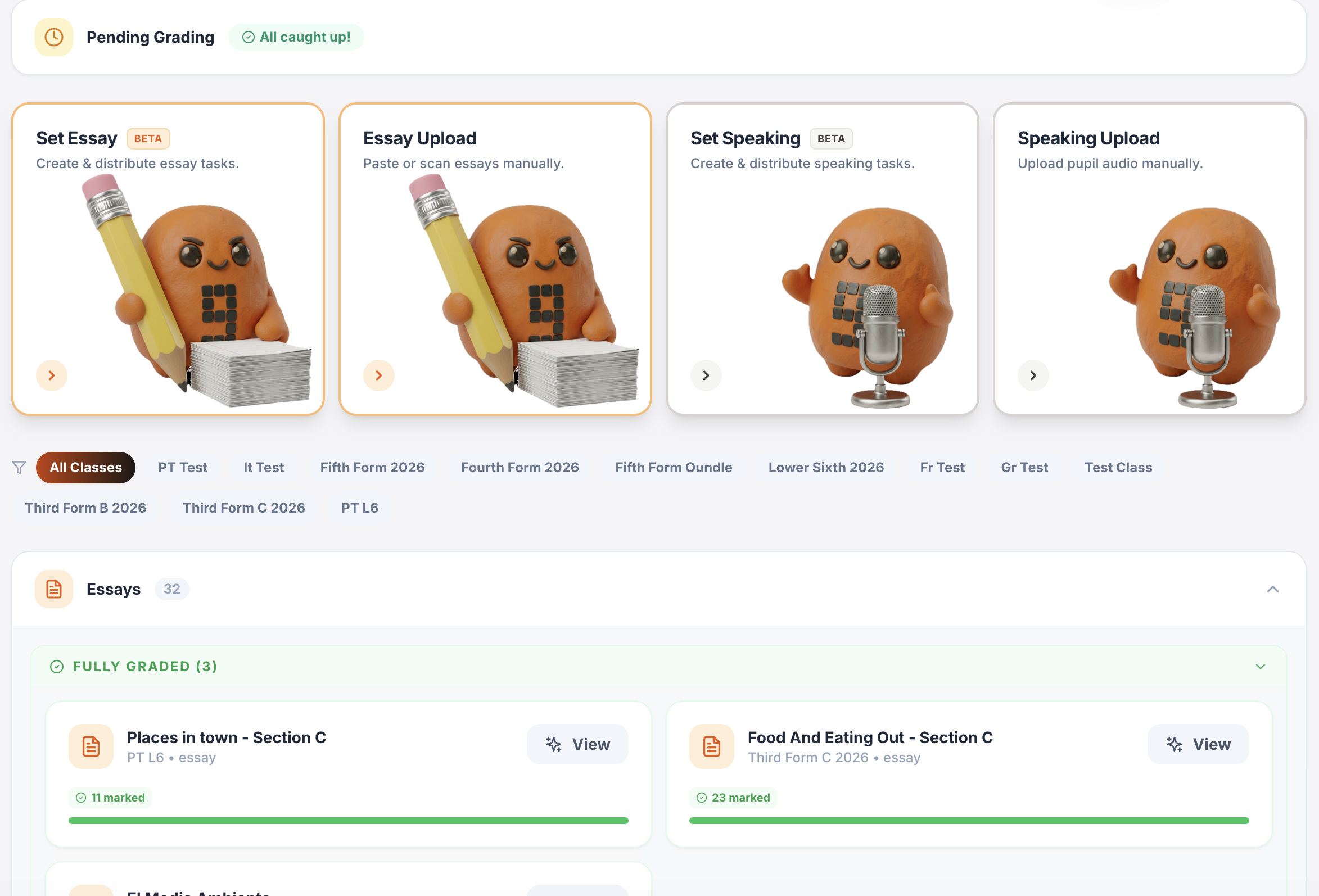
One platform for teaching, practice, feedback and progress.
Plan lessons, set homework, run live activities, generate printables, give AI-supported marking and track progress across Spanish, French, German, Portuguese and Italian.
Writing & speaking marking
Set writing and speaking tasks, collect submissions, generate detailed feedback and keep teacher review in the loop.
Explore this guide →Gradebook & reports
Track scores, completion, engagement and learning evidence across classes.
Explore this guide →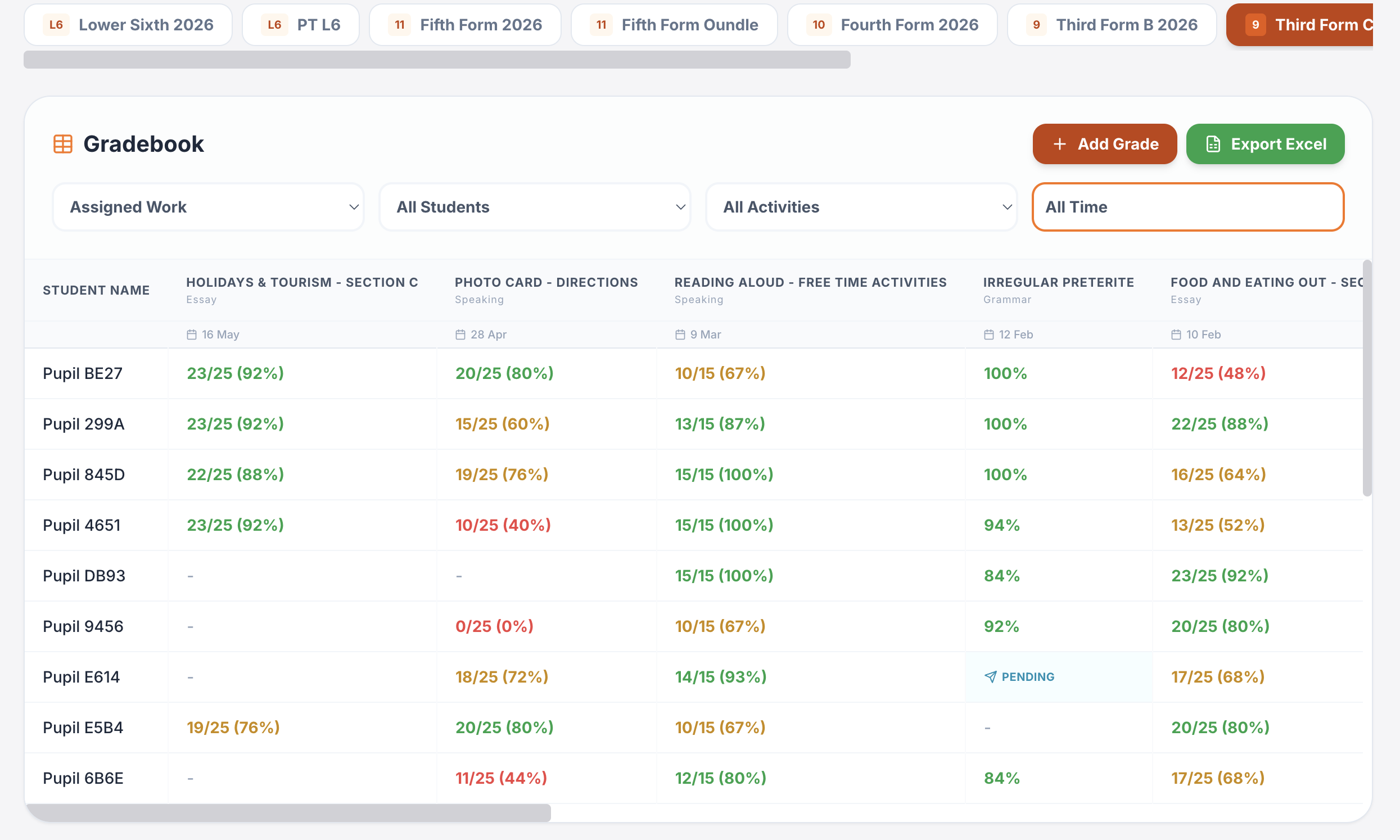
Interactive lessons
Generate, edit, save and reuse complete lesson presentations.
Explore this guide →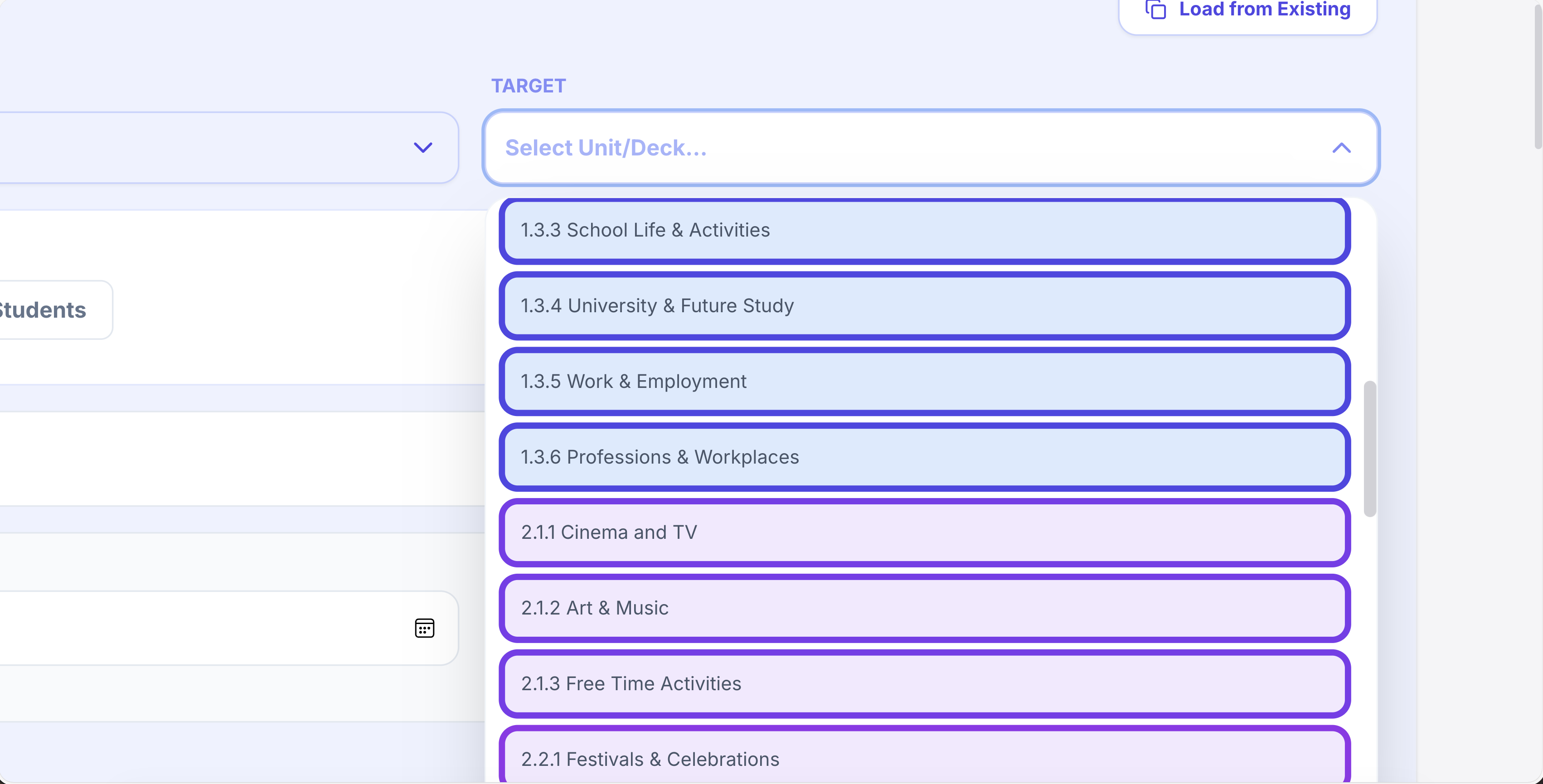
Printables in seconds
Vocabulary, grammar, translation, reading, listening, worksheets and booklets.
Explore this guide →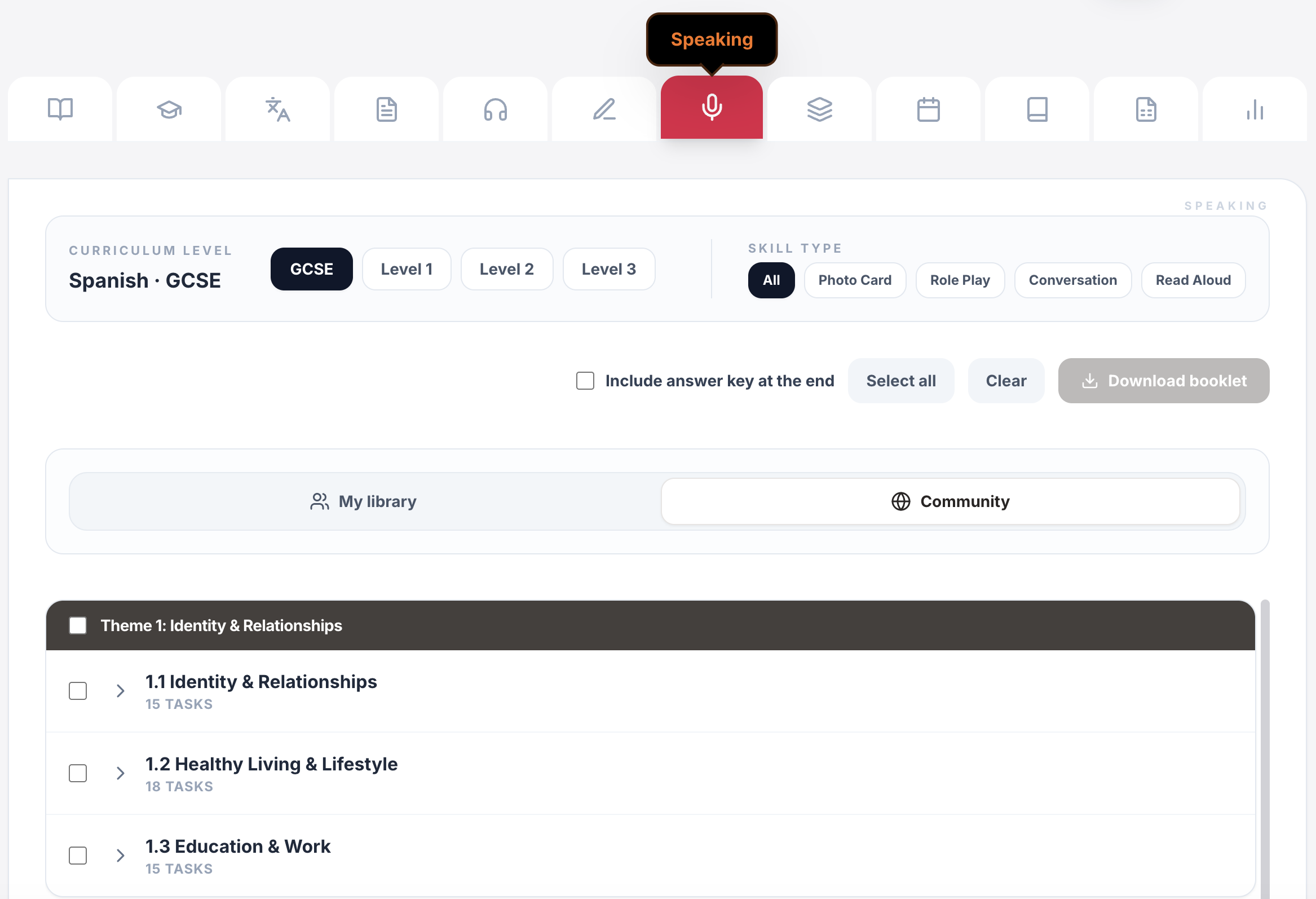
Live games & whiteboards
Turn curriculum content into whole-class competition, retrieval and live response.
Explore this guide →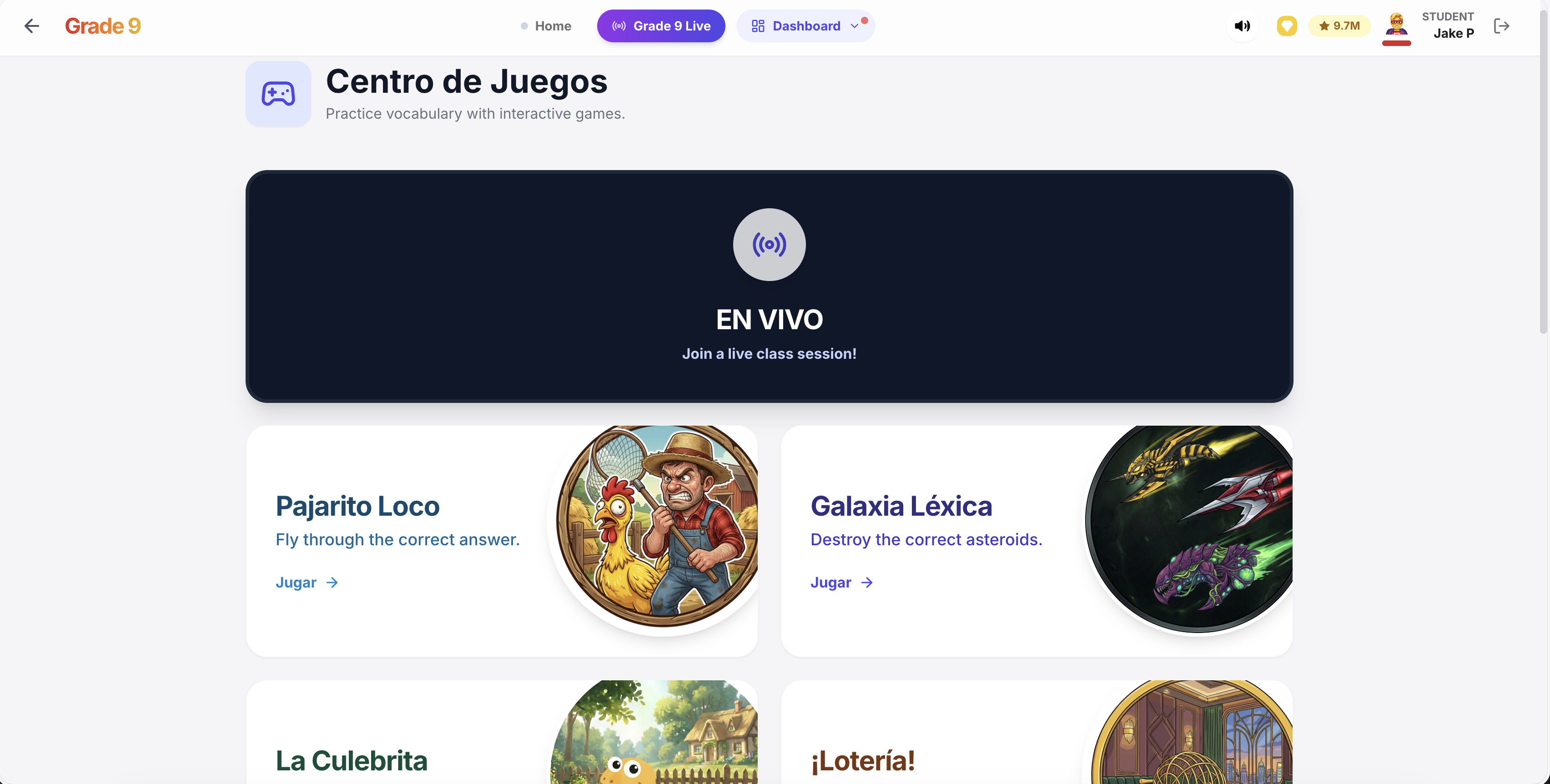
Assignments & tracking
Set work for a whole class or selected pupils, schedule it and see who has started or finished.
Explore this guide →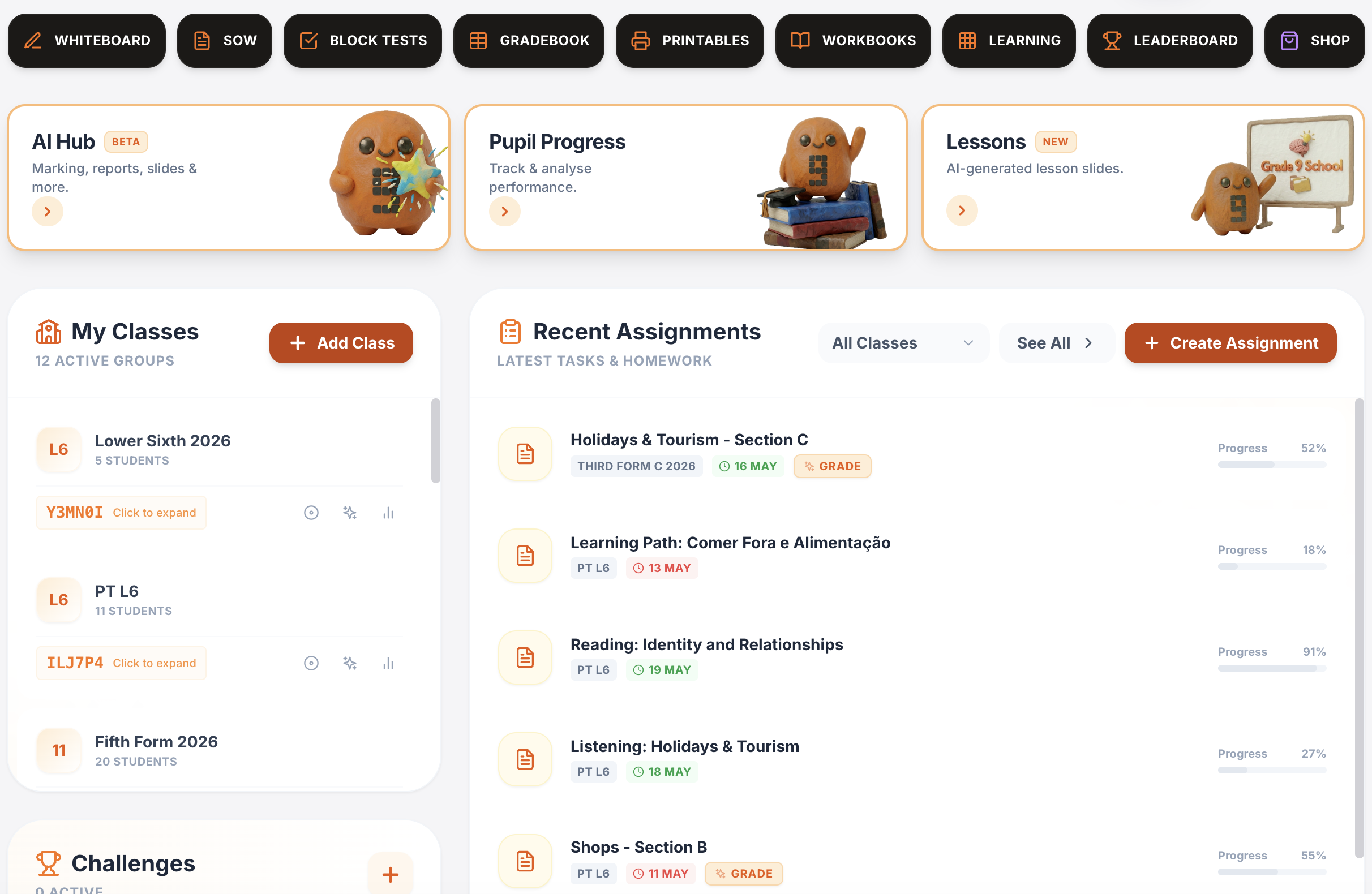
Vocabulary, grammar, translation & independent practice
Structured learning paths, flashcards, vocabulary builders, grammar, verb work, translation and tracked independent learning across supported languages.
Explore this guide →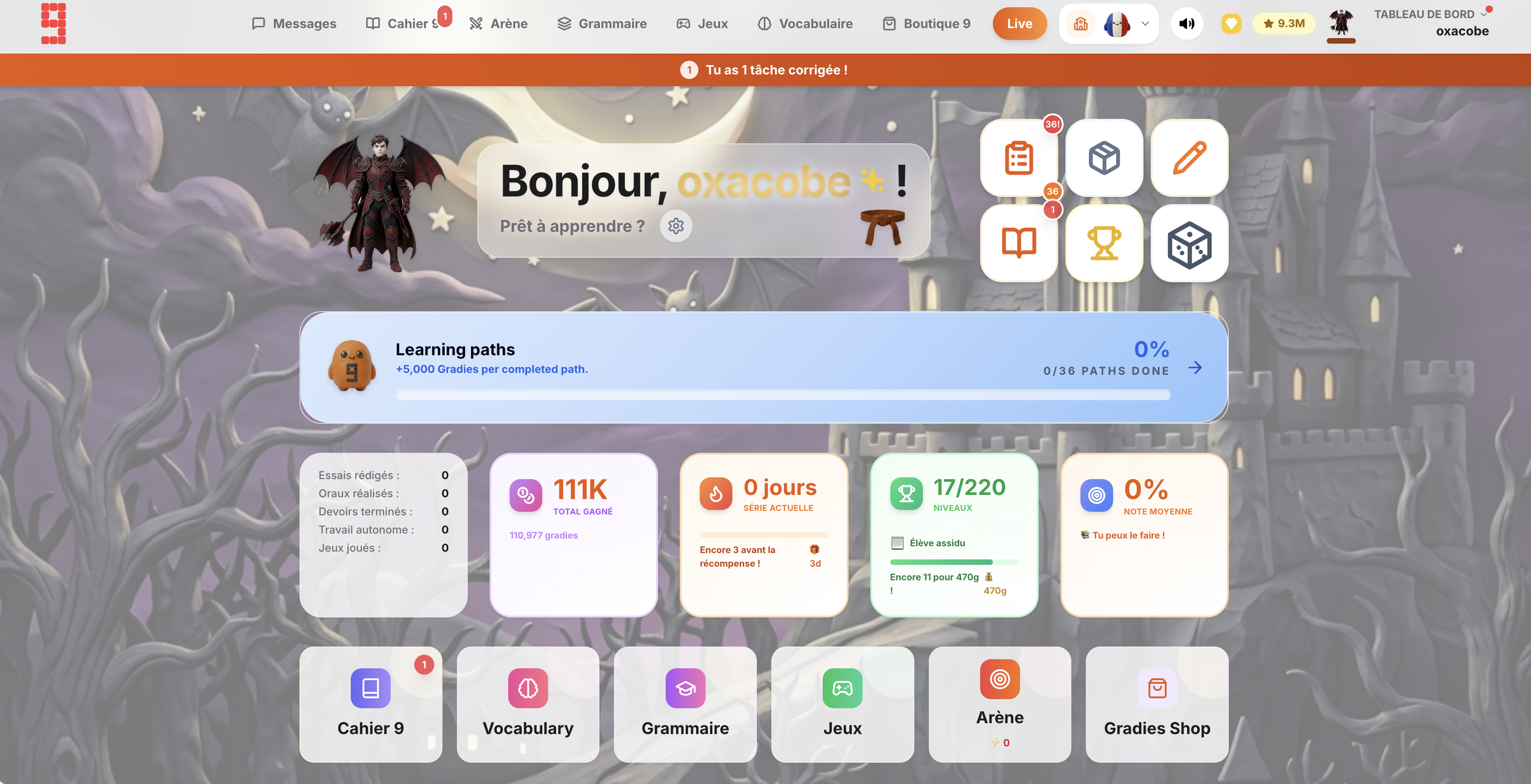
Spanish · French · German · Portuguese · Italian
Use the same platform architecture across the languages your department teaches, while keeping each class in its own language and curriculum context.
Explore language workflows →
From planning to progress, it all connects.
Curriculum management, assignments, AI feedback, printables, gradebook and lesson planning all sit inside the same Grade 9 environment.
Find the detail you need.
Open any section for the key facts, practical detail, examples and sources.
01Start with the task, not the errors⌄
Before correcting a single verb, ask:
- What was the pupil actually asked to communicate?
- Which board, tier, level or classroom rubric applies?
- Which content points were compulsory?
- What does successful performance look like for this particular task?
This sounds obvious, but it prevents a common marking failure: rewarding attractive language while missing that the pupil did not answer the question.
It also matters because current GCSE writing criteria are board-specific. AQA and Pearson Edexcel do not use identical task structures or mark allocations. A generic “GCSE Spanish score” detached from the selected task and rubric is not a sound basis for feedback.
02Read once for meaning before correcting⌄
The first read should answer:
What is this pupil trying to say, and how successfully are they saying it?
Do not interrupt that read every three words to fix an agreement.
A useful first pass looks for:
- task coverage;
- clarity of message;
- development of ideas;
- control of the required timeframe or register;
- evidence of language range;
- recurring accuracy problems.
Only after that should the teacher decide which errors deserve attention.
This makes the feedback more coherent. It also stops a piece of writing with one repeated problem from looking worse than a less communicative response with fewer visible mistakes.
03Correct less, but choose better⌄
Not every error has the same learning value.
Compare these two approaches.
Approach A: mark everything
The pupil receives twelve underlinings, six rewritten verb forms, three agreement corrections and a paragraph of comments.
The teacher has worked hard.
The pupil sees red.
Approach B: select the pattern
The teacher identifies:
- one strength;
- one recurring issue;
- two or three examples;
- one precise next step.
For example:
Strength: You give clear reasons and your ideas link well.
Target: Keep past narration consistently in the past. You move back into the present in three sentences.
Examples to repair:
- El año pasado voy…
- Después comemos…
- Mi madre compra…
Action: Rewrite those three sentences, then write one new past-tense sentence about the same event.
That is less marking and more learning.
04Separate correction from target-setting⌄
A correction answers:
What is wrong here?
A target answers:
What should the pupil get better at next?
Those are not the same thing.
If a pupil writes “mis hermana”, the immediate correction is straightforward. But if the rest of the piece shows five gender/number agreement problems, the target may be broader:
Check noun-adjective and determiner-noun agreement before submitting.
If the error is isolated, turning it into the main target would be disproportionate.
This is where professional judgement matters. Frequency, importance and teachability all count.
05Feedback should create a next action⌄
A comment is not a completed feedback cycle.
Good follow-up tasks are small enough to complete and close enough to the original work that the connection is obvious.
Useful options include:
- correct three selected sentences;
- explain why one correction was needed;
- rewrite one paragraph using the target;
- compare the original and improved version;
- add one missing detail to a compulsory bullet;
- write two new sentences that prove the target has been understood;
- translate a short parallel sentence using the same structure.
The pupil should not need to guess what “act on your feedback” means.
06A simple MFL writing-feedback routine⌄
For a typical GCSE-style response:
1. Check task coverage
Underline where each compulsory point is answered.
If a point is missing, that is usually more important than polishing an optional flourish.
2. Decide the assessment judgement
Use the actual mark scheme or classroom rubric. Do this before getting lost in sentence-level editing.
3. Choose one strength
Make it specific.
Weak:
Good vocab.
Better:
Your reasons are clear and you use “aunque” accurately to add contrast.
4. Choose one priority target
Make it transferable.
Weak:
Tenses.
Better:
When you narrate a completed event, keep the main verbs in the past instead of moving back into the present.
5. Select a few corrections
Choose examples that teach the pattern. Do not rewrite the whole piece for the pupil.
6. Require improvement
The pupil corrects, rewrites or extends.
7. Check the improvement
A feedback loop is not closed until someone looks at what the pupil did next.
07Where AI-assisted feedback can help⌄
AI can reduce some first-pass work by preparing a draft analysis, but the writing-specific judgement still belongs to the teacher.
A sensible local workflow is:
pupil submits → draft analysis is prepared → teacher checks the script, task and criteria → teacher edits or rejects the draft → only approved feedback reaches the pupil
The teacher should still decide whether the mark is defensible, whether the corrections are accurate and whether the target will help this pupil improve. For the wider school-level case about decision rights, data handling and teacher control, see Teacher-controlled AI in schools.
08What AI gets wrong in language writing⌄
AI-generated feedback can be wrong even when it sounds polished.
Writing-specific failure modes include:
- over-rewarding sophisticated-looking language that does not answer the task;
- missing a compulsory content point;
- proposing a correction that changes the pupil’s intended meaning;
- applying the wrong task or rubric context;
- treating OCR text from photographed handwriting as if transcription were perfect.
Those are reasons to check the actual script and task context before publishing, not reasons to treat a fluent-sounding draft as authoritative.
09A short teacher review check⌄
Before publishing an AI-assisted writing draft, check:
- Is this the correct task, board/tier where relevant, and response type?
- Has the pupil answered the required content?
- Are the proposed mark and strengths actually supported by the script and criteria?
- Are the target-language corrections accurate and faithful to the pupil’s intended meaning?
- Is the next-step target specific enough for the pupil to act on?
If not, edit the draft or reject it.
10The Grade 9 School writing workflow⌄
Grade 9 School separates AI generation from teacher publication.
The current writing workflow is:
teacher sets writing → pupil types or uploads work → pupil submits → AI Marking Hub shows submitted work → teacher generates a draft → teacher reviews the task, mark and feedback → teacher edits or overrides → Approve & Send publishes the teacher-approved result
That distinction appears in the status model:
- Draft / in progress: the pupil is still working.
- Submitted: the pupil has handed in the response.
- Draft Ready: an AI feedback draft exists but has not been approved.
- Published: the teacher has approved feedback and it is visible to the pupil.
- Updated Draft can coexist with Published when a teacher prepares a newer draft without replacing the already approved feedback.
The practical point is simple: generating feedback is not the same action as publishing feedback.
The teacher can change the proposed mark and edit the feedback before it reaches the pupil.
11Typed work and photographed work need different checks⌄
For typed work, the teacher is reviewing the submitted text.
For image-based writing, Grade 9 can use OCR to extract text for the writing record. OCR is useful, but handwriting recognition can be wrong.
If feedback looks strange, compare the extracted text with the pupil’s original image before accepting the analysis. A transcription error should not become a language correction.
12Turn feedback into improvement⌄
Where the Grade 9 Feedback Action feature is enabled, a teacher can release a follow-up task alongside approved feedback.
A writing improvement sequence can ask a pupil to:
- read the feedback;
- identify the target;
- correct selected errors;
- rewrite an extract;
- compare versions;
- reflect on the improvement.
The teacher can then review the pupil’s improvement and either approve it or return it with a specific instruction.
This matters more than producing a longer AI comment. The value is in the loop:
original work → approved feedback → pupil improvement → teacher decision → retained evidence
Feedback Actions are feature-gated, so they should not be described as universally available in every deployment.
13An illustrative classroom example⌄
The following is an example of how the workflow could operate; it is not a reported customer result.
A Year 11 class completes a Spanish writing task on local area and environment.
Twenty-one pupils submit. Two still have saved drafts, so those two are not treated as marking-ready.
The teacher generates draft feedback for the submitted work.
For one pupil, the proposed mark looks generous because one compulsory point is barely addressed. The teacher changes the mark and rewrites the target so the missing content is explicit.
For another, the draft correction changes the intended meaning of a sentence. The teacher removes it.
Only then does the teacher publish.
The follow-up task asks pupils to correct selected errors and rewrite one short extract. When the revisions come back, the teacher checks whether the target has actually been applied.
The useful evidence is not “AI marked 21 essays”. It is that the teacher reached a defensible judgement and the pupils did something with it.
14What this workflow does not claim⌄
- AI feedback is not official examiner judgement.
- A model-generated mark is not authoritative because it is numerically precise.
- The AI can be wrong, incomplete or pedagogically unhelpful.
- Teacher review is part of the intended workflow.
- Image/OCR submission can introduce transcription errors.
- A longer feedback report is not automatically better feedback.
- Exact Grade 9 AI-credit totals for the complete writing workflow should not be stated on this page; the live interface remains the source while current billing paths are reconciled.
16Sources and assessment references⌄
Product workflow source:
Grade 9 School Handbook — Living Master, Step 4 Batch 1: Writing, AI drafts and acting on feedback, verified 28 August 2026.
Assessment facts retained from the original worker draft, checked there on 19 September 2026:
- AQA GCSE Spanish 8692, Scheme of assessment:
https://www.aqa.org.uk/subjects/spanish/gcse/spanish-8692/specification/scheme-of-assessment
- Pearson Edexcel GCSE Spanish 1SP1 (2024), Specification Issue 2:
https://qualifications.pearson.com/content/dam/pdf/GCSE/Spanish/2024/specification-and-sample-assessments/gq000027-gcse-spanish-specification-2024-issue-2.pdf
- Pearson 2025 update clarifying writing AO3 timeframe and error descriptors:
https://qualifications.pearson.com/en/qualifications/edexcel-gcses/spanish-2024.news.html?article=%2Fcontent%2Fdemo%2Fen%2Fnews-policy%2Fsubject-updates%2Flanguages%2Fgcse-2024-amendment-update