 School




GCSE Spanish speaking exam: current AQA and Pearson Edexcel format
Current AQA and Pearson Edexcel GCSE Spanish speaking formats, prep time, task order, timings and practical classroom preparation for 2026 onward.
Grade 9 School brings curriculum, lesson planning, practice, homework, feedback, live activities, printables and progress tracking into one connected teaching workflow.
 Spanish
 French
 German
 Portuguese
 Italian
Practice, feedback and progress in one place.

For the current GCSE Spanish specifications, AQA and Pearson Edexcel both allocate 25% of the qualification to speaking. At both Foundation and Higher tier, the speaking assessment is worth 50 marks and includes 15 minutes of preparation time. The overall assessed speaking time is also the same: 7–9 minutes at Foundation and 10–12 minutes at Higher.
The similarity stops there. The task order, mark split and visual task are different. If you are preparing a class for speaking, the first rule is simple: practise the format they will actually sit.
Explore the topic ↓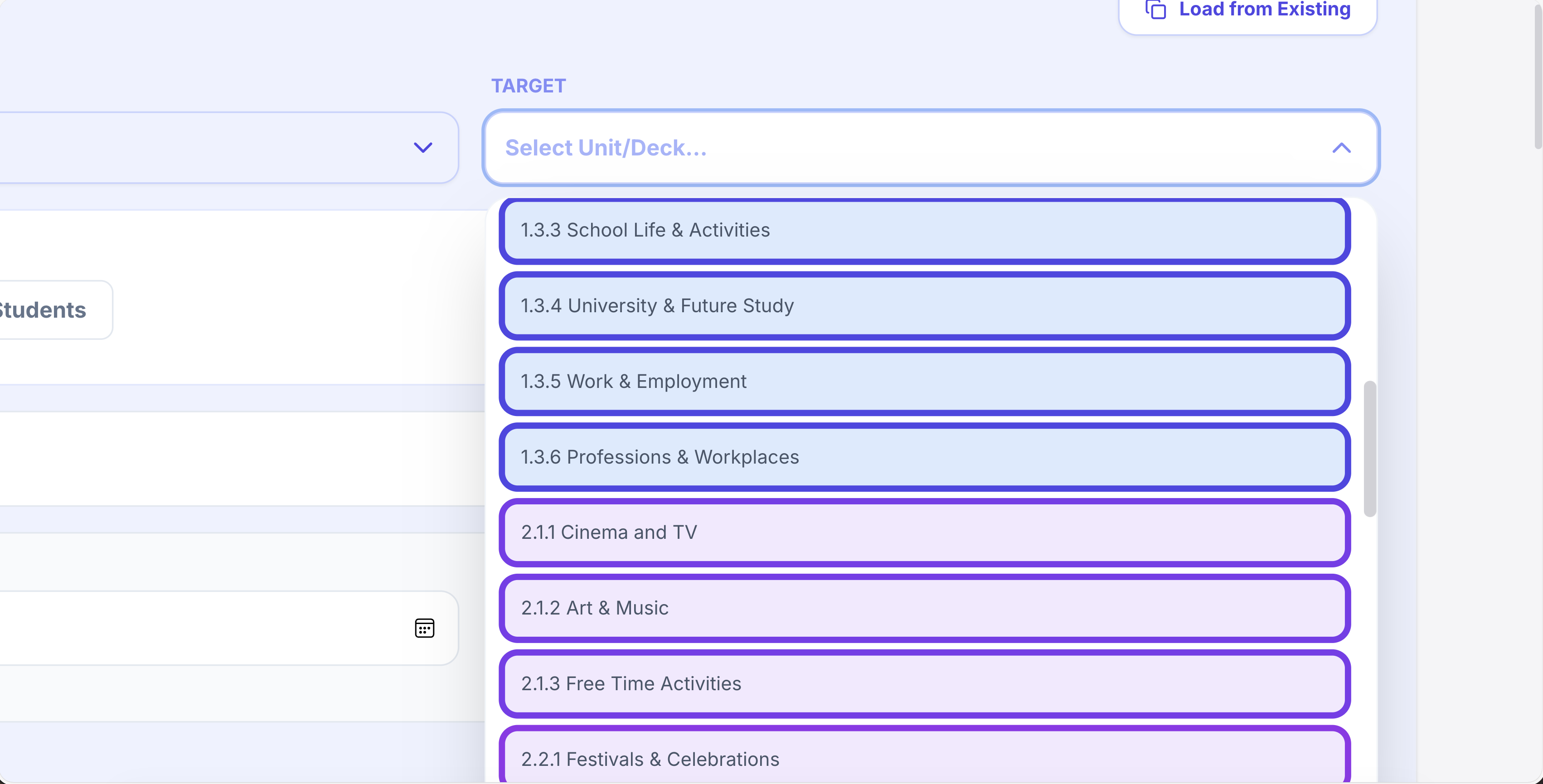
One platform for teaching, practice, feedback and progress.
Plan lessons, set homework, run live activities, generate printables, give AI-supported marking and track progress across Spanish, French, German, Portuguese and Italian.
Writing & speaking marking
Set writing and speaking tasks, collect submissions, generate detailed feedback and keep teacher review in the loop.
Explore this guide →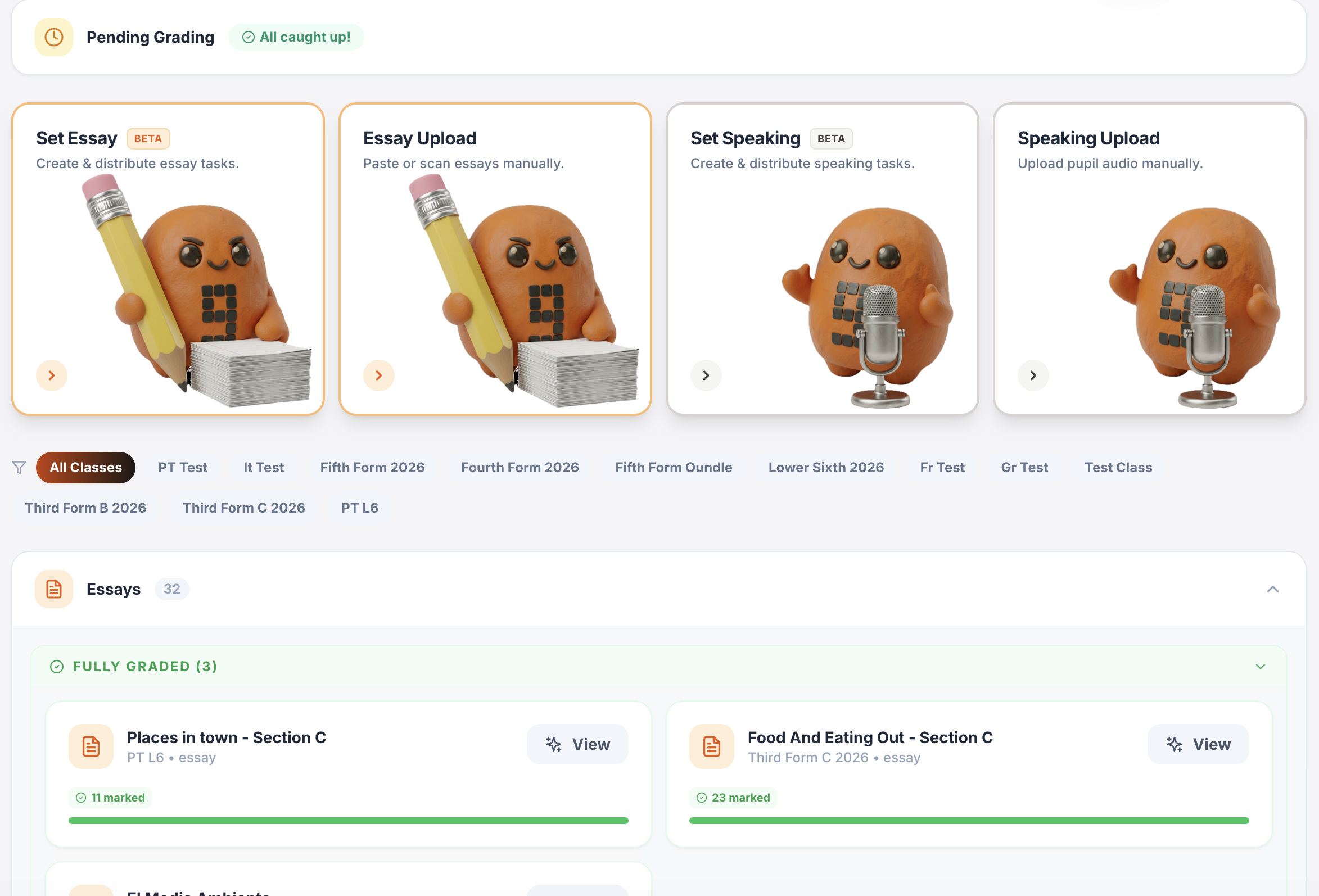
Gradebook & reports
Track scores, completion, engagement and learning evidence across classes.
Explore this guide →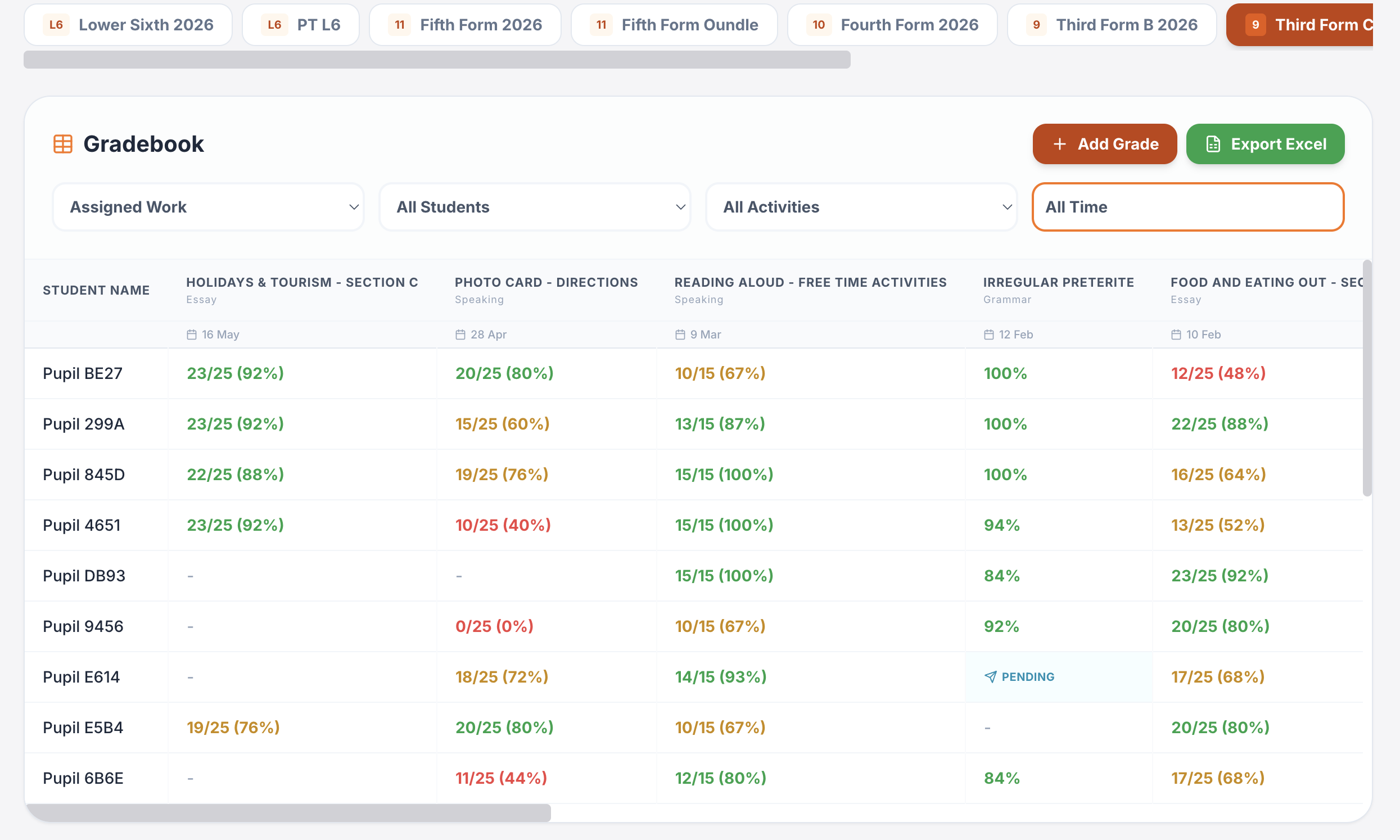
Interactive lessons
Generate, edit, save and reuse complete lesson presentations.
Explore this guide →Printables in seconds
Vocabulary, grammar, translation, reading, listening, worksheets and booklets.
Explore this guide →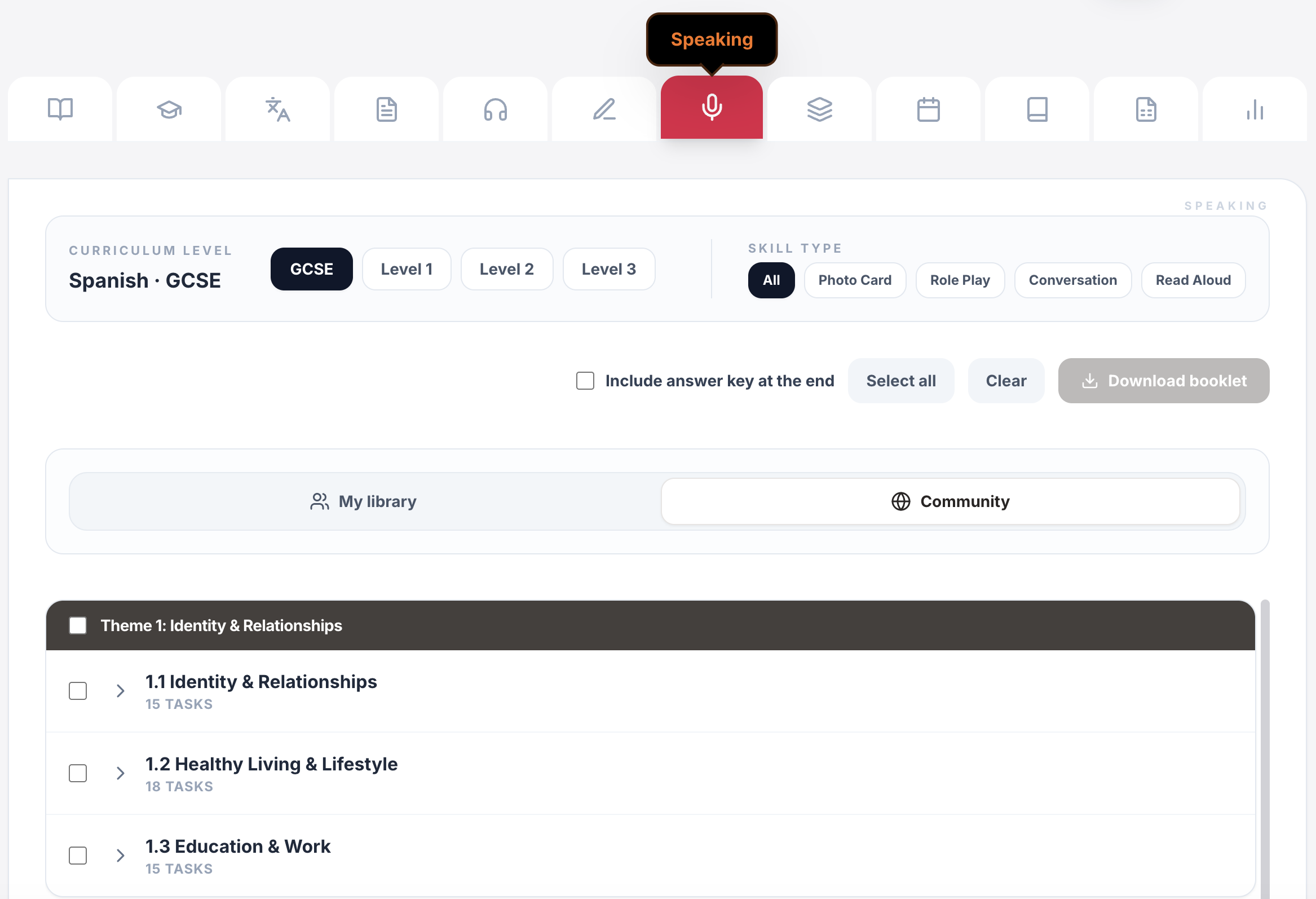
Live games & whiteboards
Turn curriculum content into whole-class competition, retrieval and live response.
Explore this guide →
Assignments & tracking
Set work for a whole class or selected pupils, schedule it and see who has started or finished.
Explore this guide →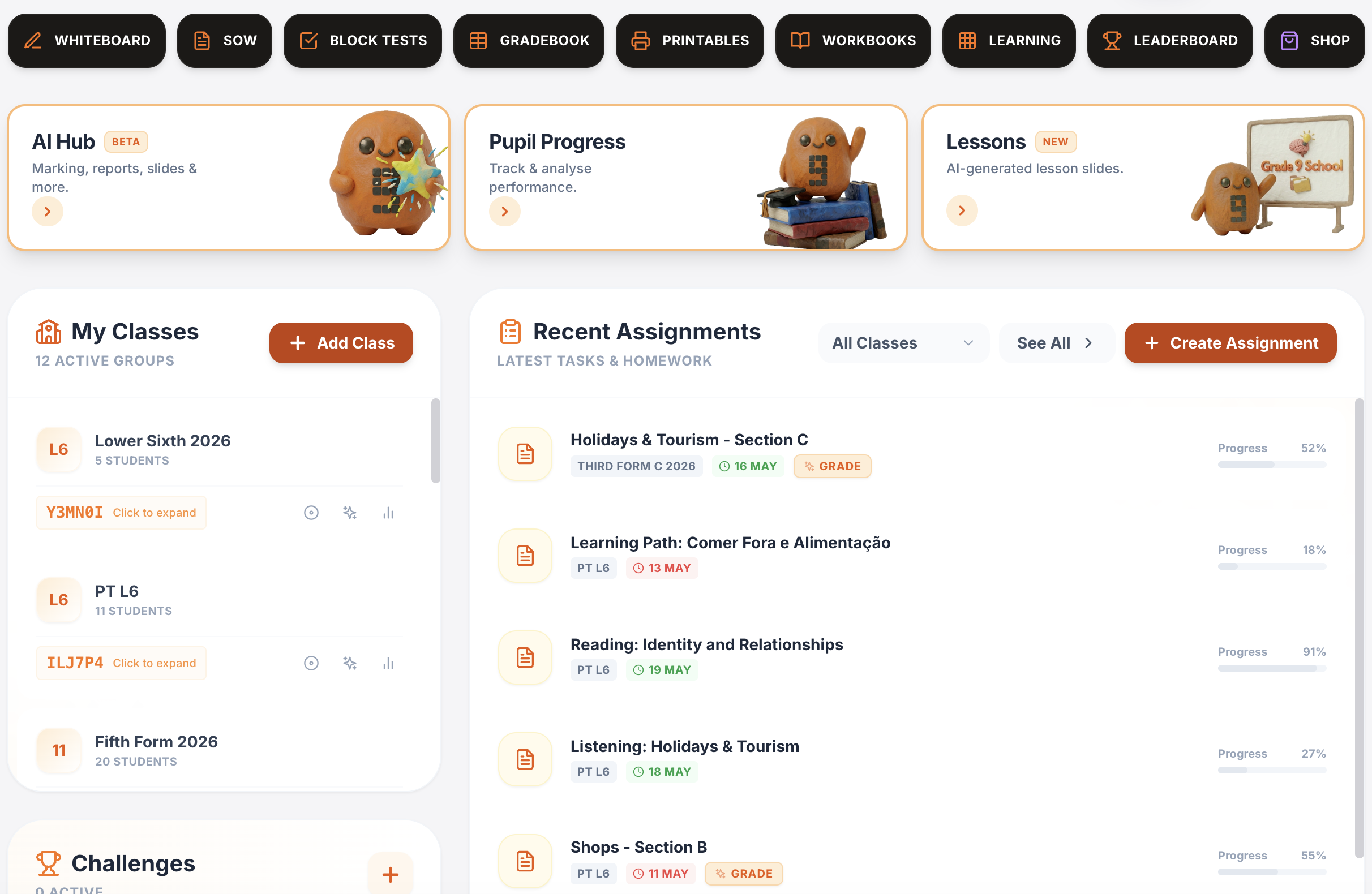
Vocabulary, grammar, translation & independent practice
Structured learning paths, flashcards, vocabulary builders, grammar, verb work, translation and tracked independent learning across supported languages.
Explore this guide →
Spanish · French · German · Portuguese · Italian
Use the same platform architecture across the languages your department teaches, while keeping each class in its own language and curriculum context.
Explore language workflows →
From planning to progress, it all connects.
Curriculum management, assignments, AI feedback, printables, gradebook and lesson planning all sit inside the same Grade 9 environment.
Find the detail you need.
Open any section for the key facts, practical detail, examples and sources.
01AQA and Pearson Edexcel speaking compared⌄
| AQA 8692 | Pearson Edexcel 1SP1 | |
|---|---|---|
| Weighting / marks | 25% / 50 marks | 25% / 50 marks |
| Preparation time | 15 minutes | 15 minutes |
| Foundation speaking time | 7–9 minutes | 7–9 minutes |
| Higher speaking time | 10–12 minutes | 10–12 minutes |
| Task order | Role-play → Reading aloud + short conversation → Photo card discussion | Read aloud → Role play → Picture task + conversation |
| Mark split | 10 + 15 + 25 | 12 + 10 + 28 |
| Read-aloud preparation | Pupils must not read the text aloud during supervised preparation | The final minute of preparation takes place in the examination room and may be used to practise the read-aloud text aloud |
| Visual task | Two photos, followed by unprepared conversation | Choice of two pictures within the selected thematic context, followed by compulsory questions and broader conversation |
Both boards use teacher-conducted speaking assessments that are externally assessed. For live examinations, use the current awarding-body instructions for that series.
02Choose the task you are preparing⌄
- Role-play: practise the communicative job and the board-specific card format. GCSE Spanish role-play
- Reading aloud: practise decoding, pronunciation and the board-specific follow-up interaction. GCSE Spanish reading aloud
- Photo / picture task: practise the correct visual routine and the transition into conversation. GCSE Spanish photo card and picture task
03Prepare habits, not scripts⌄
The format matters, but speaking preparation should not become months of rehearsing a small number of polished paragraphs. The current assessments contain unprepared interaction by design.
A useful speaking routine develops five habits:
- Sound-spelling confidence. Give pupils short unseen texts and make them decode before they have time to imitate a model.
- Precise task completion. In role-play practice, train pupils to identify what information the prompt actually requires before expanding.
- Short, clear first answers. A pupil should be able to answer the question before trying to make the answer impressive.
- Expansion under pressure. Add a reason, example, contrast or time shift when the task rewards a longer response.
- Recovery. Practise asking for repetition where permitted, restarting a sentence and continuing after an error instead of freezing.
The goal is not perfect spontaneous Spanish. It is a pupil who can keep communicating when the exact question is not the one they rehearsed.
04Mock the right thing⌄
A speaking mock is most useful when it reproduces the demands pupils need to manage, not when it merely creates a scary event in the calendar.
For a board-faithful mock:
- use current sample or secure materials appropriate to the board and tier;
- keep the correct task order;
- follow the current preparation rules;
- use the official teacher wording where required;
- do not coach inside the assessment;
- stop treating a memorised topic speech as evidence that the pupil can handle unprepared interaction.
For final live assessments, always follow the current awarding-body instructions for that series rather than this guide.
05What should feedback focus on?⌄
During ordinary teaching, feedback is most useful when it gives the pupil something they can change on the next attempt.
Depending on the task, that might be:
- a sound or spelling pattern that repeatedly blocks intelligibility;
- an answer that does not fully convey the requested message;
- a high-frequency verb form that keeps collapsing;
- an over-rehearsed answer that becomes irrelevant when the question changes;
- a missed opportunity to extend a conversation answer;
- a question form the pupil cannot yet produce reliably.
Avoid returning a page of corrections after every 45-second recording. One or two high-value changes followed by another attempt gives the pupil a chance to turn feedback into performance.
06Common preparation mistakes⌄
Mixing the boards
The most serious avoidable mistake is practising the wrong order or visual-task format. Put the board and tier on every shared speaking resource.
Overtraining scripts
Prepared language is useful raw material. A fixed script is fragile. Change names, time frames, pictures and follow-up questions so pupils learn to manipulate the language rather than wait for the sentence they memorised.
Leaving pronunciation until Year 11
Reading aloud makes sound-symbol knowledge visible, but pronunciation is also part of ordinary communication. Build short decoding and read-aloud practice into the course before formal speaking preparation intensifies.
Treating the picture as the whole conversation
On both boards, the visual task develops beyond simple description. Train the transition from “what I can see” into opinions, experiences and broader conversation.
Trusting a transcript more than the recording
If you use digital transcription or AI-assisted feedback in classroom practice, the audio is the speaking evidence. A transcript can mishear pronunciation, accents, hesitation or ambiguous forms. Teachers should listen before accepting a consequential mark or feedback point.
07Using Grade 9 for speaking practice⌄
Grade 9’s current UK speaking creator lets the teacher select AQA or Edexcel, tier and speaking task family. Current supported families include role play, photo/picture-based tasks, general conversation and reading aloud. The teacher can build or edit prompts manually, or generate a draft prompt from the selected curriculum context and then edit it before assigning.
For recorded work, the original pupil audio remains the evidence the teacher should check. Grade 9 can generate a draft transcript, mark and feedback where that workflow is enabled, but the handbook explicitly treats AI output as a draft rather than official examiner judgement. The teacher remains responsible for the mark or grade and the feedback that is published.
For the separate teacher workflow, see MFL speaking feedback. This page stays focused on exam format and preparation.