 School



GCSE Spanish writing: what the current AQA and Edexcel papers actually require
A current guide to GCSE Spanish writing for AQA 8692 and Pearson Edexcel 1SP1, with paper structure, task advice, translation practice and classroom preparation.
Grade 9 School brings curriculum, lesson planning, practice, homework, feedback, live activities, printables and progress tracking into one connected teaching workflow.
 Spanish
 French
 German
 Portuguese
 Italian
Practice, feedback and progress in one place.
The current GCSE Spanish writing papers are not interchangeable.
AQA and Pearson Edexcel both assess pupils’ ability to communicate accurately in written Spanish and translate into Spanish, but the task shapes, timings and mark allocations differ. If you teach “GCSE writing” as one generic routine, pupils can practise the wrong habits for their board.
This guide covers the current AQA 8692 and Pearson Edexcel 1SP1 specifications, both first assessed in 2026.
Explore the topic ↓
One platform for teaching, practice, feedback and progress.
Plan lessons, set homework, run live activities, generate printables, give AI-supported marking and track progress across Spanish, French, German, Portuguese and Italian.
Writing & speaking marking
Set writing and speaking tasks, collect submissions, generate detailed feedback and keep teacher review in the loop.
Explore this guide →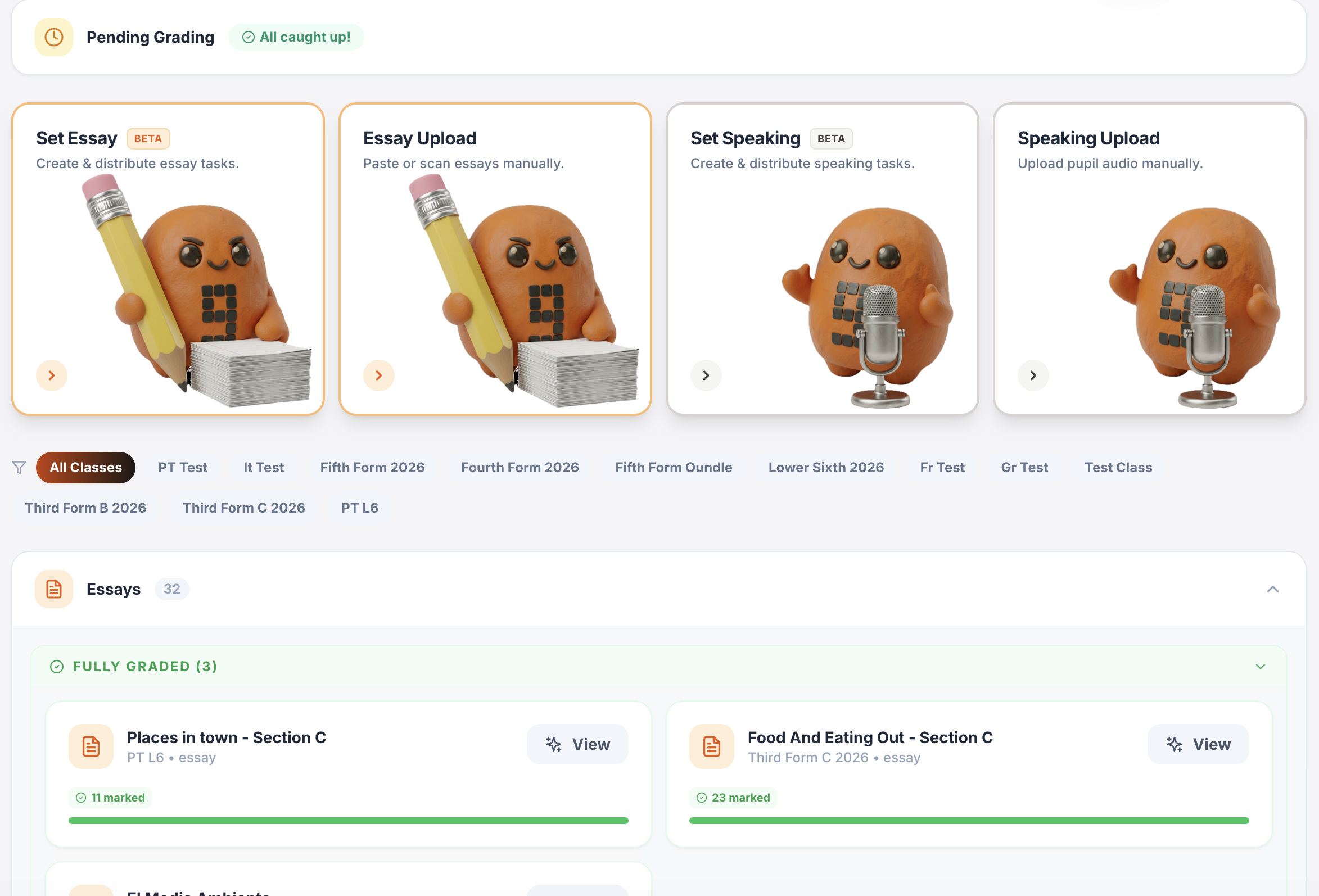
Gradebook & reports
Track scores, completion, engagement and learning evidence across classes.
Explore this guide →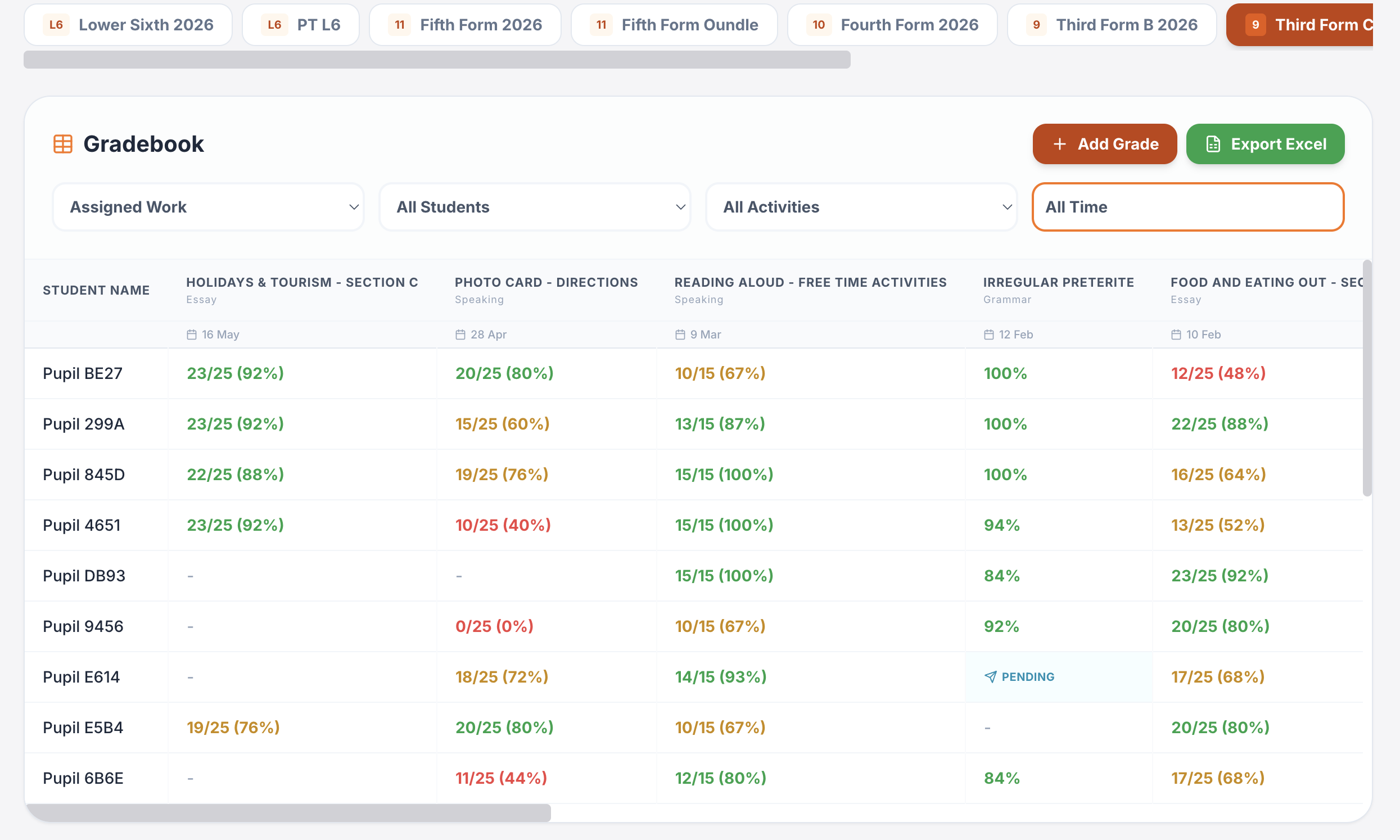
Interactive lessons
Generate, edit, save and reuse complete lesson presentations.
Explore this guide →Printables in seconds
Vocabulary, grammar, translation, reading, listening, worksheets and booklets.
Explore this guide →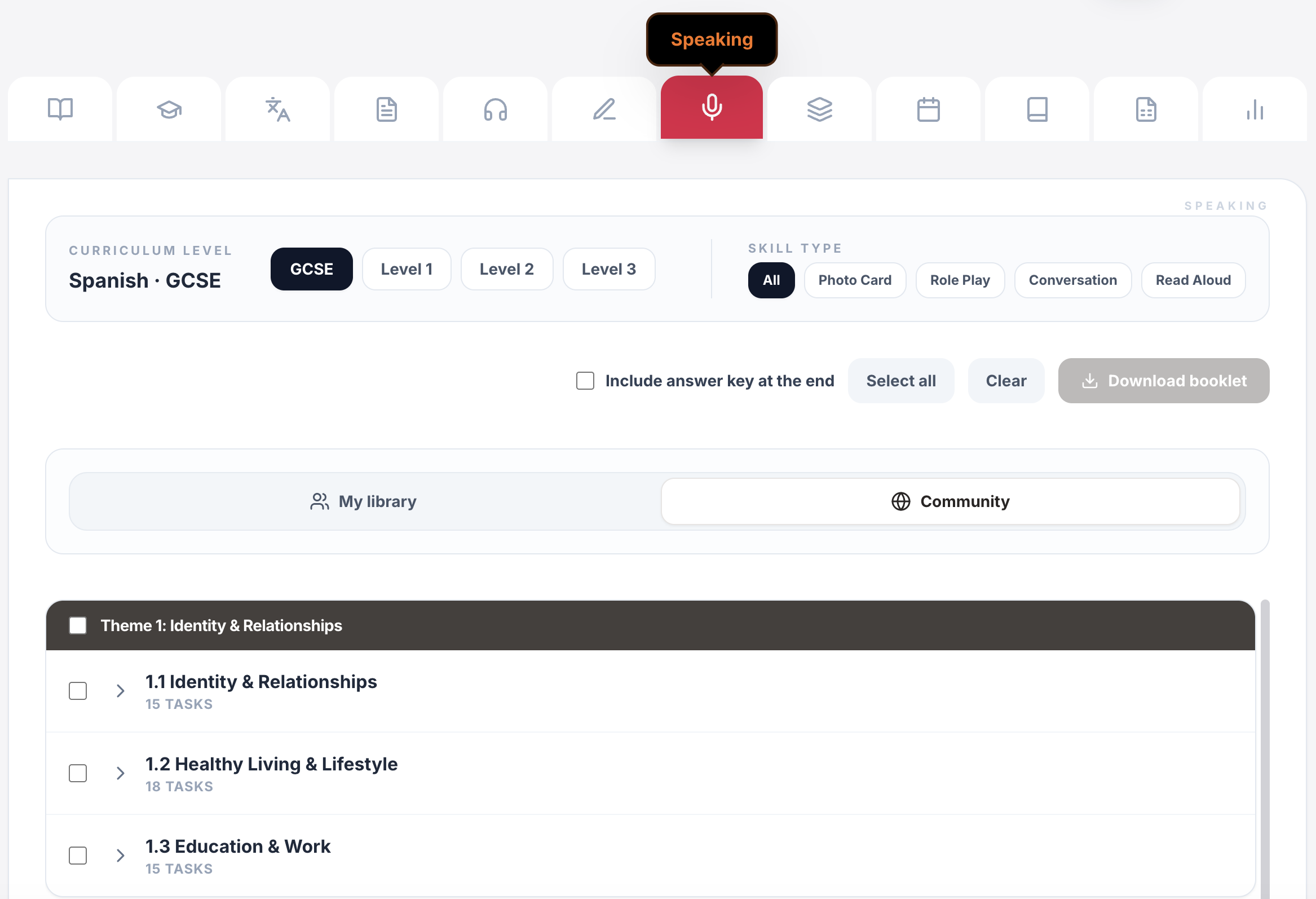
Live games & whiteboards
Turn curriculum content into whole-class competition, retrieval and live response.
Explore this guide →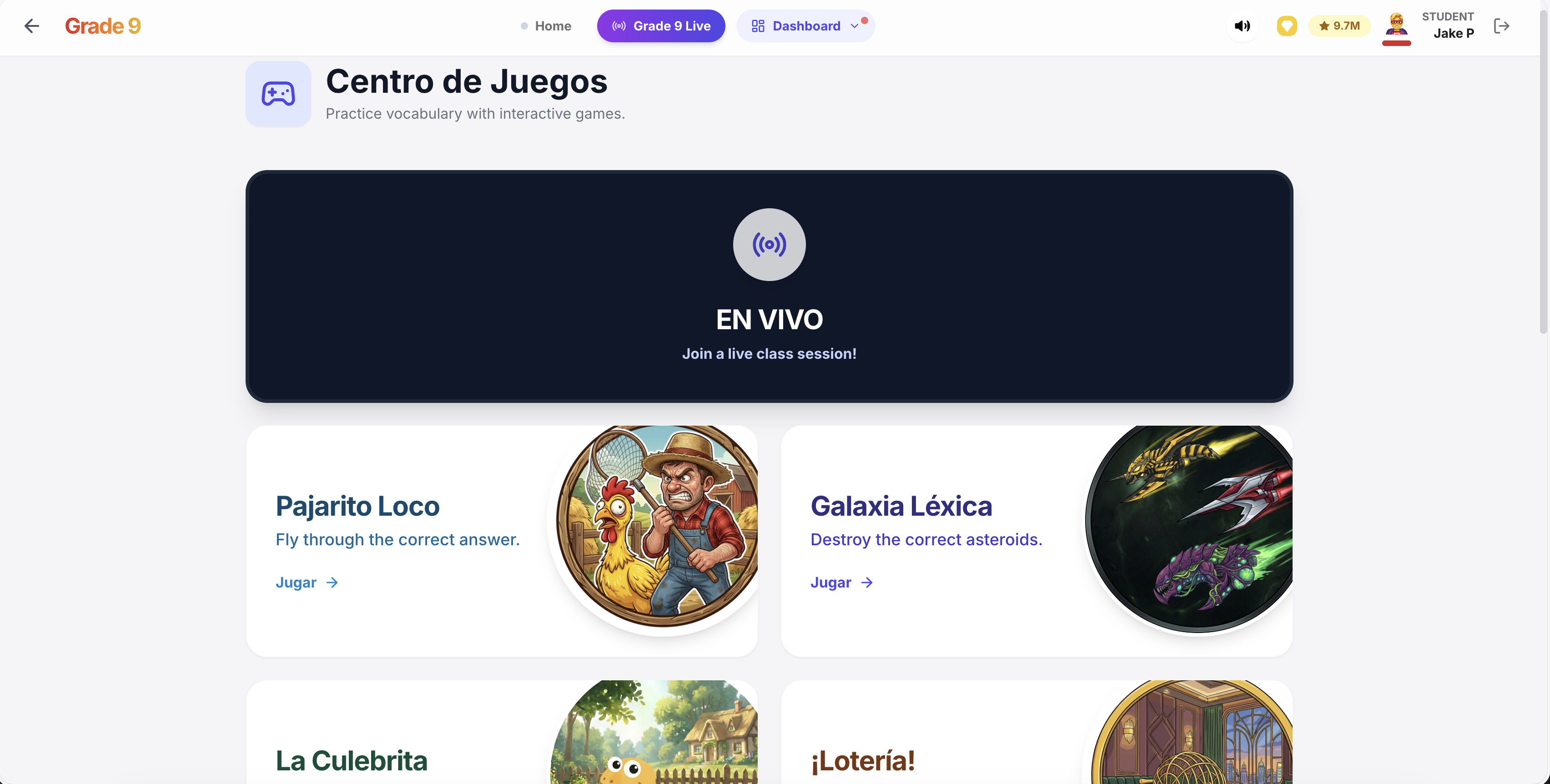
Assignments & tracking
Set work for a whole class or selected pupils, schedule it and see who has started or finished.
Explore this guide →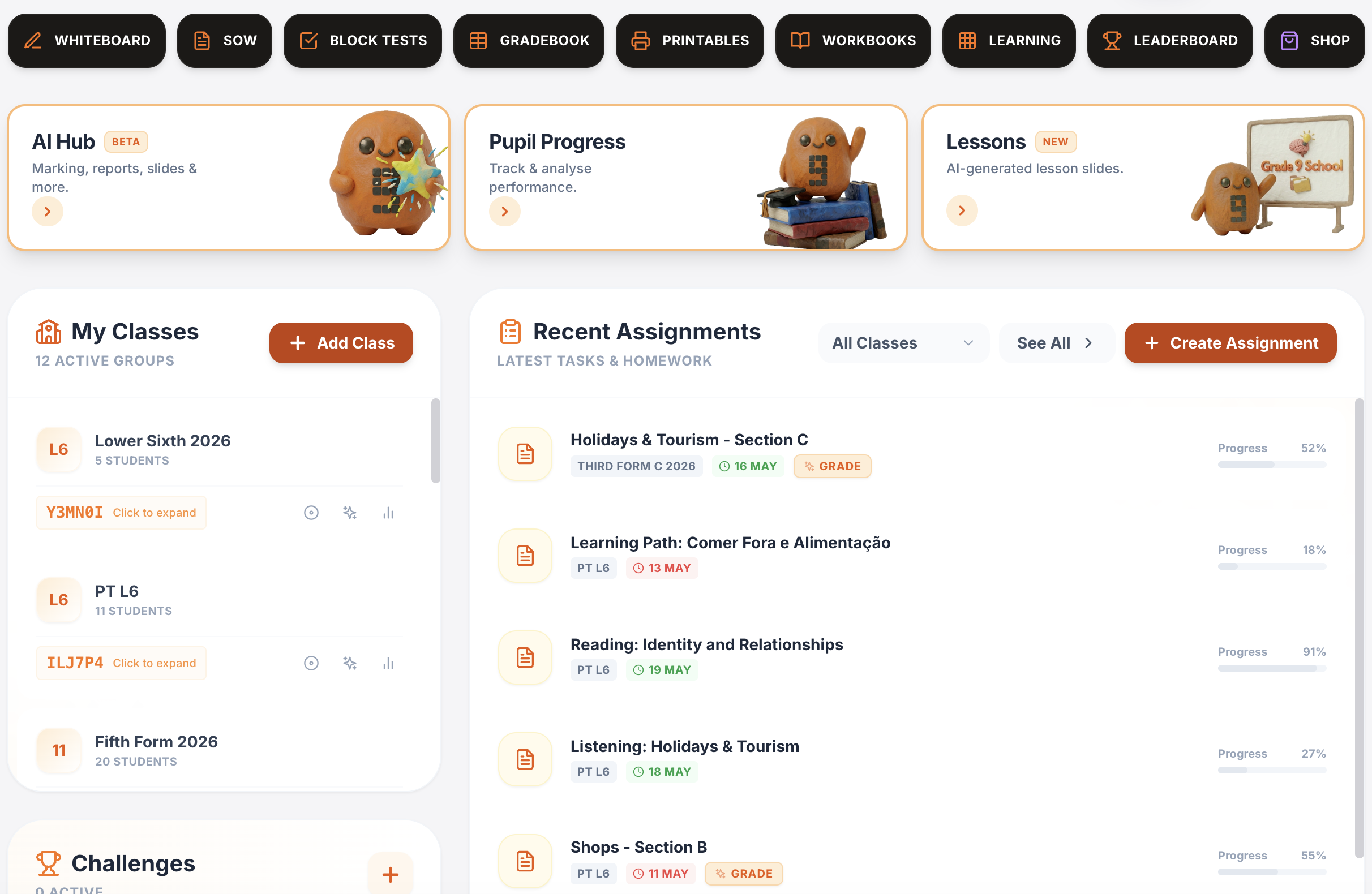
Vocabulary, grammar, translation & independent practice
Structured learning paths, flashcards, vocabulary builders, grammar, verb work, translation and tracked independent learning across supported languages.
Explore this guide →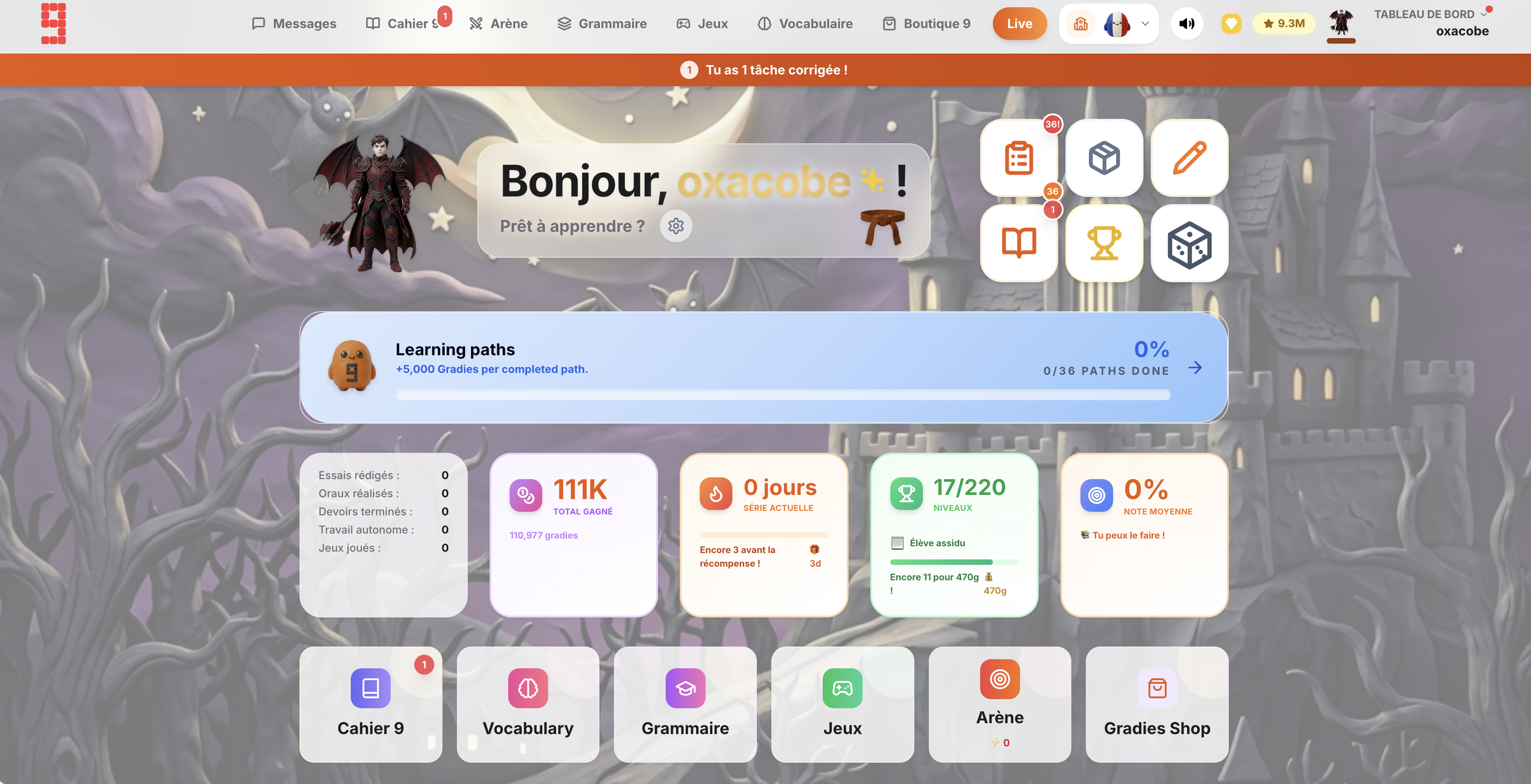
Spanish · French · German · Portuguese · Italian
Use the same platform architecture across the languages your department teaches, while keeping each class in its own language and curriculum context.
Explore language workflows →
From planning to progress, it all connects.
Curriculum management, assignments, AI feedback, printables, gradebook and lesson planning all sit inside the same Grade 9 environment.
Find the detail you need.
Open any section for the key facts, practical detail, examples and sources.
01The quick comparison⌄
| Board | Foundation | Higher | Total | Time |
|---|---|---|---|---|
| AQA 8692 | Photo sentences, c.50 words, grammar task, translation, c.90 words | Translation, c.90 words, c.150 words | 50 marks | 1h10 F / 1h15 H |
| Pearson Edexcel 1SP1 | Picture task, 40–50 words formal, 80–90 words informal, translation | 80–90 words informal, 130–150 words formal, translation | 50 marks | 1h15 F / 1h20 H |
That table is useful for orientation, but the more important question is what pupils have to do inside each task.
02AQA GCSE Spanish writing⌄
AQA Paper 4 is worth 25% of the GCSE and is marked out of 50 at both tiers.
AQA Foundation
The current paper has five questions:
- Five short sentences about a photo, 10 marks.
- A short response to five compulsory bullet points, approximately 50 words, 10 marks.
- Five short grammar items, 5 marks.
- Translation from English into Spanish, at least 35 words in total, 10 marks.
- A structured response to three compulsory bullet points, approximately 90 words, 15 marks. Pupils choose one of two tasks.
The 90-word question is the overlap task and also appears on Higher.
AQA Higher
The current paper has three questions:
- Translation from English into Spanish, at least 50 words in total, 10 marks.
- A response to three compulsory bullet points, approximately 90 words, 15 marks. Pupils choose one of two tasks.
- An open-ended response to two compulsory bullet points, approximately 150 words, 25 marks. Pupils choose one of two tasks.
AQA states that the suggested word counts are approximate. The mark descriptors matter more than mechanically landing on a particular number.
03Pearson Edexcel GCSE Spanish writing⌄
Pearson Edexcel Paper 4 is also worth 25% of the GCSE and is marked out of 50 at both tiers.
Pearson Edexcel Foundation
The current paper has four questions:
- A picture-based task in which pupils write four short sentences, 8 marks.
- One of two formal-context tasks, recommended 40–50 words, 14 marks. The task assesses giving an opinion, presenting facts and using present and future timeframes.
- One of two informal-context tasks, recommended 80–90 words, 18 marks. The task assesses expressing and justifying opinions, narrating and expressing future plans across present, past and future timeframes.
- Translation from English into Spanish, 10 marks.
Pearson Edexcel Higher
The current paper has three questions:
- One of two informal-context tasks, recommended 80–90 words, 18 marks. This is the overlap task with Foundation Question 3.
- One of two formal-context tasks, recommended 130–150 words, 22 marks. Pupils are expected to express pros and cons, explain and narrate across present, past and future timeframes.
- Translation from English into Spanish, 10 marks.
Pearson updated its writing and speaking mark-scheme wording before first assessment in 2026 to make expectations around timeframes and major/minor errors clearer. That matters because “three tenses” is not just a generic revision slogan in the same way across every board and every task.
04Do not teach one universal “perfect paragraph”⌄
There is a temptation to give pupils a memorised paragraph that can be bent towards holidays, school, free time and the environment. It feels efficient. It also creates three recurring problems:
- pupils answer the language they prepared rather than the question in front of them;
- compulsory bullets get thin or missed;
- sophisticated phrases consume space without adding relevant information.
A stronger routine is:
answer the exact prompt → add one relevant detail → justify or develop where the task rewards it → check the language you actually used
For example, if the bullet is about what a pupil did at the weekend:
El sábado fui al centro con mis amigos.
That answers the prompt. It is not yet developed.
El sábado fui al centro con mis amigos porque queríamos comprar un regalo para mi hermana.
Now the response has relevant development, a reason and a controlled past tense. A pupil can then add contrast, opinion or consequence if the task and available space justify it.
The aim is not maximum ornament. It is clear, relevant Spanish with enough range to show control.
05A practical way to prepare the 90-word task⌄
Both boards include an overlap task around the 80–90/90-word range, but the wording and criteria are not identical. The following classroom method works because it starts with task coverage rather than a memorised structure.
Step 1: mark the compulsory content
Before writing, pupils should identify every bullet or content demand.
A simple code is enough:
- A = answered
- D = developed
- C = checked
The pupil should be able to point to the sentence that answers each bullet. “I sort of covered it somewhere” is not a reliable exam strategy.
Step 2: give each bullet a job
For each bullet, aim for:
- direct answer;
- one useful detail;
- a reason, example, reaction or consequence where appropriate.
Not every bullet needs the same length. AQA explicitly says compulsory bullets do not need equal coverage. The key is that the response remains relevant and clear.
Step 3: build range from meaning
Instead of bolting on a “complex phrase”, ask what the pupil genuinely needs to express.
Useful expansion patterns include:
- cause: porque, ya que
- contrast: pero, aunque, sin embargo
- consequence: por eso, así que
- relative detail: que, donde
- sequencing: primero, luego, después
- comparison: más… que, menos… que
The grammar is serving the message, not decorating it.
Step 4: proofread in passes
One vague final reread misses too much. Use three quick passes:
Pass 1: verbs
- Is the subject clear?
- Is the tense the intended one?
- Is the ending plausible?
Pass 2: agreements and small words
- adjective/noun agreement;
- articles;
- prepositions;
- pronouns.
Pass 3: task
- Has every compulsory point actually been answered?
- Is any sentence irrelevant?
- Has a memorised phrase distorted the meaning?
06Preparing the longest Higher task⌄
The longer task is where many pupils need to stop thinking in “sentences to include” and start thinking in ideas to develop.
For AQA Higher, the current 150-word task has two compulsory bullets. For Pearson Edexcel Higher, the 130–150-word formal task asks for a more developed formal response and current criteria reward communication, development, linguistic range and accuracy.
A useful planning box can be tiny:
| Prompt | Main point | Detail/example | Language opportunity |
|---|---|---|---|
| Bullet 1 | What I think | Why + example | contrast / past |
| Bullet 2 | What should happen | consequence | future / conditional where appropriate |
Then write.
If the plan becomes half a page, it is stealing time from the response. The best plan is the shortest one that prevents omission and repetition.
07A note on timeframes⌄
Pupils need flexible control of time. They do not need a superstition.
Pearson’s current writing criteria explicitly refer to successful use of timeframes in relevant tasks. AQA’s current writing grids are framed around communication, development, range and accuracy rather than a universal “three tense rule” for every question.
So the classroom message should be:
Use the timeframe the task requires, and be able to move between timeframes when the meaning requires it.
That is better than inserting one memorised future sentence into every answer regardless of the question.
08Translation into Spanish: accuracy before ambition⌄
Translation is not the place to add extra ideas.
A reliable process is:
- underline the verb in each clause;
- identify who is doing it;
- identify the timeframe;
- translate the meaning in manageable chunks;
- check agreements and high-frequency grammar;
- only then improve wording if the first version is secure.
If a pupil does not know one exact word, the choice depends on the sentence. Sometimes a simple accurate alternative can preserve meaning. Sometimes the missing word is central and cannot be dodged. What pupils should not do is rewrite the whole sentence into something easier that no longer says the same thing.
Translation practice should therefore be frequent and short. Five well-reviewed sentences can be more useful than a full mock translation that gets marked and never revisited.
09What to practise between full papers⌄
Full papers are useful, but they are expensive in lesson time. Most writing improvement comes from smaller deliberate repetitions.
A strong weekly sequence might include:
- one five-minute translation;
- one bullet-point expansion;
- one 40–50 or 50-word response;
- one “repair this sentence” accuracy task;
- one short proofreading routine;
- one longer response every few lessons;
- regular rewriting after feedback.
The key is to recycle errors. If ser/estar, preterite endings or adjective agreement keep appearing in feedback, the next practice should make the pupil use those features again.
10Common GCSE Spanish writing mistakes⌄
Missing a compulsory bullet
This is a task-reading error before it is a Spanish error.
Fix:
Make pupils label each bullet and point to the sentence that answers it before they submit practice.
Writing around a rehearsed paragraph
A polished paragraph about “my town” scores poorly if the task asks what should change in the town and the response never really answers.
Fix:
Highlight relevant information in one colour and rehearsed-but-irrelevant language in another. The visual difference is usually obvious.
Adding complexity that breaks the sentence
A correct simple sentence is more useful than a half-remembered subjunctive phrase that makes the meaning collapse.
Fix:
Build complexity from structures the pupil can already control, then extend deliberately.
Treating the word count as the mark scheme
Recommended word counts guide task size. They are not a substitute for communication and language quality.
Fix:
Practise writing to the task first, then check whether the response length is sensible.
Proofreading by “reading it again”
Pupils often see what they intended to write.
Fix:
Use separate verb, agreement and task-coverage passes.
11A classroom example: from feedback to the next response⌄
Suppose a pupil writes:
El año pasado voy a Madrid con mi familia y fue muy divertido porque visitamos muchos sitios.
A useful response is not to cover the page in corrections.
The teacher might identify:
- strength: clear meaning and a useful reason;
- correction: fui, not voy, because the sentence is anchored in the past;
- next target: keep past narration consistent across the paragraph;
- action: rewrite the next three sentences with a deliberate past-timeframe check.
That creates a transfer task. The pupil has something to do, not just something to read.
For a fuller teacher workflow on turning marked writing into a next attempt, see MFL writing feedback.
12How Grade 9 can support practice without changing the exam⌄
Grade 9 School can be used to set writing assignments, collect typed or image-based submissions, and prepare teacher-reviewed feedback. The platform’s AI-assisted marking workflow produces a draft for the teacher rather than publishing an automated verdict directly to the pupil.
The practical boundary matters:
AI proposes → teacher checks → teacher edits or rejects → teacher approves → pupil sees the approved result
That is a workflow aid, not an examiner.
For classroom use, the more important question is what pupils do after feedback. Where the Feedback Action feature is enabled, a teacher can attach an improvement sequence such as correcting selected errors, rewriting an extract and reflecting on the change.
The exam is still handwritten, timed pupil performance. Digital practice should prepare pupils for that reality, not replace it.
14Sources and exam-board references⌄
Exam-board facts checked on 19 September 2026.
- AQA GCSE Spanish 8692, Scheme of assessment:
https://www.aqa.org.uk/subjects/spanish/gcse/spanish-8692/specification/scheme-of-assessment
- AQA GCSE Spanish 8692, Specification at a glance:
https://www.aqa.org.uk/subjects/spanish/gcse/spanish-8692/specification/specification-at-a-glance
- Pearson Edexcel GCSE Spanish 1SP1 (2024), Specification Issue 2, May 2025:
https://qualifications.pearson.com/content/dam/pdf/GCSE/Spanish/2024/specification-and-sample-assessments/gq000027-gcse-spanish-specification-2024-issue-2.pdf
- Pearson subject update on 2025 specification/SAM amendments, including writing mark-scheme clarification:
https://qualifications.pearson.com/en/qualifications/edexcel-gcses/spanish-2024.news.html?article=%2Fcontent%2Fdemo%2Fen%2Fnews-policy%2Fsubject-updates%2Flanguages%2Fgcse-2024-amendment-update