 School




GCSE Spanish: a practical guide to the current AQA and Edexcel course
A practical guide to the current GCSE Spanish course across AQA and Pearson Edexcel: four skills, tiering, current assessment features and useful preparation.
Grade 9 School brings curriculum, lesson planning, practice, homework, feedback, live activities, printables and progress tracking into one connected teaching workflow.
 Spanish
 French
 German
 Portuguese
 Italian
Practice, feedback and progress in one place.
The current GCSE Spanish qualifications from AQA and Pearson Edexcel are built around the same four language skills: listening, speaking, reading and writing. On both boards, each skill contributes 25% of the qualification, pupils enter Foundation or Higher tier, and they take the same tier across the qualification.
That common structure is useful, but the details are not interchangeable. AQA 8692 and Pearson Edexcel 1SP1 use different thematic structures and different speaking-task mechanics. If you teach one board, use that board’s live specification and sample materials rather than a generic “GCSE Spanish” worksheet that may be based on an older format.
The current specifications were first assessed in 2026. Two features worth building into normal teaching from early in the course are dictation in listening and reading aloud in speaking. Neither is best treated as a last-minute exam trick: both draw on the relationship between Spanish sounds and spelling.
Explore the topic ↓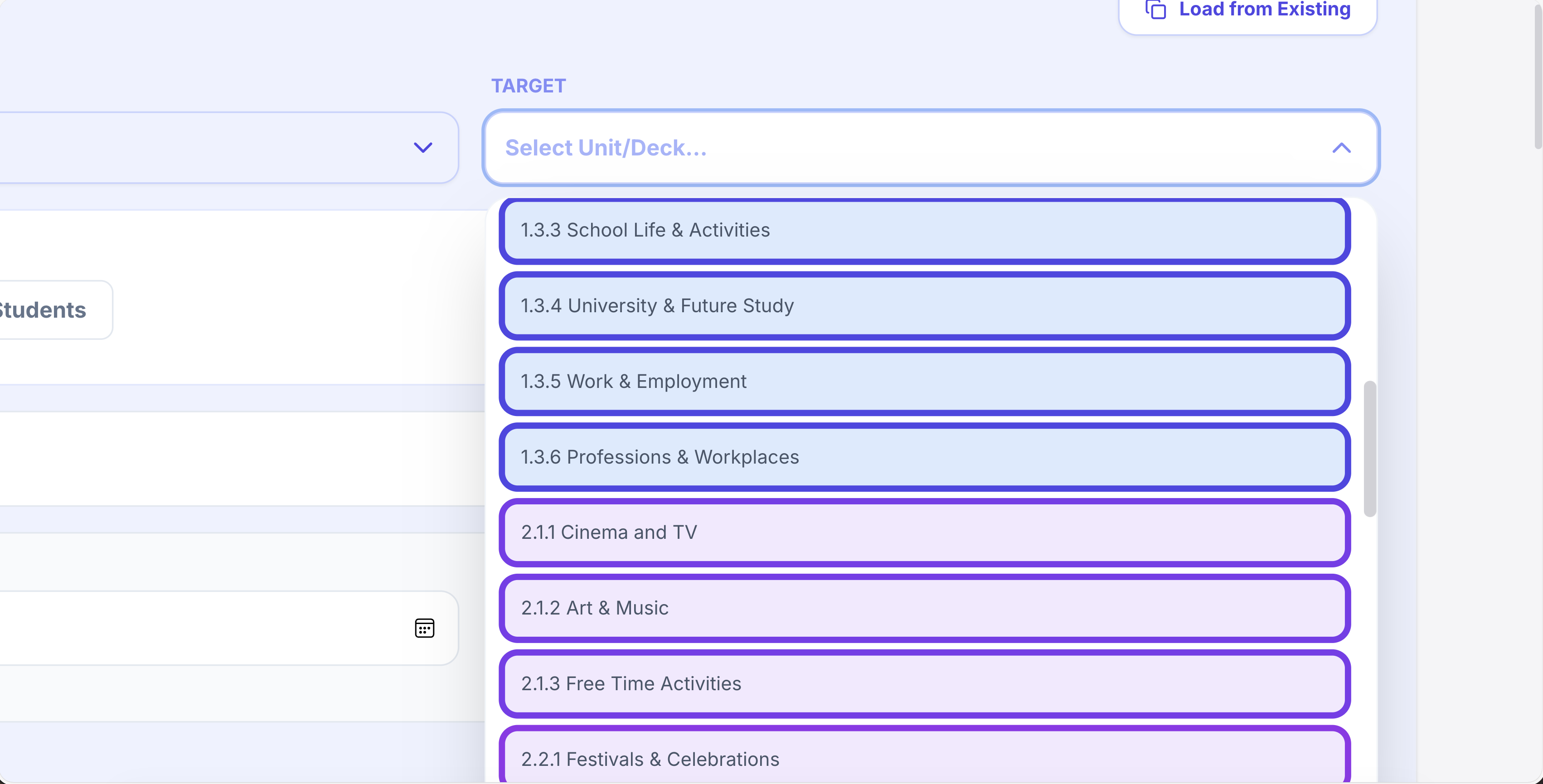
One platform for teaching, practice, feedback and progress.
Plan lessons, set homework, run live activities, generate printables, give AI-supported marking and track progress across Spanish, French, German, Portuguese and Italian.
Writing & speaking marking
Set writing and speaking tasks, collect submissions, generate detailed feedback and keep teacher review in the loop.
Explore this guide →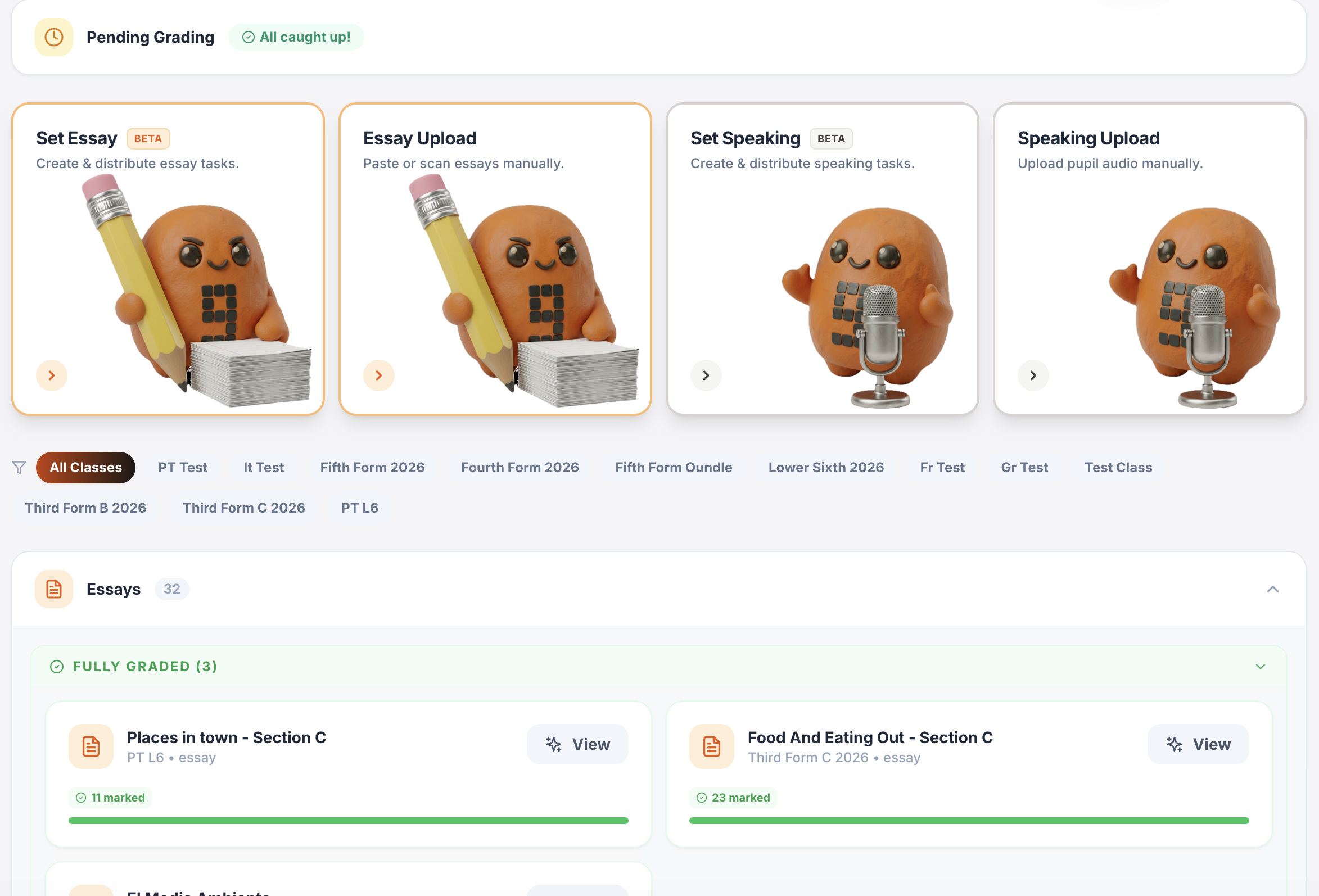
Gradebook & reports
Track scores, completion, engagement and learning evidence across classes.
Explore this guide →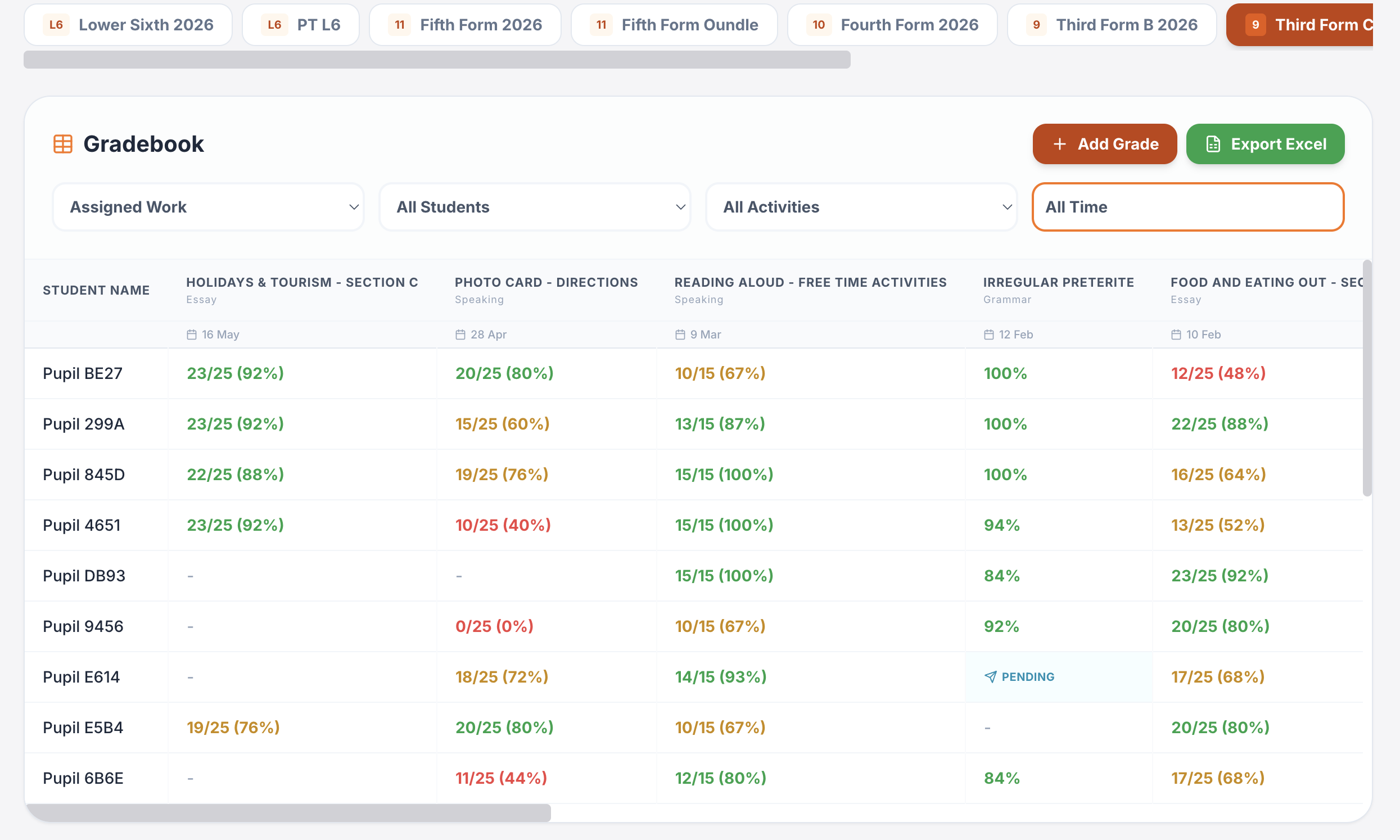
Interactive lessons
Generate, edit, save and reuse complete lesson presentations.
Explore this guide →Printables in seconds
Vocabulary, grammar, translation, reading, listening, worksheets and booklets.
Explore this guide →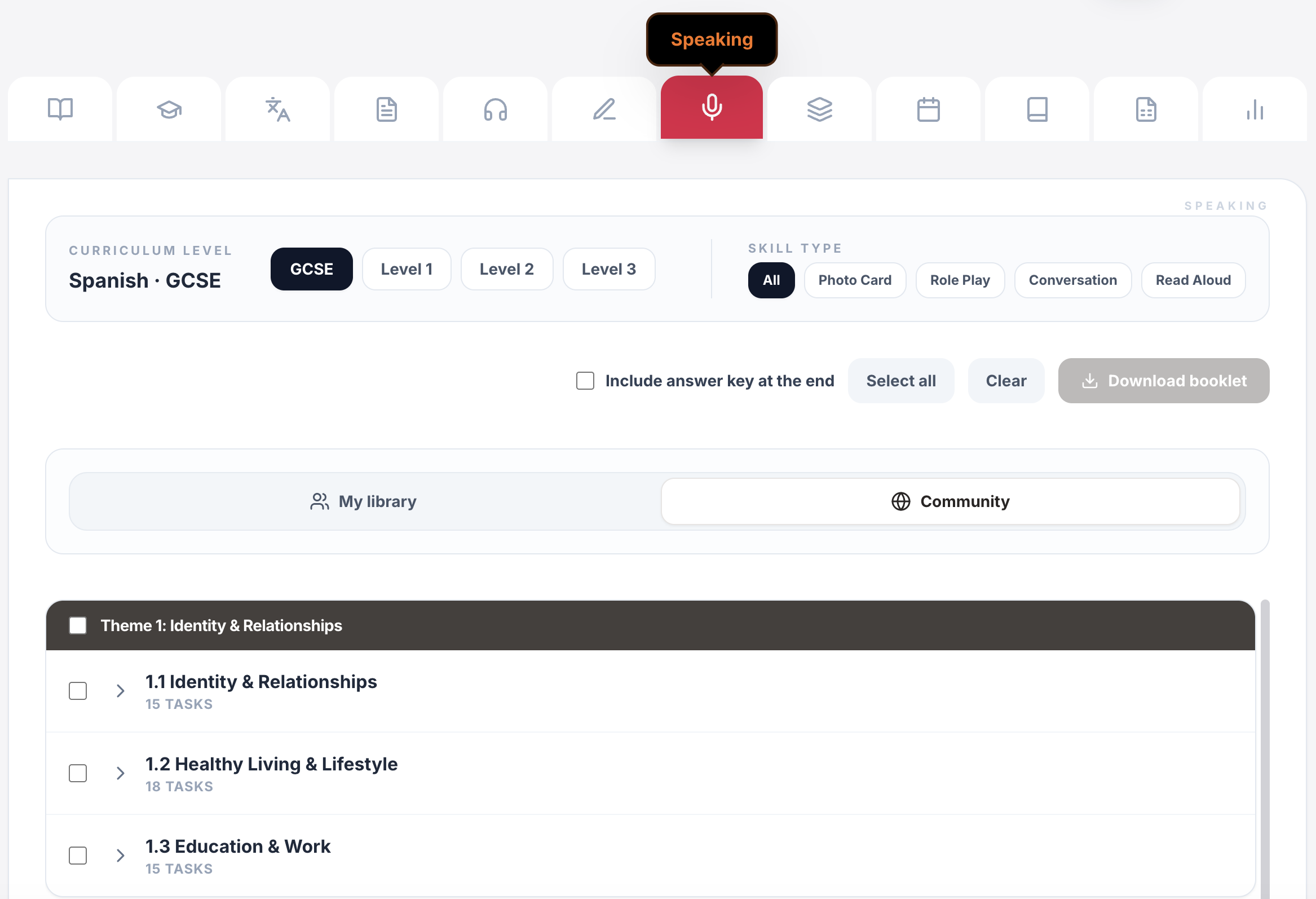
Live games & whiteboards
Turn curriculum content into whole-class competition, retrieval and live response.
Explore this guide →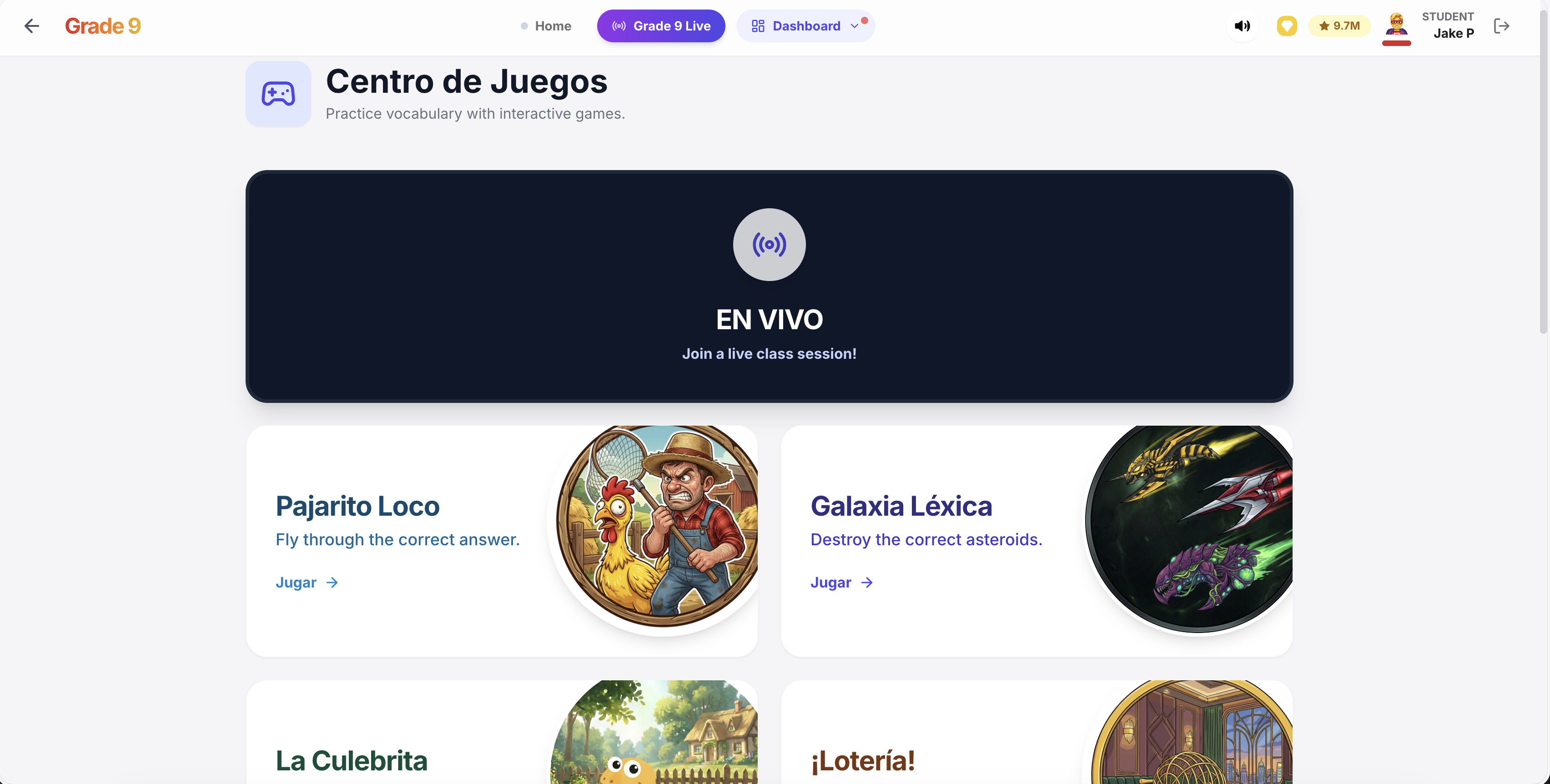
Assignments & tracking
Set work for a whole class or selected pupils, schedule it and see who has started or finished.
Explore this guide →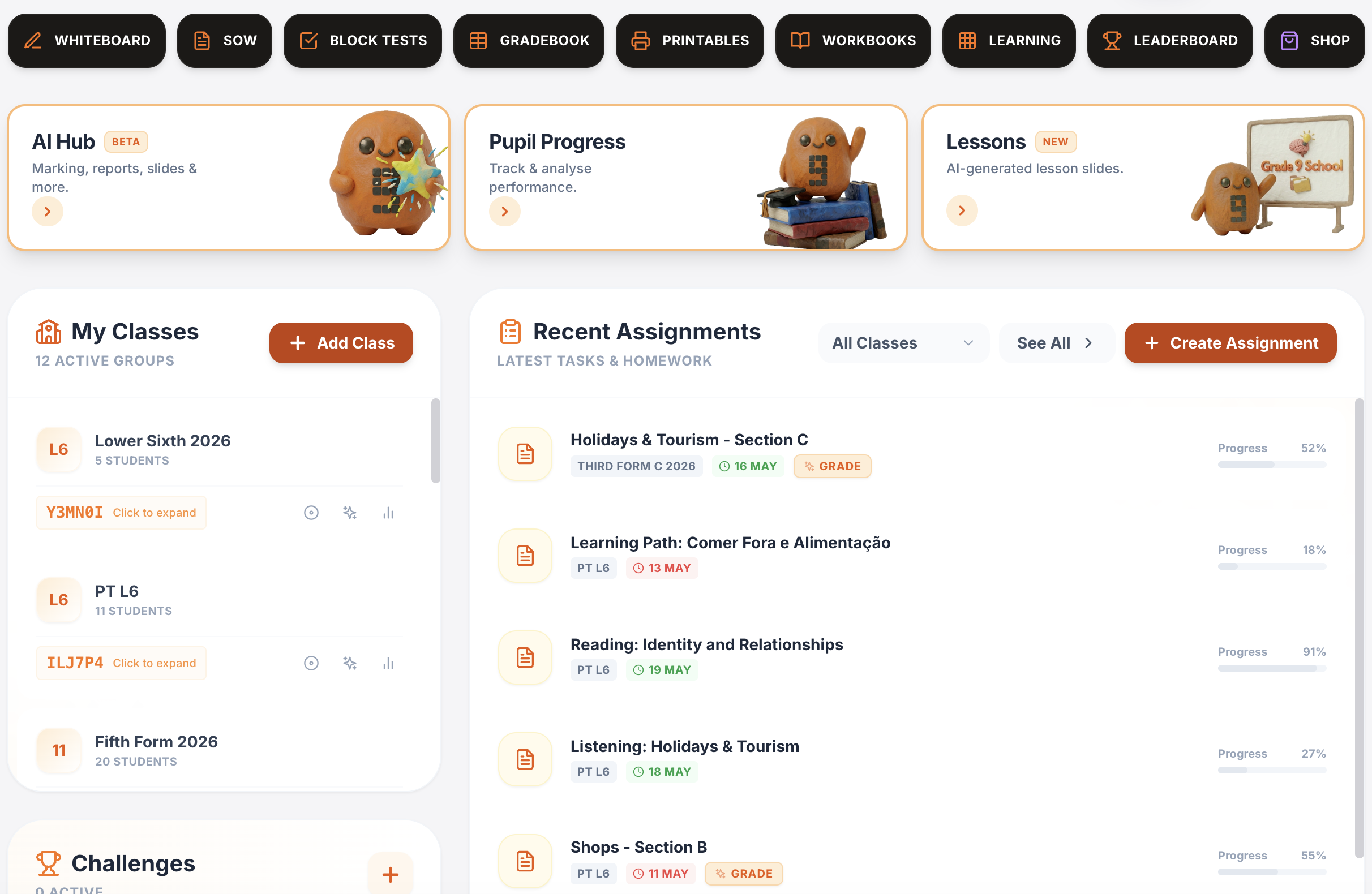
Vocabulary, grammar, translation & independent practice
Structured learning paths, flashcards, vocabulary builders, grammar, verb work, translation and tracked independent learning across supported languages.
Explore this guide →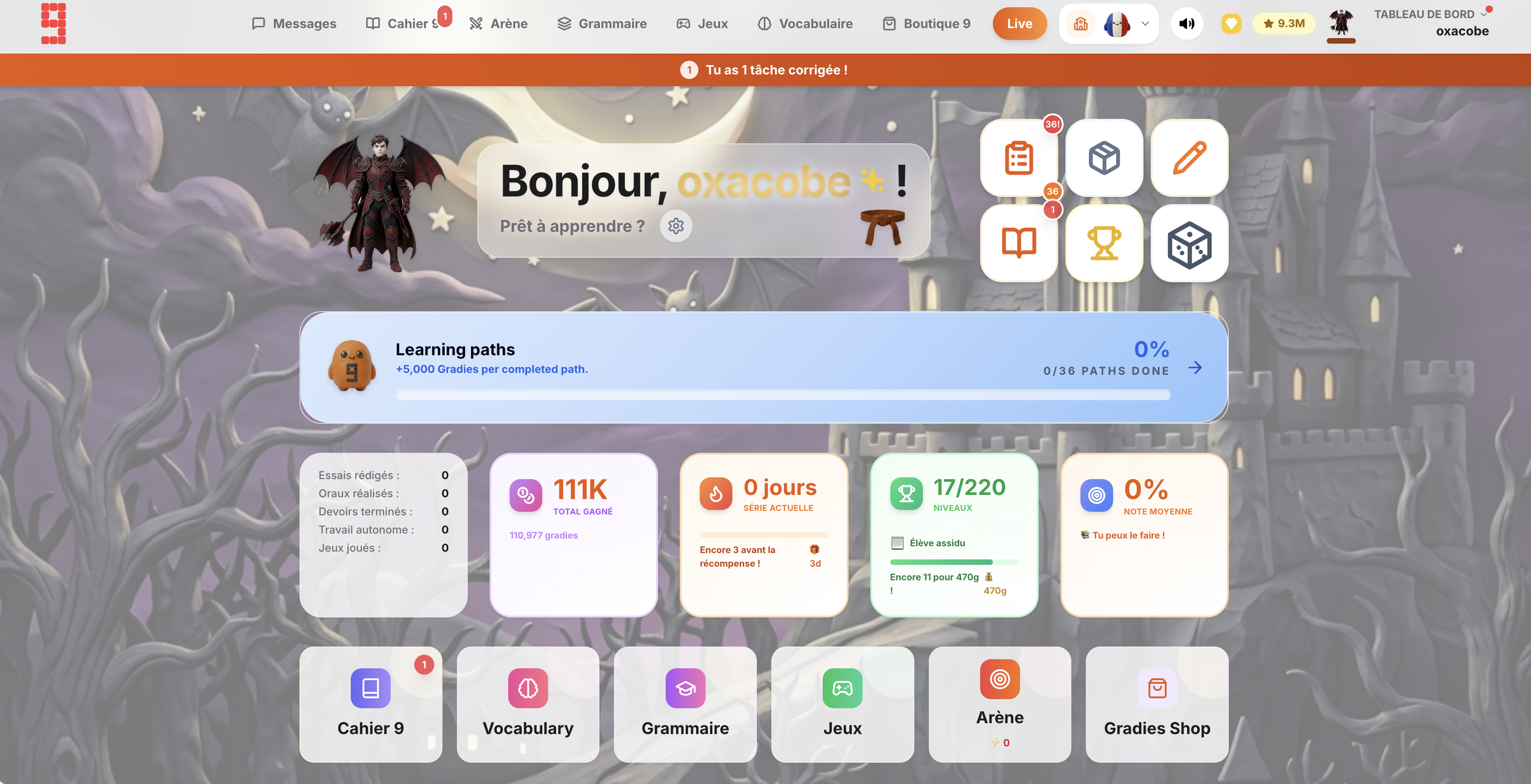
Spanish · French · German · Portuguese · Italian
Use the same platform architecture across the languages your department teaches, while keeping each class in its own language and curriculum context.
Explore language workflows →
From planning to progress, it all connects.
Curriculum management, assignments, AI feedback, printables, gradebook and lesson planning all sit inside the same Grade 9 environment.
Find the detail you need.
Open any section for the key facts, practical detail, examples and sources.
01GCSE Spanish at a glance⌄
| AQA 8692 | Pearson Edexcel 1SP1 | |
|---|---|---|
| First assessment of current specification | 2026 | 2026 |
| Skills assessed | Listening, speaking, reading, writing | Listening, speaking, reading, writing |
| Weighting | 25% per skill | 25% per skill |
| Tiers | Foundation or Higher | Foundation or Higher |
| Tier entry | Same tier across all four papers | Same tier across all four papers |
| Listening | Includes dictation | Includes dictation |
| Speaking | Role-play, reading aloud, photo card discussion | Read aloud, role play, picture task with conversation |
| Reading | Reading comprehension plus translation into English | Reading comprehension plus translation into English |
| Writing | Writing tasks plus translation into Spanish | Writing tasks plus translation into Spanish |
The row that most often causes trouble is speaking. The boards share some task families, but the order, marks and visual-task format differ. See GCSE Spanish speaking exam before planning a mock or building a speaking sequence.
02The topics are not organised in the same way⌄
AQA organises assessment content through three themes:
- People and lifestyle
- Popular culture
- Communication and the world around us
Pearson Edexcel uses six thematic contexts:
- My personal world
- Lifestyle and wellbeing
- My neighbourhood
- Media and technology
- Studying and my future
- Travel and tourism
That does not mean pupils need six isolated vocabulary folders for one board and three for the other. The prescribed vocabulary and grammar are reused across skills and contexts. A stronger course keeps returning to useful language in new combinations instead of teaching a topic once and assuming it is finished.
03Four papers, one language system⌄
A pupil who “does vocabulary” on Monday, “does speaking” on Tuesday and then forgets both until mock season is being asked to rebuild the language every time. GCSE preparation works better when the same language moves through recognition, retrieval and production.
One workable sequence is:
- Retrieve a small set of useful words and chunks without looking.
- Meet the same language in a short listening or reading.
- Notice or practise the grammar that changes meaning.
- Use the language in a brief spoken or written response.
- Correct one or two real errors and try the response again later.
This is not an exam-board rule. It is simply a practical way to make the four assessed skills reinforce each other.
For example, a class working on holidays might retrieve transport and accommodation language, hear it in a short listening, transcribe one sentence accurately, manipulate a past-tense pattern, then answer an unpredictable speaking question. A later writing task can reuse the same language under different pressure. That is more useful than five unrelated “revision activities” labelled by skill.
04What each skill needs from normal teaching⌄
Listening
Build regular practice in extracting meaning from connected Spanish and mapping sound back to spelling. Go deeper: GCSE Spanish listening and dictation.
Speaking
Practise the current board format, intelligible pronunciation and responses that can survive an unpredictable follow-up. Start with the speaking overview, then use the role-play, reading aloud and photo/picture task guides.
Reading
Move between gist, precise detail and translation, and teach pupils to keep reading when familiar language appears in unfamiliar combinations.
Writing
Practise producing complete answers from memory, using familiar language flexibly and editing recurring errors. Go deeper: GCSE Spanish writing.
Vocabulary and grammar
Treat vocabulary and grammar as the language pupils retrieve and manipulate across all four papers, not as separate revision subjects. Go deeper: vocabulary and grammar.
05A practical planning check for a GCSE Spanish unit⌄
Before calling a unit “done”, ask whether pupils can do more than recognise its word list.
Can they:
- retrieve the core language without a model?
- hear important words and grammar in connected speech?
- spell enough of what they hear to cope with dictation?
- read the language in a new sentence or text?
- manipulate a useful grammatical pattern?
- answer a simple question aloud without a written script?
- write a short response from memory and improve it after feedback?
A “no” is not a reason to reteach the whole topic. It tells you which kind of retrieval or production needs another pass.
06Do not revise the wrong specification⌄
Many GCSE Spanish resources remain online for older specifications. Before using a speaking card, revision booklet or mock, check three things:
- Is it written for the current AQA 8692 or Pearson Edexcel 1SP1 specification?
- Does its task format match the current board, not just the word “GCSE”?
- Is the tier and assessment purpose clear?
This matters especially for speaking, where superficially similar task names can hide different instructions and mark allocations.
07Using Grade 9 alongside a GCSE Spanish course⌄
Grade 9’s UK setup can connect GCSE curriculum content with saved lesson and activity workflows, including board- and tier-aware speaking tasks. Teachers can edit generated material before assigning it, and any AI-supported marking or feedback remains a draft for teacher review rather than official examiner judgement.
08Where to go next⌄
If the immediate problem is understanding the oral assessment, use GCSE Spanish speaking exam.
For individual speaking tasks:
For the other course strands: