 School


GCSE Spanish role-play: communicate the message, not a memorised speech
Teach the current GCSE Spanish role-play with clear AQA and Pearson Edexcel requirements, classroom drills, examples, common mistakes and practical preparation.
Grade 9 School brings curriculum, lesson planning, practice, homework, feedback, live activities, printables and progress tracking into one connected teaching workflow.
 Spanish
 French
 German
 Portuguese
 Italian
Practice, feedback and progress in one place.
The GCSE Spanish role-play is short, but it exposes weak habits very quickly. Pupils have to understand a cue, listen to the teacher-examiner, give the required information and ask a question when the task demands it. There is little time to recover from answering the wrong thing.
The most useful preparation is therefore not learning longer and longer answers. It is learning to recognise the communicative job of each prompt and deliver the required meaning clearly.
There is one important complication: AQA and Pearson Edexcel do not use the same role-play design. Teach the format your pupils will actually sit.
Explore the topic ↓
One platform for teaching, practice, feedback and progress.
Plan lessons, set homework, run live activities, generate printables, give AI-supported marking and track progress across Spanish, French, German, Portuguese and Italian.
Writing & speaking marking
Set writing and speaking tasks, collect submissions, generate detailed feedback and keep teacher review in the loop.
Explore this guide →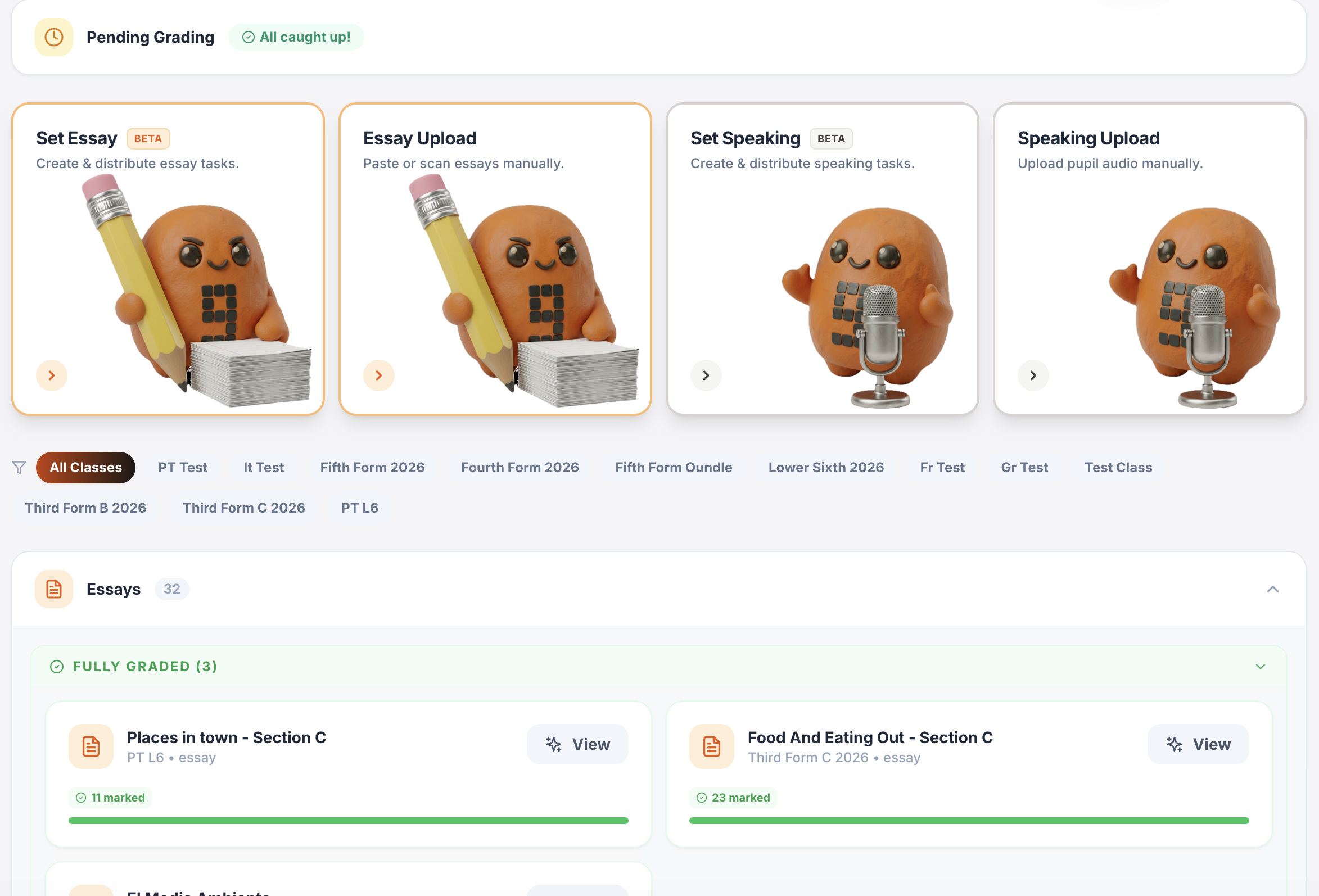
Gradebook & reports
Track scores, completion, engagement and learning evidence across classes.
Explore this guide →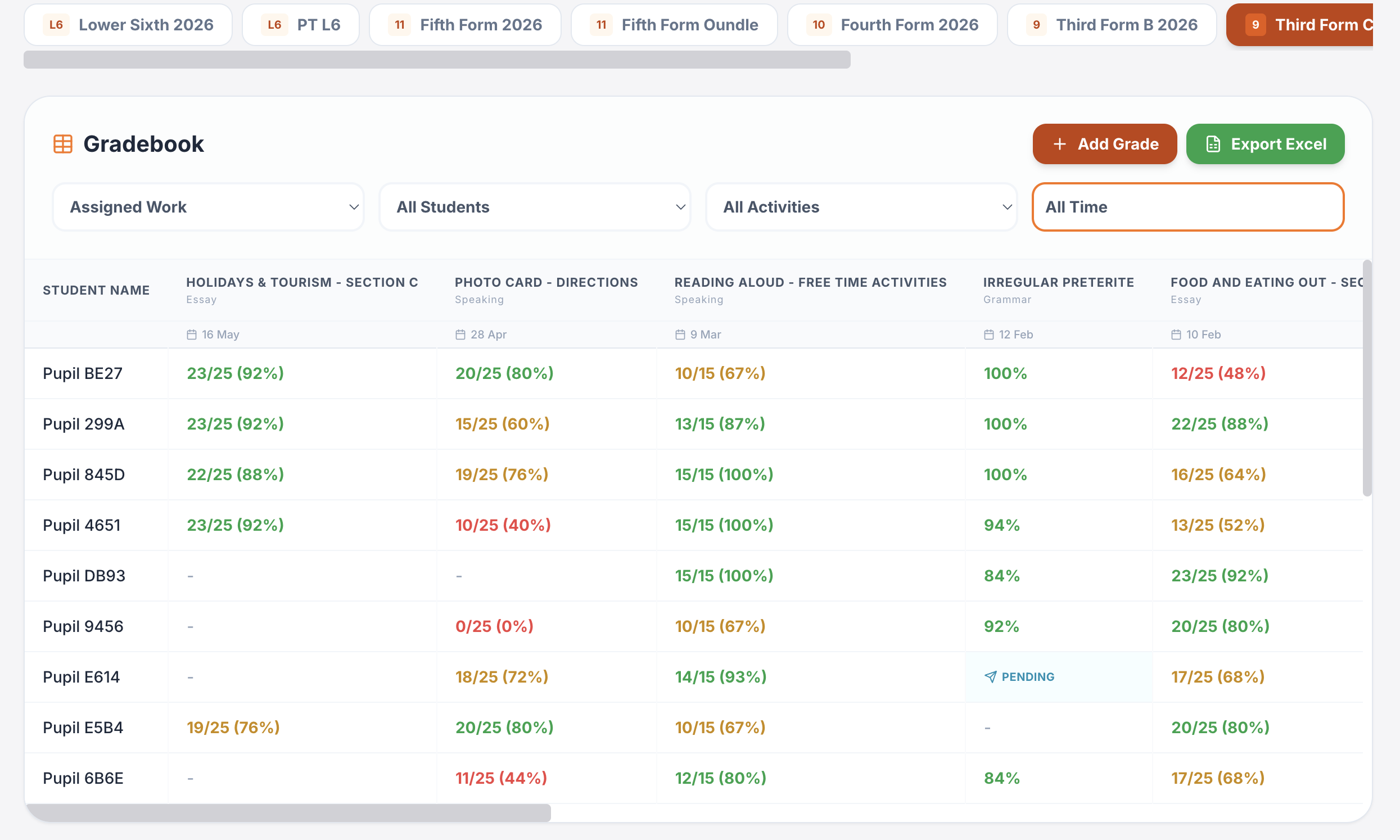
Interactive lessons
Generate, edit, save and reuse complete lesson presentations.
Explore this guide →Printables in seconds
Vocabulary, grammar, translation, reading, listening, worksheets and booklets.
Explore this guide →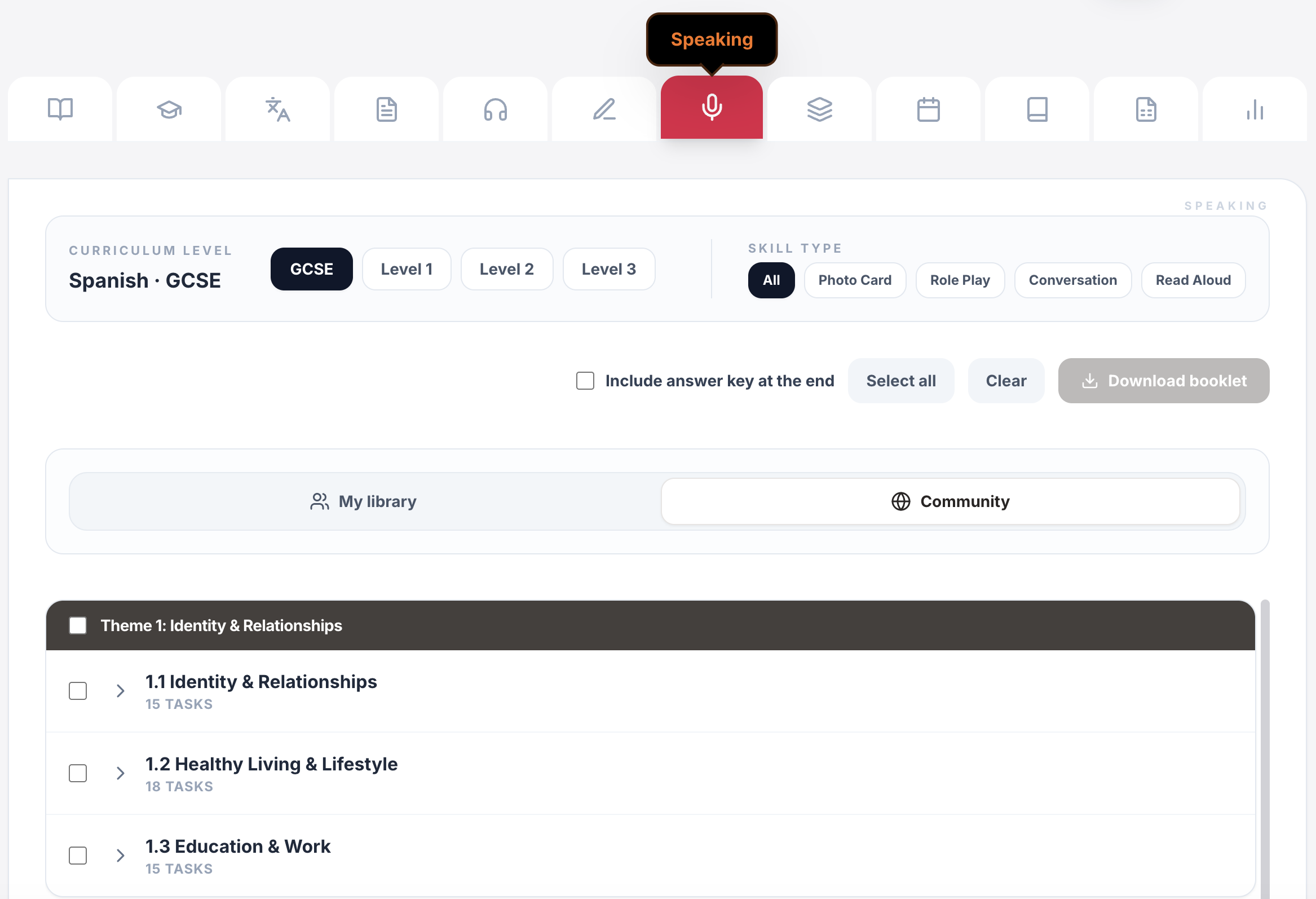
Live games & whiteboards
Turn curriculum content into whole-class competition, retrieval and live response.
Explore this guide →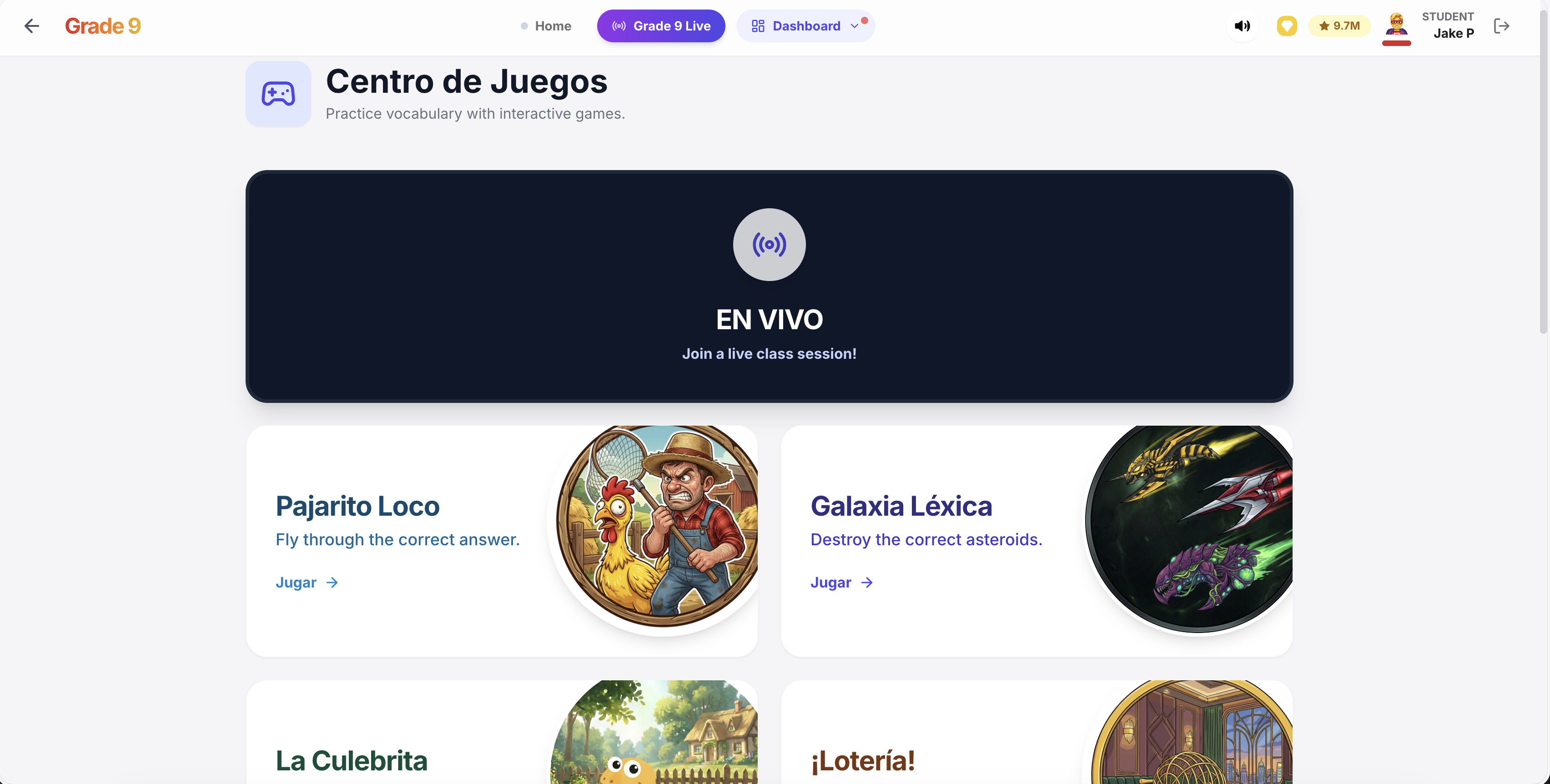
Assignments & tracking
Set work for a whole class or selected pupils, schedule it and see who has started or finished.
Explore this guide →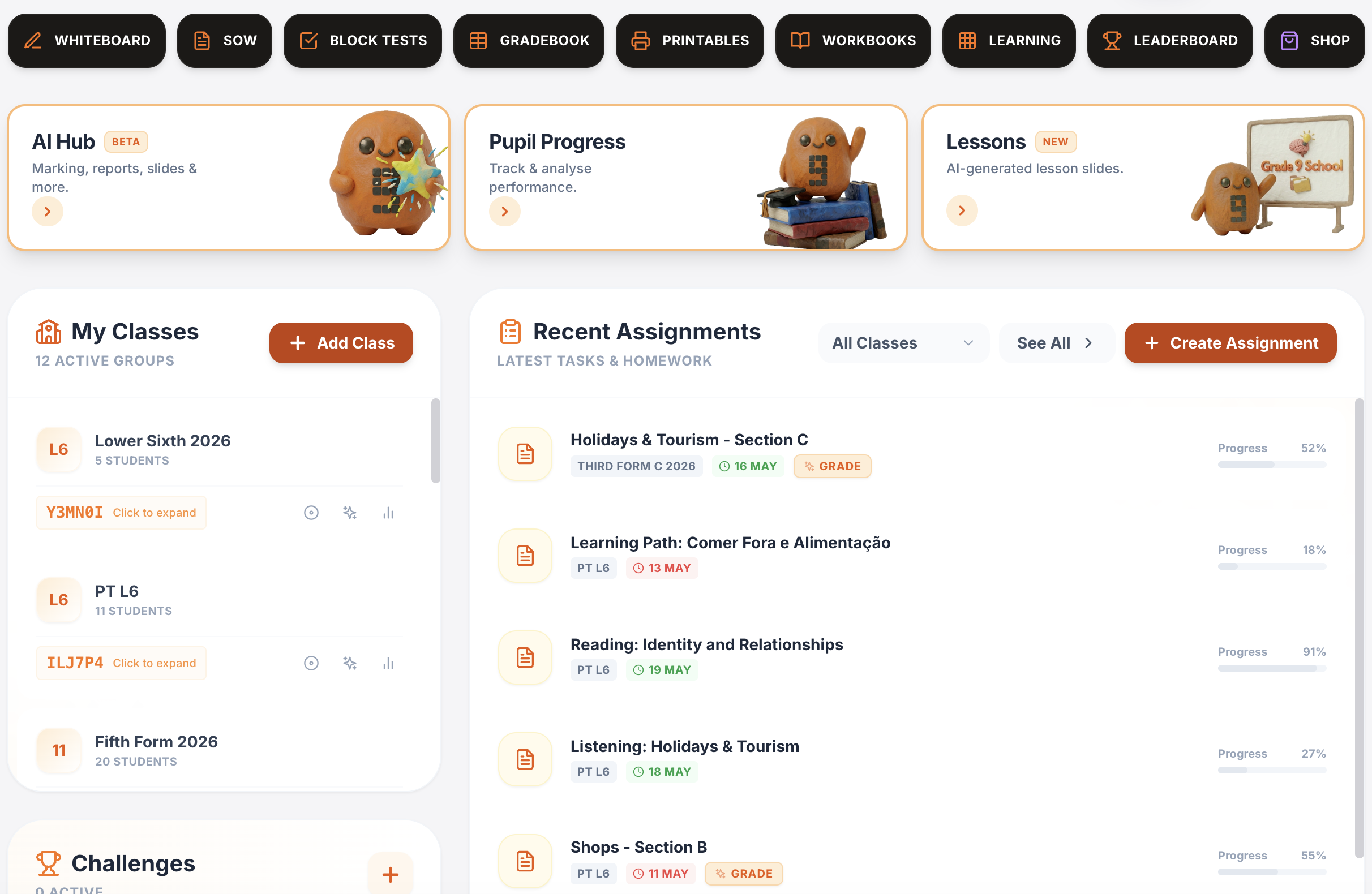
Vocabulary, grammar, translation & independent practice
Structured learning paths, flashcards, vocabulary builders, grammar, verb work, translation and tracked independent learning across supported languages.
Explore this guide →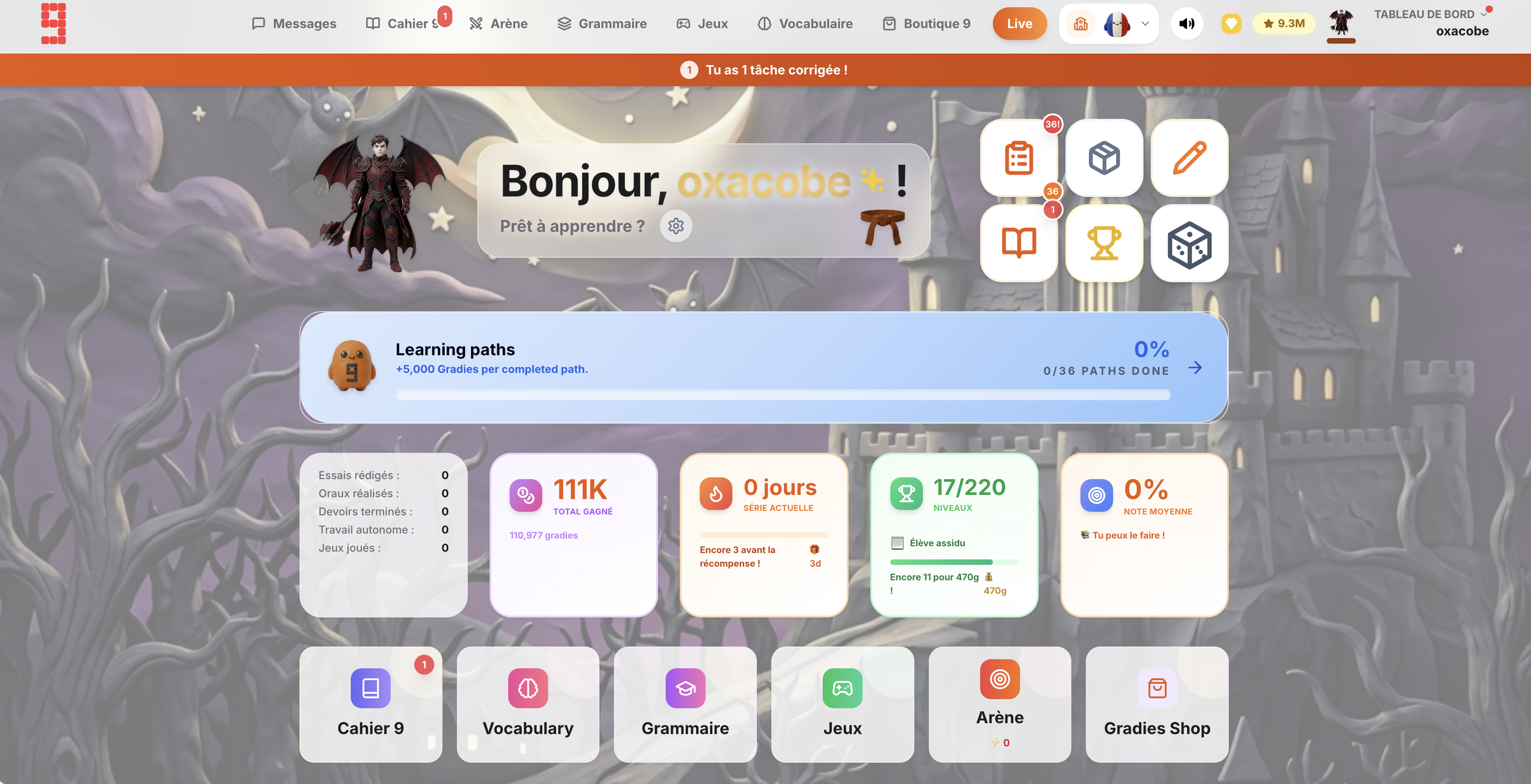
Spanish · French · German · Portuguese · Italian
Use the same platform architecture across the languages your department teaches, while keeping each class in its own language and curriculum context.
Explore language workflows →
From planning to progress, it all connects.
Curriculum management, assignments, AI feedback, printables, gradebook and lesson planning all sit inside the same Grade 9 environment.
Find the detail you need.
Open any section for the key facts, practical detail, examples and sources.
01AQA and Pearson Edexcel: what is different?⌄
AQA GCSE Spanish 8692
AQA places the role-play first in the speaking test. It is worth 10 marks and is recommended to last between 1 and 1.5 minutes at both Foundation and Higher tier.
The candidate card contains five tasks in English. Each task is worth up to 2 marks and pupils must ask a question as part of the role-play. The central marking idea is whether the required message has been conveyed without ambiguity.
AQA's specification also makes a useful point for teaching: once the required task has been accomplished, additional incorrect information after that point is ignored for that task. That is not a reason to encourage rambling. It is a reason to train pupils to make the required message clear early.
Official source: AQA GCSE Spanish 8692 Scheme of Assessment
Pearson Edexcel GCSE Spanish 1SP1
Pearson Edexcel places the role play second, after the read aloud. It is also worth 10 marks and is recommended to last 1 to 1.5 minutes at both tiers.
The task is explicitly transactional and comes from a defined set of settings, including cafés and restaurants, shops, hotels, train stations, tourist information offices, entertainment venues, campsites, leisure centres, medical settings and situations in town.
At Foundation tier, the card contains five bullet points eliciting five utterances and the pupil must ask one question. The required language is in the present tense, or a familiar conditional where that is more natural, such as me gustaría.
At Higher tier, there are again five bullet points, but the pupil must ask two questions and respond to one question using a future timeframe.
Pearson describes the role play as assessing communication only. All role plays are set in a formal context, but pupils are not required to use a formal register.
Official source: Pearson Edexcel GCSE Spanish 1SP1 Specification, Issue 2
02What pupils actually need to be good at⌄
A pupil can know a lot of Spanish and still drop marks in a role-play because the task is not a mini conversation prepared in advance. It is a sequence of small communicative decisions.
The core skills are:
- Identify what the cue is asking for.
A prompt may require information, an opinion, a reason, a complaint, a request, a plan or a question. Pupils should name that function before they build the language.
- Put the essential meaning first.
If the prompt is "say there is a problem with your room", No funciona la ducha is safer than beginning a long story about the hotel and hoping the key information eventually appears.
- Listen to the teacher-examiner.
A role-play is interaction. Pupils who stare only at the card can miss a direct question, repeat prepared material or answer a different prompt.
- Form questions reliably.
Question formation should be automatic enough that the pupil can concentrate on meaning. Useful stems include:
- ¿Cuánto cuesta...?
- ¿Dónde está...?
- ¿A qué hora...?
- ¿Hay...?
- ¿Se puede...?
- ¿Qué recomienda?
- Control timeframes when the board requires them.
This matters particularly at Pearson Edexcel Higher tier, where one examiner question requires a future timeframe.
03A simple classroom method: Function -> Meaning -> Spanish⌄
Role-play practice improves when pupils stop treating each card as a unique script.
Give them a cue in English and make them work through three quick decisions:
Function: What do I need to do?
Meaning: What is the shortest clear message?
Spanish: What language delivers that message accurately?
For example:
Prompt: Tell the receptionist there is a problem with your room.
Function: report a problem
Meaning: the shower does not work
Spanish: No funciona la ducha.
Prompt: Ask what time breakfast starts.
Function: ask for information
Meaning: breakfast starting time
Spanish: ¿A qué hora empieza el desayuno?
The response is not impressive because it is long. It is effective because it does the job.
04Original classroom drill: the hotel⌄
This is a teaching example, not an exam-board specimen.
Situation: You are speaking to a hotel receptionist.
Cue 1: Say there is a problem with your room.
Possible response: No funciona la ducha.
Cue 2: Say what you need.
Possible response: Necesito otra habitación, por favor.
Cue 3: Answer a question about your stay.
Teacher: ¿Cuántas noches va a quedarse?
Possible response: Voy a quedarme tres noches.
Cue 4: Give an opinion about the hotel.
Possible response: Me gusta el hotel porque está cerca del centro.
Cue 5: Ask what time breakfast starts.
Possible response: ¿A qué hora empieza el desayuno?
For Pearson Edexcel Higher practice, add an examiner question that forces a future timeframe:
Teacher: ¿Qué va a hacer mañana?
Pupil: Mañana voy a visitar el centro.
The point is not to memorise this hotel exchange. Change one variable at a time: hotel to campsite, complaint to request, breakfast to transport, tomorrow to next weekend. Pupils learn the transferable communicative move.
05Six classroom drills that are worth doing⌄
1. Ten-second cue classification
Show an English cue for ten seconds. Pupils write only the function: question, complaint, opinion, reason, request, information, plan.
This separates comprehension of the task from language production.
2. One-message answers
Set a rule: one sentence, one clear required meaning. Once pupils can do that reliably, allow extension.
This is particularly useful for pupils who try to compensate for uncertainty with memorised filler.
3. Question-stem roulette
Give pupils a noun or situation and a question stem:
- precio + ¿Cuánto...?
- estación + ¿Dónde...?
- apertura + ¿A qué hora...?
- recomendación + ¿Qué...?
They have five seconds to create a complete question.
4. Examiner-listening drills
Do not let the pupil see the teacher's question. Ask it naturally and require an immediate relevant answer.
The skill being trained is listening and responding, not decoding a written prompt.
5. Deliberate trap cards
Build cards containing common traps:
- two details required in one cue
- a question cue hidden among statements
- a change of timeframe
- a complaint where the pupil must state the actual problem
- a request where the pupil gives an opinion instead
After the attempt, ask pupils to identify the trap before discussing language.
6. Full-speed five-task rounds
Once the micro-skills are secure, run complete role-plays with the correct board timing. Do not interrupt to teach during the attempt. Debrief afterwards.
A one-minute task should feel familiar because pupils have rehearsed the decision-making process, not because they have memorised the card.
06What pupils commonly get wrong⌄
They answer the topic, not the cue
Prompt: Ask the price.
Pupil: Quiero comprar una camiseta.
The language is plausible, but the required message has not been delivered.
Fix: underline the verb in the English instruction before planning the Spanish.
They forget the question
This is costly because asking a question is an explicit task demand. The exact requirement differs by board and tier, so train it deliberately rather than hoping a question appears naturally.
Fix: during practice, pupils mark every question cue with a large Q before writing any notes.
They give two details when only one is secure
Extra language is useful only if it remains accurate and relevant. A clear short response is better than a long answer that obscures the required detail.
Fix: secure the minimum message first, then add extension as a second layer.
They ignore the examiner's words
A pupil may have prepared a sentence that is excellent Spanish but irrelevant to the question just asked.
Fix: make listening-only role-play questions a normal retrieval activity.
They use a prepared question everywhere
¿Y tú? is not a universal solution to a task that asks for specific information.
Fix: build a small bank of high-frequency question frames linked to functions, not topics.
They mix up Pearson Edexcel tier requirements
Foundation and Higher do not require the same question pattern. At Higher, pupils need two questions and must respond once in a future timeframe.
Fix: label practice cards clearly by board and tier. Never recycle a generic card without checking that its demand matches the specification.
07Preparation time: what should pupils do?⌄
Both boards allow supervised preparation before the speaking test and neither allows a dictionary.
For AQA, the 15-minute preparation period covers all three speaking tasks. Pupils may make notes and use them during the test.
For Pearson Edexcel, pupils also have 15 minutes' supervised preparation and may make notes on A4 paper. The same preparation period covers the read aloud, role play and picture task.
A useful role-play preparation routine is:
- Read all cues once without writing.
- Circle every task that requires a question.
- Underline any required detail or timeframe.
- Write the shortest accurate Spanish that completes each cue.
- Check verb person and tense.
- Spend the remaining time on the cue most likely to fail, not on polishing the easiest answer.
Official preparation details: AQA Scheme of Assessment and Pearson Edexcel GCSE Spanish 1SP1 Specification
08Using Grade 9 School for role-play practice⌄
Role-play practice does not need technology to work. The drills above can be run with cards, mini-whiteboards or pairs.
Where Grade 9 is useful is in creating a repeatable record-and-review loop. The current speaking creator lets a teacher select the exam board, tier and speaking task family, choose a curriculum topic, and build or edit the task prompts before setting them. Pupils can record their responses, and the teacher can listen to the original audio during review.
That last step matters. An automated transcript is not the speaking evidence. If a transcript and the recording disagree, the recording is the evidence the teacher should trust.
A sensible workflow is:
create a board-accurate role-play -> edit the prompts -> set it -> pupil records -> teacher listens -> pupil corrects and re-records a weak response.
Use the platform to increase the number of meaningful attempts, not to replace teacher judgement.
09Quick teacher checklist⌄
Before calling a pupil role-play ready, check that they can:
- identify the communicative function of an English cue quickly;
- convey one clear required message without unnecessary padding;
- ask the correct number and type of questions for their board and tier;
- listen and answer an unseen teacher question;
- use a future timeframe when Pearson Edexcel Higher requires it;
- complete a full practice role-play inside the recommended time;
- recover from one weak answer without abandoning the rest of the task.
10Frequently asked questions⌄
How long should a GCSE Spanish role-play answer be?
Long enough to convey the required meaning clearly. The task is not rewarded simply for length. AQA's role-play marking focuses on whether each message is conveyed without ambiguity, while Pearson describes its role play as assessing communication only. Secure the task first, then extend only where it adds useful language.
Do pupils have to ask a question?
Yes, but the exact requirement depends on the board and tier. AQA requires a question as part of the role-play. Pearson Edexcel Foundation requires one question; Higher requires two.
Should pupils memorise model role-plays?
They should memorise useful language patterns, not whole scripts. The examination card and teacher questions change. A pupil who can adapt ¿A qué hora...?, Quisiera..., No funciona..., Prefiero... porque... and Voy a... has something reusable. A memorised paragraph tied to one scenario is much less robust.