 School





GCSE Spanish photo card: describe what is there, then be ready to talk
Teach the current GCSE Spanish photo card and picture task with board-specific requirements, description routines, conversation practice, examples and common errors.
Grade 9 School brings curriculum, lesson planning, practice, homework, feedback, live activities, printables and progress tracking into one connected teaching workflow.
 Spanish
 French
 German
 Portuguese
 Italian
Practice, feedback and progress in one place.
A photo task can tempt pupils into learning one description paragraph and hoping the picture fits.
That is exactly the wrong direction.
The current GCSE speaking tasks reward pupils who can observe what is actually in front of them, turn visual evidence into controlled Spanish, and then respond when the interaction moves beyond the image.
AQA calls this the Photo card discussion. Pearson Edexcel calls it the Picture task. They are not interchangeable.
Explore the topic ↓
One platform for teaching, practice, feedback and progress.
Plan lessons, set homework, run live activities, generate printables, give AI-supported marking and track progress across Spanish, French, German, Portuguese and Italian.
Writing & speaking marking
Set writing and speaking tasks, collect submissions, generate detailed feedback and keep teacher review in the loop.
Explore this guide →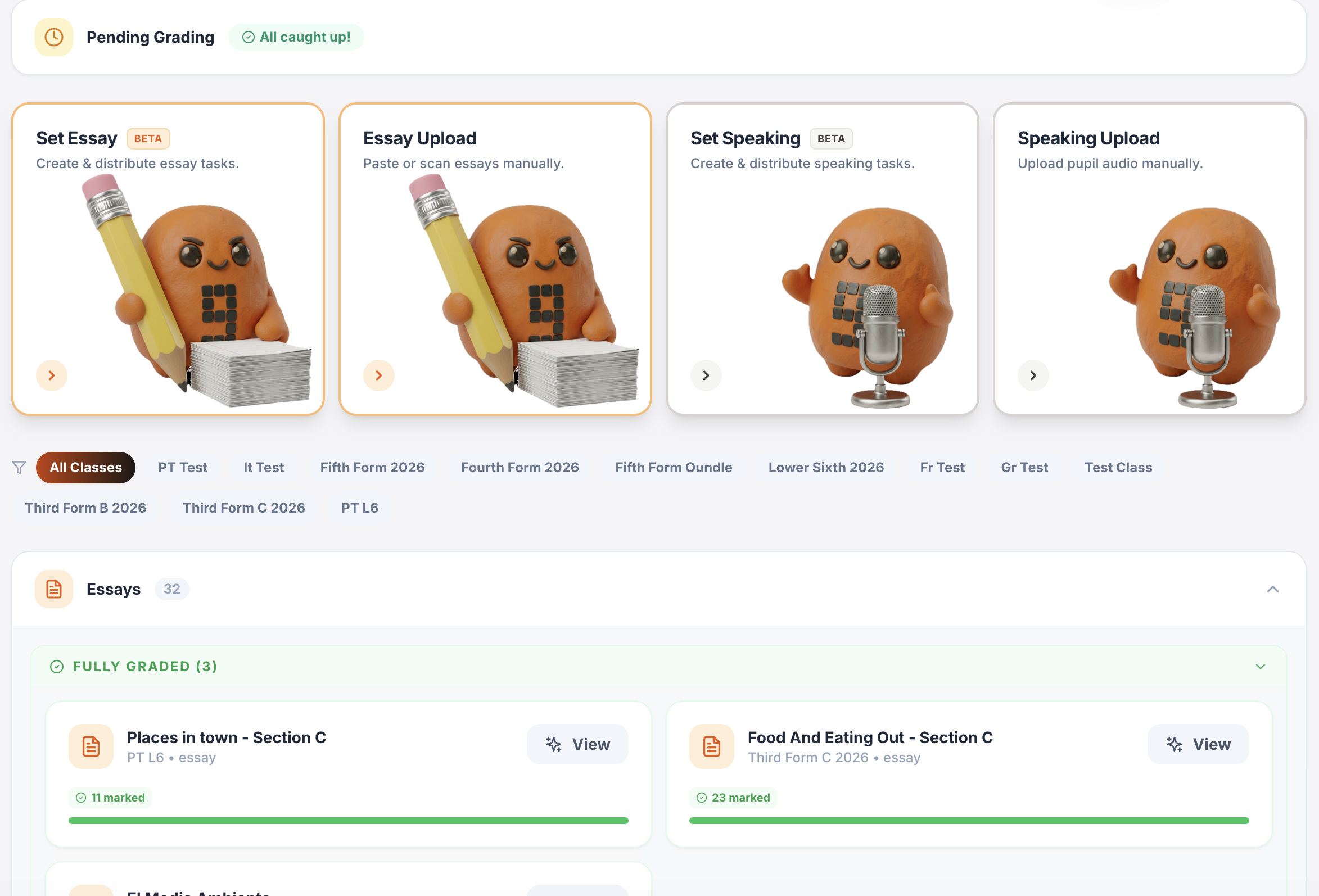
Gradebook & reports
Track scores, completion, engagement and learning evidence across classes.
Explore this guide →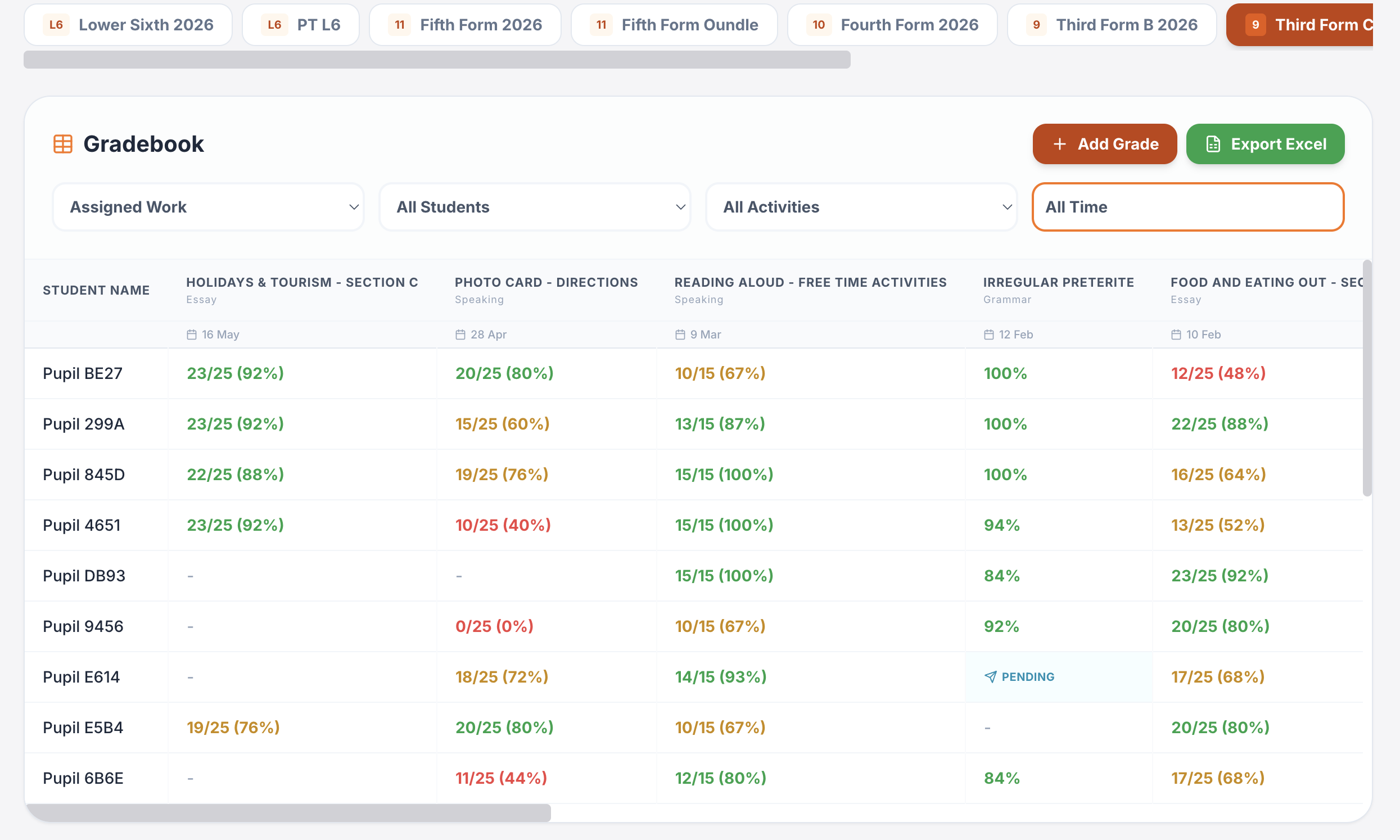
Interactive lessons
Generate, edit, save and reuse complete lesson presentations.
Explore this guide →Printables in seconds
Vocabulary, grammar, translation, reading, listening, worksheets and booklets.
Explore this guide →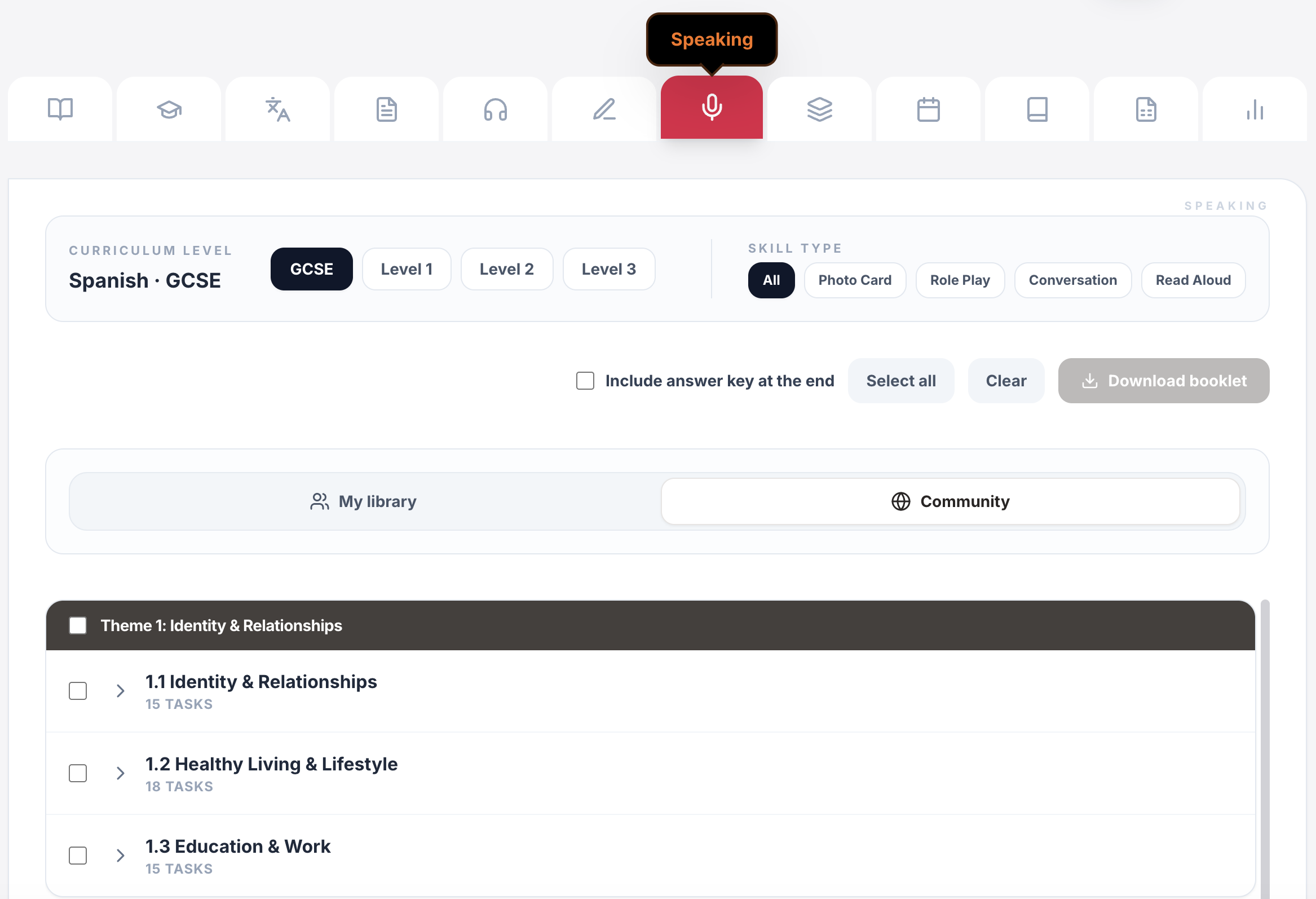
Live games & whiteboards
Turn curriculum content into whole-class competition, retrieval and live response.
Explore this guide →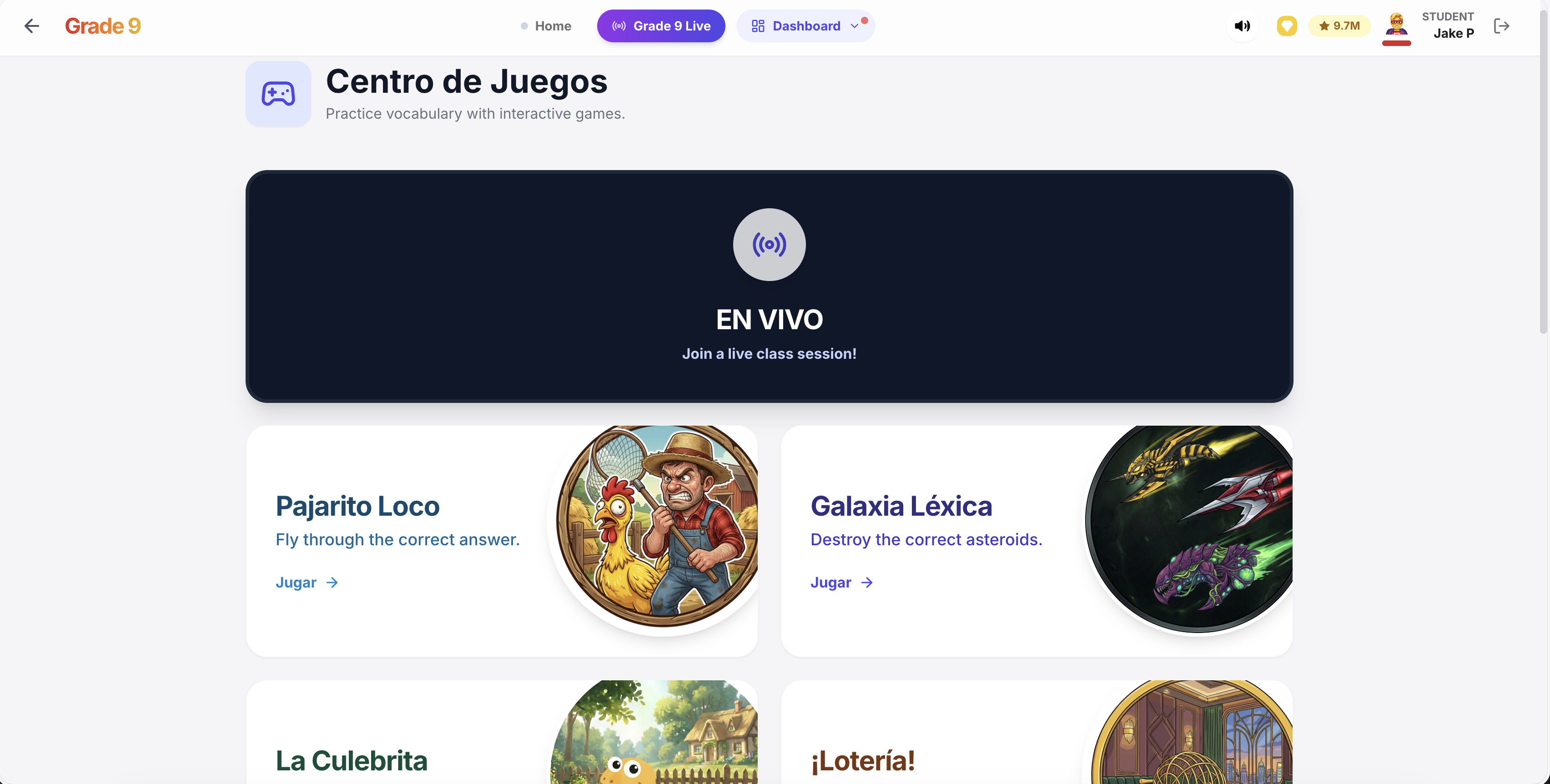
Assignments & tracking
Set work for a whole class or selected pupils, schedule it and see who has started or finished.
Explore this guide →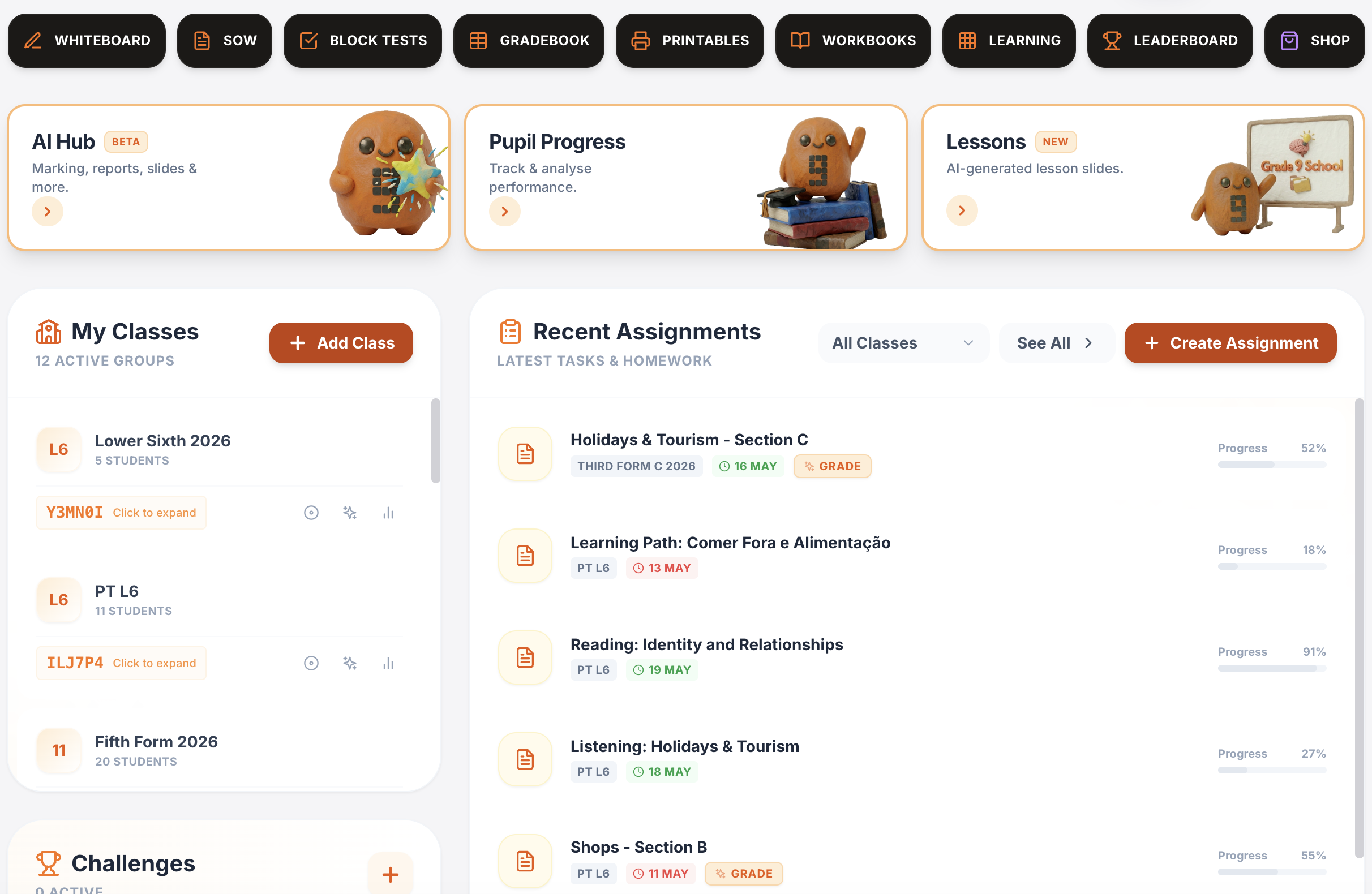
Vocabulary, grammar, translation & independent practice
Structured learning paths, flashcards, vocabulary builders, grammar, verb work, translation and tracked independent learning across supported languages.
Explore this guide →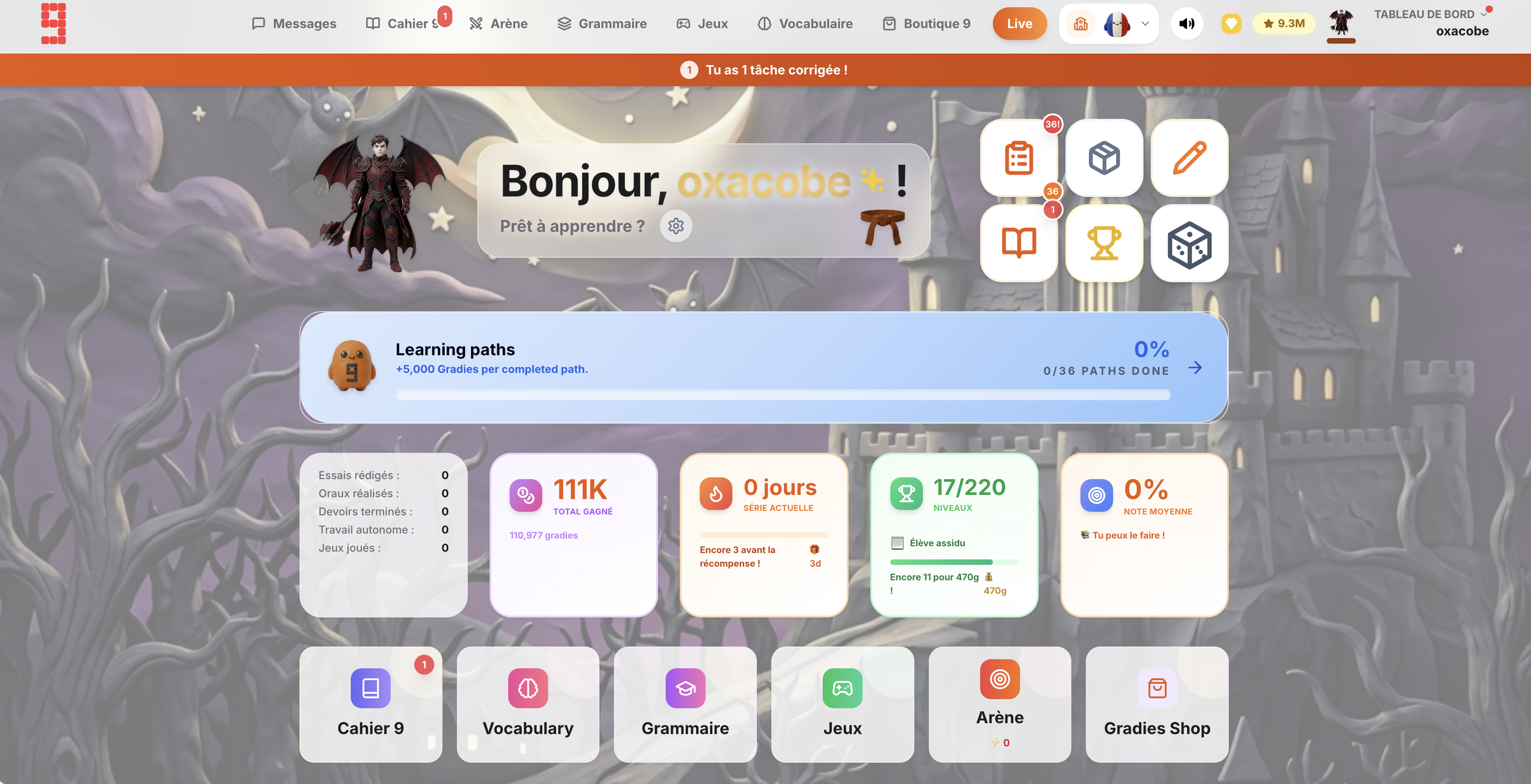
Spanish · French · German · Portuguese · Italian
Use the same platform architecture across the languages your department teaches, while keeping each class in its own language and curriculum context.
Explore language workflows →
From planning to progress, it all connects.
Curriculum management, assignments, AI feedback, printables, gradebook and lesson planning all sit inside the same Grade 9 environment.
Find the detail you need.
Open any section for the key facts, practical detail, examples and sources.
01AQA and Pearson Edexcel: the important differences⌄
AQA GCSE Spanish 8692
The AQA Photo card task is worth 25 marks.
The card contains two photos from one of the three AQA themes. During preparation, pupils can prepare their response to the first compulsory question about the content of the photos.
In the assessment, pupils are expected to talk about both photos. Coverage does not have to be equal, but they must say at least one thing about each photo.
The recommended photo-response time is approximately:
- 1 minute at Foundation tier;
- 1.5 minutes at Higher tier.
That leads directly into an unprepared conversation. The total Photo card section is recommended to last:
- 4 to 5 minutes at Foundation, including a 3 to 4 minute unprepared conversation;
- 6 to 7 minutes at Higher, including a 4.5 to 5.5 minute unprepared conversation.
The conversation can range across any or all of the three topics within the theme shown on the candidate card. AQA explicitly states that pupils must not know the conversation questions, theme or topic areas in advance, and teachers must not narrow the scope beforehand by discussing preferred areas with pupils.
Official source: AQA GCSE Spanish 8692 Scheme of Assessment
Pearson Edexcel GCSE Spanish 1SP1
Pearson Edexcel's Picture task is worth 28 marks in total.
The pupil sees two colour pictures and chooses one. The description is guided by three compulsory details in English:
- people;
- location;
- activity.
The picture description and two compulsory unprepared questions are worth 12 marks. After that, the pupil takes part in a broader conversation worth 16 marks, extending from the selected thematic context.
At Foundation tier, the two unprepared questions are both in the present tense.
At Higher tier, the first is in the present and the second is in the past.
The broader conversation should allow pupils to develop ideas, justify opinions and refer to past, present and future events.
The complete Picture task is recommended to last:
- 4.5 to 5.5 minutes at Foundation;
- 7 to 8 minutes at Higher.
Pearson also uses a distinctive advance-choice process. Two weeks before the speaking assessment, the pupil is offered a choice of two thematic contexts randomly generated by Pearson and selects one. That choice informs the allocated picture task. It does not turn the eventual unprepared questions into a rehearsed script.
Official source: Pearson Edexcel GCSE Spanish 1SP1 Specification, Issue 2
02The key classroom distinction: observation is not invention⌄
Pupils often believe a stronger answer must contain more imaginative detail.
It does not.
The safest description starts with visible evidence, then makes cautious inferences only when the language remains controlled.
Visible:
Hay tres personas.
Están en una estación.
Una chica lleva una mochila.
Reasonable inference:
Parece que van de viaje.
Creo que están esperando el tren.
Unsupported invention:
La chica se llama Marta, tiene dieciséis años y está enfadada porque su tren lleva exactamente dos horas de retraso.
The final sentence may contain impressive Spanish, but the image did not give the pupil that information. A description should not become a creative-writing exercise.
03A flexible visual routine: People -> Place -> Action -> Detail -> Inference⌄
This is not an exam-board mnemonic and should not replace board-specific requirements. It is a classroom thinking routine.
People: Who can you actually see?
Place: Where are they?
Action: What are they doing?
Detail: What visible object, clothing, expression or background detail helps?
Inference: What can you cautiously suggest using parece que or creo que?
For Pearson Edexcel, people, location and activity are compulsory description points, so the first three elements map naturally onto the task.
For AQA, pupils must deal with two photos rather than choosing one. Use the same observation routine on each image, but train pupils to make sure neither photo disappears from the response.
04Original classroom example⌄
Imagine a picture showing three people at a railway station. One person is looking at a departure board, one is holding a suitcase, and another is carrying a backpack.
A controlled description could be:
En la foto hay tres personas en una estación. Una mujer está mirando el horario y un chico lleva una mochila grande. También hay una maleta, así que parece que van de viaje. El ambiente parece tranquilo, aunque quizá están esperando el tren.
Why it works:
- it begins with visible facts;
- it uses a present continuous idea naturally without relying on it for every sentence;
- it adds a justified inference;
- it avoids inventing precise biographical details.
Now turn it into an AQA two-photo drill.
Photo 1: the station scene above.
Photo 2: a family riding bicycles in the countryside.
Pupil opening:
En la primera foto hay tres personas en una estación y parece que van de viaje. En la segunda, una familia está montando en bicicleta en el campo. Las dos fotos muestran actividades de ocio, pero la primera está relacionada con el transporte.
The contrast is useful, but the minimum teaching target comes first: say something about both.
05Do not teach the description in isolation⌄
The photo or picture is the entry point, not the whole task.
After any classroom description, ask unpredictable follow-up questions.
For example, from the station image:
- ¿Te gusta viajar en tren? ¿Por qué?
- ¿Cómo prefieres viajar?
- ¿Adónde fuiste la última vez que viajaste?
- ¿Qué vas a hacer durante las próximas vacaciones?
- ¿Es importante usar más el transporte público?
Not every question belongs to every tier or board format. The point is to build the habit of moving from "what I can see" to "what I can say about the wider theme."
06Seven classroom routines that work⌄
1. Ten-second scan
Show an image for ten seconds, then remove it.
Pupils write:
- two people/details;
- the location;
- one action.
This trains observation before sentence building.
2. Noun to sentence
Display five nouns from an image:
maleta, estación, mujer, móvil, tren
Pupils are not allowed to list them. Each must become part of a sentence:
La mujer tiene una maleta.
Hay un tren al fondo.
This prevents the "shopping list" style of description.
3. Fact or inference?
Read statements about an image and pupils label them:
F = visible fact
I = reasonable inference
X = unsupported invention
Then rewrite the inference with parece que, creo que or quizá.
4. Two-photo switching
For AQA practice, display two images. The pupil must switch after no more than three sentences and say something about the second image.
This directly targets the common problem of spending the whole prepared response on the first photo.
5. Sixty/ninety-second description
Use approximately one minute for Foundation AQA-style practice and about one and a half minutes for Higher AQA-style practice.
For Pearson Edexcel, practise the picture description together with the two follow-up questions inside the board's recommended task window rather than using the AQA timing mechanically.
6. Unpredictable question ladder
After the image disappears, ask a sequence moving through:
personal experience -> opinion -> reason -> past -> future.
The pupil does not need a memorised paragraph. They need a small number of flexible structures they can recombine.
7. Record, review, re-record
Record one attempt. During feedback, choose no more than two targets:
- description coverage;
- accuracy;
- range;
- pronunciation;
- response development;
- tense control.
Then repeat the same task or a closely related one. A second attempt should demonstrate a change, not just create another file.
07What pupils commonly get wrong⌄
AQA: they describe only one photo
The card contains two images and pupils must say at least one thing about each.
Fix: train an automatic switch phrase such as En la segunda foto... and use it in every two-photo practice until coverage is dependable.
Pearson Edexcel: they ignore a compulsory detail
People, location and activity are not optional suggestions.
Fix: use a three-point visual check before speaking. Once all three are covered, extend naturally.
They list objects instead of describing a scene
Hay una mesa. Hay una silla. Hay una persona. Hay una ventana.
The Spanish may be correct, but the response never becomes connected description.
Fix: require verbs and relationships: Una familia está comiendo en una terraza y al fondo se ve el mar.
They invent too much
Speculation can become linguistically expensive and factually detached from the image.
Fix: separate observation from inference. Use parece que when the statement goes beyond what is certain.
They use one memorised template for every image
A rigid script can produce absurd sentences when the picture changes.
Fix: memorise flexible building blocks, not a paragraph:
- En la foto...
- se ve...
- hay...
- está / están...
- parece que...
- al fondo...
- a la derecha / izquierda...
They think the task ends after the description
AQA continues into an extended unprepared conversation. Pearson continues through two unprepared questions and then a broader conversation.
Fix: never end classroom photo practice when the picture description ends.
Higher-tier pupils stay in the present
This is especially risky in the broader Pearson conversation, where the design allows pupils to show past, present and future language, and one of the compulsory Higher follow-up questions is in the past.
Fix: build natural time-shifts into normal questioning instead of bolting on a tense at the end.
08Preparing for the unprepared part⌄
"Unprepared" does not mean "nothing can be prepared."
Pupils can prepare language systems:
- opinion + reason;
- past experience;
- current habit;
- future plan;
- comparison;
- justification;
- repair phrases when they need a moment.
What they should not do is rely on knowing the exact questions.
A compact response frame is useful:
answer -> detail -> reason/example.
Question: ¿Qué tipo de vacaciones prefieres?
Answer: Prefiero las vacaciones en la ciudad.
Detail: Me gusta visitar museos y probar comida diferente.
Reason: Es más interesante porque siempre hay algo que hacer.
That gives the teacher something to develop naturally.
09Using Grade 9 School for photo-card practice⌄
The current Grade 9 speaking creator supports photo-card / picture-based tasks. A teacher can select the board and tier, choose a curriculum topic, build or edit the task, and use platform or teacher-supplied images in supported picture workflows.
Generated prompts and images should still be reviewed before pupils see them. Exam-board accuracy and suitability remain the teacher's responsibility.
Pupils can record a speaking response. In the teacher marking workflow, the original audio can be played alongside the feedback draft. The teacher can edit proposed marks and feedback before publishing.
That matters for picture work because a transcript can flatten pronunciation problems or mishear what a pupil actually said. The audio is the evidence.
A useful classroom loop is:
fresh image -> timed response -> listen -> one description target + one conversation target -> improved recording.
Avoid turning the activity into "generate, grade, move on." The learning happens in the correction.
10Where the existing Grade 9 media genuinely helps⌄
The photo-card page is the strongest place in this cluster to reuse the existing tutorials.
Use one creation asset and one review asset rather than filling the page with a gallery.
Suggested sequence:
- After "Using Grade 9 School for photo-card practice":
/images/teacher-gallery/Create speaking.png
or
/videos/tutorials/Set PhotoCard.mp4
- After the paragraph explaining teacher review:
/images/teacher-gallery/Photocard feedback.png
or
/videos/tutorials/Teacher Grade PhotoCard.mp4
The videos should be lazy-loaded and should never contain the only explanation of the workflow.
11Quick teacher checklist⌄
A pupil is becoming ready when they can:
- identify visible people, place and action quickly;
- build sentences rather than list nouns;
- distinguish fact from cautious inference;
- cover both AQA photos;
- cover Pearson's compulsory people/location/activity points;
- move from image description into unpredictable questions;
- give an opinion and justify it;
- shift timeframe when the interaction requires it;
- maintain a response without relying on one memorised photo paragraph;
- listen back to a recording and make a specific second attempt.
12Frequently asked questions⌄
Does AQA use one photo or two?
Two. Pupils are required to say at least one thing about each photo, although the coverage does not have to be equal.
Does Pearson Edexcel also require pupils to describe both pictures?
No. The Pearson card contains two colour pictures and the pupil chooses one to describe.
What must a Pearson Edexcel picture description include?
The card gives three compulsory points in English: people, location and activity.
Should pupils memorise a photo-card template?
A small bank of flexible language is useful. A fixed paragraph is not. The image and the conversation change, and rigid templates often produce irrelevant or invented detail.
Is the conversation prepared?
The visual stimulus can be prepared according to the board's rules, but the follow-up interaction is designed to be unprepared. AQA explicitly prohibits teachers from narrowing the future conversation by agreeing preferred areas with pupils in advance. Pearson's two picture questions are unprepared, and the broader conversation develops from the selected thematic context.